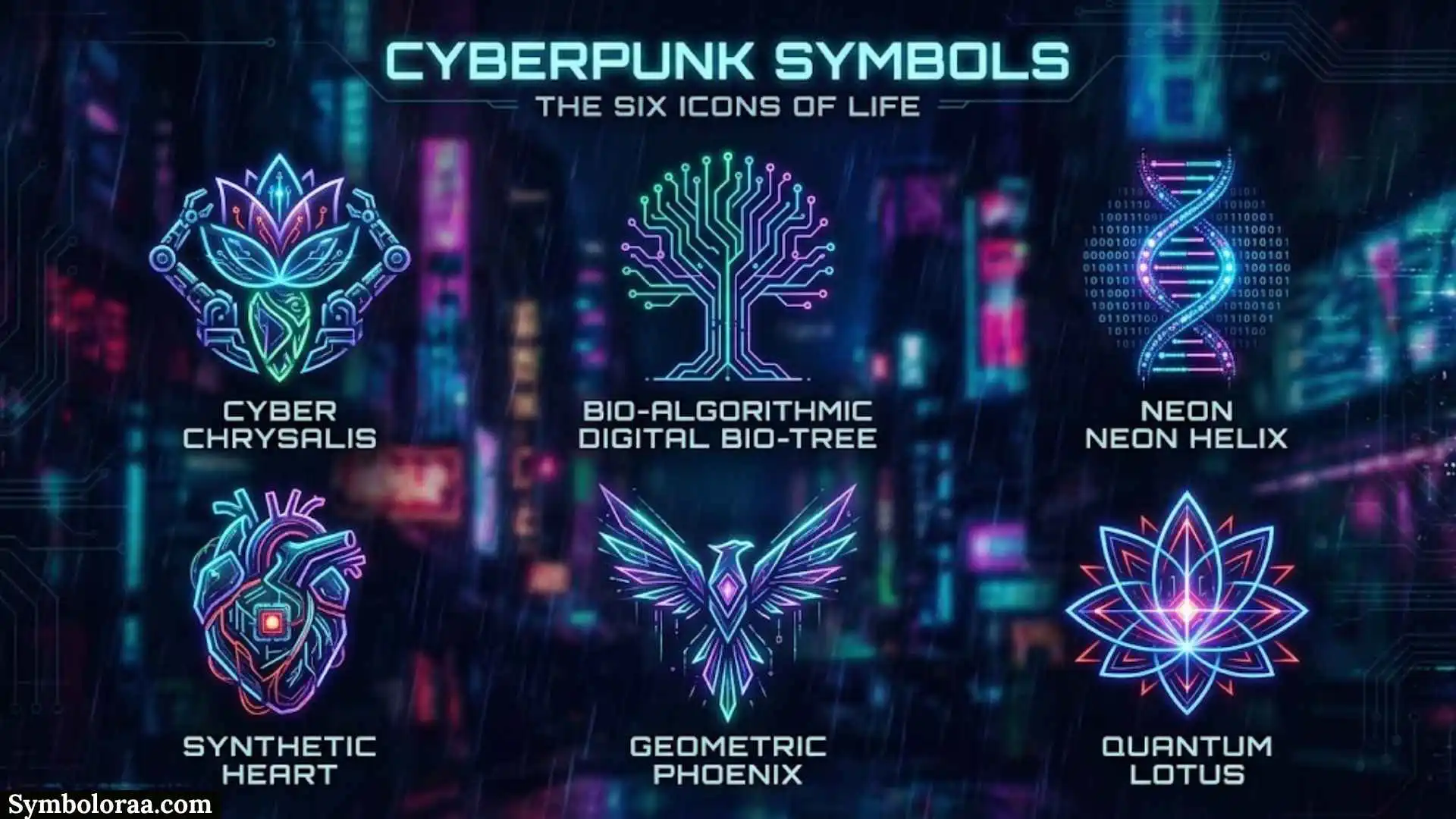
Cyberpunk symbols are visual elements that communicate ideas about technology, artificial intelligence, cybernetics, hacking, surveillance, corporate power, digital identity, rebellion, and life in a technologically advanced but socially troubled world.
Common examples include cybernetic eyes, circuit boards, neon signs, computer code, glitches, surveillance cameras, barcodes, digital masks, robotic bodies, corporate logos, holographic interfaces, and futuristic city imagery. However, there is no official universal dictionary of cyberpunk symbols. Some are established themes of the genre, while others are visual conventions that became popular through movies, anime, games, literature, and graphic design.
The term cyberpunk itself became widely associated with science fiction in the 1980s. The Encyclopedia of Science Fiction notes that Bruce Bethke likely coined the word in his 1983 story “Cyberpunk,” while William Gibson’s Neuromancer (1984) became a defining work for the genre.
This guide explains the most recognizable cyberpunk symbols, what they can mean, how the symbolism developed, how cyberpunk differs from related aesthetics, and how to choose the right symbol for tattoos, logos, artwork, games, fashion, and digital design.
Quick Answer: What Are Cyberpunk Symbols?
Cyberpunk symbols are images, objects, patterns, colors, interfaces, and visual motifs associated with cyberpunk themes such as advanced technology, human-machine integration, hacking, surveillance, corporate control, social inequality, and rebellion.
There is no single official cyberpunk symbol. Instead, the genre has developed a recognizable visual and thematic vocabulary.
Some of the most common examples are:
- Cybernetic eye — augmentation, surveillance, enhanced perception
- Circuit board — computing, connectivity, cybernetics
- Neon sign — futuristic urban life, advertising, artificiality
- Computer code — hacking, information, digital systems
- Glitch — system failure, corruption, instability, rebellion
- Surveillance camera — monitoring, privacy, social control
- Barcode or QR-style pattern — identification, data, commodification
- Digital mask — anonymity and online identity
- Robotic body — automation and human-machine relationships
- Corporate logo — institutional power and consumerism
- Hologram — advanced technology and digital information
- Wires and implants — technological dependence and augmentation
- Neon megacity — the classic “high tech, low life” environment
The key is context. A circuit board by itself represents electronics. A circuit board integrated into a human face can represent cybernetics and the merging of technology with human identity.
Key Takeaways About Cyberpunk Symbols
- Cyberpunk does not have one official universal symbol.
- Its symbols generally combine technology with social or human conflict.
- Neon is a common visual convention, but neon alone does not make something cyberpunk.
- Cybernetic body parts often symbolize the relationship between humans and machines.
- Cameras and digital eyes can represent surveillance and loss of privacy.
- Corporate imagery can represent institutional power and consumerism.
- Glitches can symbolize system failure, corrupted information, or resistance.
- Cyberpunk is different from generic futuristic design because it often examines the social consequences of technology.
- The strongest cyberpunk imagery usually contains a contrast between technological advancement and human vulnerability.
What Makes a Symbol Cyberpunk?
A futuristic object does not automatically become a cyberpunk symbol.
A sleek spaceship, clean laboratory, or advanced robot can belong to optimistic science fiction without having anything particularly cyberpunk about it.
Cyberpunk usually becomes recognizable when technology is connected to human, political, or social tension.
Technology Symbols
These represent the technological side of the genre:
- Computers
- Circuits
- Artificial intelligence
- Neural networks
- Cybernetic implants
- Robots
- Digital interfaces
- Holograms
Control Symbols
These communicate the darker side of technology:
- Surveillance cameras
- Facial-recognition systems
- Corporate logos
- Identification numbers
- Barcodes
- Drones
- Data tracking
Rebellion Symbols
These represent individuals challenging powerful systems:
- Glitches
- Hacked interfaces
- Masks
- Graffiti
- Broken corporate logos
- Unauthorized code
- Warning messages
Identity Symbols
These explore what happens when technology changes the human body or mind:
- Cybernetic eyes
- Artificial limbs
- Digital faces
- Androids
- Neural interfaces
- Human-machine hybrids
This gives cyberpunk symbolism a useful formula:
Technology + human conflict + social consequences = stronger cyberpunk symbolism.
Top Cyberpunk Symbols and Their Meanings
The following are among the most recognizable visual elements associated with cyberpunk.
Cybernetic Eye
The cybernetic eye combines a human eye with mechanical, electronic, or digital components.
It is one of the most effective cyberpunk symbols because it can communicate several ideas simultaneously.
It may represent:
- Human enhancement
- Artificial vision
- Surveillance
- Digital perception
- Transhumanism
- Loss of privacy
- Human-machine integration
Its meaning can change depending on the design.
A glowing mechanical eye on a superhero-like character may suggest enhanced ability.
A camera-like eye surrounded by surveillance screens may suggest constant monitoring.
A human eye divided by circuit lines can suggest technology changing personal identity.
Circuit Board
Circuit patterns are strongly associated with computers and electronics.
They can represent:
- Computing
- Connectivity
- Digital systems
- Cybernetics
- Artificial intelligence
- Information networks
A circuit board becomes more symbolically powerful when combined with another element.
For example:
Human face + circuit board → human-machine integration
Brain + circuit board → artificial or enhanced intelligence
Heart + circuit board → technology changing emotion or human life
Neon Signs
Neon is one of the most recognizable visual conventions of cyberpunk.
Bright signs against dark streets create a strong contrast between artificial light and a troubled urban environment.
Neon can suggest:
- Futuristic cities
- Commercialism
- Consumer culture
- Nightlife
- Artificial beauty
- Technology
- Information overload
But neon is not an official cyberpunk symbol.
It is better understood as a visual convention that became strongly associated with cyberpunk through influential works and later media.
Computer Code
Code is frequently used to communicate hacking, programming, artificial intelligence, and digital systems.
It can symbolize:
- Hidden information
- Hacking
- Software
- Digital control
- Cybersecurity
- Machine intelligence
- Networked society
However, random code placed in a design is not automatically meaningful.
If the code is used to represent hacking, it works best alongside other elements such as terminals, encrypted messages, network diagrams, or digital locks.
Glitch
A glitch is a visual representation of digital malfunction.
It can involve:
- Broken pixels
- Distorted text
- Repeated images
- Missing sections
- Color separation
- Corrupted interfaces
Glitches can symbolize:
- System failure
- Digital corruption
- Unstable identity
- Information breakdown
- Resistance
- A controlled system losing control
This makes glitch imagery particularly useful for cyberpunk themes involving rebellion.
Surveillance Camera
A surveillance camera is one of the clearest symbols of technological control.
It can represent:
- Loss of privacy
- Government monitoring
- Corporate surveillance
- Facial recognition
- Data collection
- Security systems
- Social control
A single camera can therefore communicate an entire cyberpunk theme: technology allows institutions to observe individuals at an unprecedented scale.
Barcode
A barcode is a machine-readable identifier, but in cyberpunk artwork it can become a metaphor for identity and commercialization.
It can suggest:
- Commodification
- Identification
- Consumerism
- Tracking
- Data collection
- Loss of individuality
A barcode printed across a person’s body can communicate the idea that society treats the individual like a product.
QR-Style Codes
QR codes are a more modern visual reference than many classic cyberpunk motifs.
They can suggest:
- Digital identity
- Information access
- Data
- Automation
- Tracking
- Digital commerce
Unlike the classic cyberpunk symbols found in early literature and film, QR codes belong more to modern cyberpunk-inspired design.
That distinction is important.
Digital Mask
A mask can represent anonymity, hidden identity, or resistance.
When combined with digital elements, it can suggest:
- Anonymous online identity
- Hacking
- Privacy
- Rebellion
- Digital personas
- Protection from surveillance
The mask is particularly useful when the theme is about an individual hiding from a powerful system.
Robotic Skull
Skulls are not uniquely cyberpunk, but combining a skull with mechanical parts creates a strong technological interpretation.
A cybernetic skull can symbolize:
- Mortality
- Artificial intelligence
- Human-machine fusion
- Technological danger
- Digital identity
- The loss of humanity
It can also communicate the contrast between biological death and technological permanence.
Cyberpunk Symbols by Theme
Instead of viewing cyberpunk imagery as one large category, it is useful to divide it into thematic groups.
Technology and Computing
Common symbols include:
- Circuits
- Computer chips
- Code
- Data streams
- Digital interfaces
- Neural networks
- Holograms
These emphasize technological advancement.
Human-Machine Integration
Common symbols include:
- Cybernetic eyes
- Mechanical arms
- Neural implants
- Robotic faces
- Artificial organs
- Human-machine hybrids
These focus on the question of where humanity ends and technology begins.
Surveillance and Control
Common symbols include:
- Cameras
- Drones
- Digital eyes
- Facial-recognition interfaces
- Identification numbers
- Tracking systems
These represent privacy, monitoring, and institutional control.
Corporate Power
Common imagery includes:
- Megacorporation logos
- Skyscrapers
- Advertising screens
- Corporate identification cards
- Branded technology
- Financial interfaces
These symbols communicate wealth, authority, consumerism, and institutional influence.
Rebellion and Resistance
Common imagery includes:
- Glitches
- Graffiti
- Masks
- Broken logos
- Hacked screens
- Warning symbols
- Unauthorized messages
These suggest individuals challenging a dominant system.
Cyberpunk Symbols and Meanings: Comparison Table
| Symbol | Basic Meaning | Common Cyberpunk Interpretation | Typical Use |
| Cybernetic eye | Vision | Enhancement or surveillance | Tattoos, characters |
| Circuit board | Electronics | Connectivity and cybernetics | Logos, artwork |
| Neon sign | Artificial light | Urban technology and consumerism | Cities, posters |
| Computer code | Programming | Hacking and digital control | Interfaces |
| Glitch | Malfunction | Corruption or rebellion | Graphic design |
| Camera | Monitoring | Surveillance and loss of privacy | Dystopian art |
| Barcode | Identification | Commodification and tracking | Character design |
| Digital mask | Anonymity | Hacker identity and resistance | Characters |
| Robot | Machine | Automation and artificial life | Games, artwork |
| Corporate logo | Branding | Institutional power | Worldbuilding |
| Hologram | Digital projection | Information and advanced technology | City scenes |
| Wires | Connectivity | Technological dependence | Character designs |
| Cybernetic skull | Mortality | Human-machine conflict | Tattoos, posters |
| Neural network | Intelligence | AI and digital consciousness | Technology branding |
| Megacity | Urban environment | High technology and social inequality | Film and games |
This table should be treated as a practical interpretation guide, not an official dictionary. Cyberpunk symbolism changes according to the work, creator, culture, and context.
Cyberpunk Color Symbolism
Color is an important part of cyberpunk-inspired design, but there is no official cyberpunk color standard.
Certain combinations became common because they create a strong visual contrast.
Cyan and Blue
Blue and cyan can suggest:
- Digital technology
- Coldness
- Artificial environments
- Machines
- Isolation
Magenta and Pink
Bright pink and magenta can suggest:
- Neon advertising
- Nightlife
- Artificial beauty
- Consumer culture
- Energy
Red
Red can create associations with:
- Danger
- Warning
- Violence
- Emergency
- Power
Green
Green is often associated with:
- Computer terminals
- Code
- Digital information
- Hacking
These meanings are conventions rather than fixed rules. A creator can intentionally use different colors to produce a different emotional effect.
The History of Cyberpunk Symbolism
Cyberpunk symbolism developed from a combination of science fiction literature, film noir, computing culture, Japanese popular culture, industrial design, and concerns about rapidly changing technology.
Early Influences
Cyberpunk did not appear from nowhere.
Earlier works such as Fritz Lang’s Metropolis (1927) explored technological cities, social inequality, powerful elites, and oppressed workers. BFI identifies Metropolis as an important precursor to later cyberpunk themes.
Other science-fiction writers also explored technological control, corporate systems, artificial intelligence, and changing human identities before the cyberpunk movement became established.
The 1980s Cyberpunk Movement
The term became strongly associated with a literary movement in the 1980s.
The Encyclopedia of Science Fiction identifies William Gibson and Bruce Sterling among the early major figures and notes the importance of Gibson’s Neuromancer (1984) in shaping the genre. Bruce Sterling’s Mirrorshades: The Cyberpunk Anthology (1986) also helped define the movement.
This period established themes that remain central today:
- Information networks
- Artificial intelligence
- Cybernetic modification
- Global corporations
- Marginalized individuals
- Digital identity
- Human-machine relationships
Blade Runner and Visual Cyberpunk
Ridley Scott’s Blade Runner (1982) had an enormous influence on cyberpunk’s visual identity.
Its version of future Los Angeles combined:
- Towering buildings
- Neon and advertising
- Rain
- Darkness
- Industrial architecture
- Synthetic humans
- Corporate power
- Multilingual urban culture
BFI describes the film’s city as a dystopian landscape of skyscrapers, advertising holograms, rain, and synthetic humans.
The film helped establish a visual vocabulary that later cyberpunk works repeatedly adapted.
Japanese Cyberpunk
Japanese creators developed their own powerful interpretations of cyberpunk.
Akira (1988) became a major landmark, depicting a dystopian Neo Tokyo filled with political instability, youth rebellion, military power, technology, and urban decay. BFI describes it as a cornerstone of cyberpunk and notes its influence on Western audiences.
Ghost in the Shell (1995) pushed the genre toward deeper questions about identity, consciousness, artificial intelligence, and the relationship between mind and machine.
This means Japanese cyberpunk should not be treated merely as a decorative version of Western cyberpunk. It developed its own themes, visual language, and cultural context.
Cyberpunk Symbols in Movies
Film helped transform cyberpunk concepts into recognizable visual imagery.
Blade Runner
The most important visual ideas include:
- Rain-soaked streets
- Neon advertisements
- Corporate skyscrapers
- Synthetic humans
- Industrial architecture
- Artificial environments
The film uses these elements to explore identity, mortality, power, and what it means to be human. BFI notes its influence on later cyberpunk aesthetics and its combination of science fiction with noir.
The Matrix
The Matrix expanded cyberpunk themes around digital reality, machine control, and resistance.
Its famous flowing-code imagery became an especially recognizable representation of the hidden digital system underlying the fictional world. BFI notes the film’s connection to Ghost in the Shell and its shared concerns about humans, machines, and digital interconnection.
RoboCop
RoboCop combines cybernetic enhancement with corporate power, policing, violence, and commercialization.
Its symbolism is less focused on neon aesthetics and more on the question of what happens when a human body becomes part of an institutional machine.
Cyberpunk Symbols in Anime
Anime played a major role in expanding cyberpunk’s visual and philosophical vocabulary.
Akira
Akira uses:
- Neo Tokyo
- Motorcycles
- Military technology
- Youth rebellion
- Political unrest
- Experimental science
- Urban destruction
The result is a cyberpunk environment where technology and social instability exist together.
Ghost in the Shell
Ghost in the Shell focuses more directly on:
- Cybernetic bodies
- Digital consciousness
- Hacking
- Artificial intelligence
- Identity
- Human-machine boundaries
Its protagonist has a synthetic body and a human brain, making the body itself a symbol of the genre’s central questions.
Cyberpunk Symbols in Video Games
Video games turned cyberpunk symbolism into interactive environments.
Cyberpunk 2077
Cyberpunk 2077 uses many established cyberpunk motifs:
- Neon streets
- Corporate power
- Cybernetic augmentation
- Advertising
- Social inequality
- Weapons technology
- Artificial intelligence
- Urban density
BFI describes the game as drawing on Blade Runner while presenting rampant capitalism, grimy neon streets, and body upgrades.
Deus Ex
The Deus Ex series uses cybernetic augmentation to explore political power, surveillance, conspiracy, and the consequences of modifying the human body.
System Shock
System Shock is important for its treatment of artificial intelligence, technological environments, and the relationship between human beings and powerful computer systems.
Games therefore demonstrate that cyberpunk symbolism is not limited to visual style. It can also become part of gameplay and worldbuilding.
Cyberpunk vs. Dystopian Symbols
Cyberpunk and dystopian fiction overlap, but they are not identical.
| Cyberpunk | General Dystopian Fiction |
| Advanced technology is usually central | Technology may or may not be central |
| Cybernetics are common | Cybernetics are optional |
| Hacking often appears | Hacking may be absent |
| Corporations may hold enormous power | Governments or institutions may dominate |
| Digital identity is important | Social control can take many forms |
| High-tech environments are common | Technology level can vary |
| Individual rebels are common | Protagonists may or may not rebel |
A dystopian story can be cyberpunk, but not every dystopian story is cyberpunk.
Cyberpunk vs. Futuristic Symbols
“Futuristic” is much broader than “cyberpunk.”
A futuristic design may show:
- Clean architecture
- Space travel
- Advanced medicine
- Flying vehicles
- Artificial intelligence
Cyberpunk adds a particular social dimension.
For example:
Clean futuristic city
→ technological optimism
Neon city controlled by corporations and filled with surveillance
→ cyberpunk
The difference is not simply visual darkness. It is the relationship between technology and society.
Cyberpunk vs. Steampunk
These two genres are sometimes confused because both imagine alternative technological futures.
Cyberpunk
Focuses on:
- Computers
- Cybernetics
- AI
- Digital networks
- Megacorporations
- Surveillance
- Neon cities
Steampunk
Often focuses on:
- Steam technology
- Gears
- Mechanical machinery
- Victorian-inspired fashion
- Alternate industrial history
A circuit board belongs naturally to cyberpunk; a brass gear-driven machine is much more characteristic of steampunk.
Cyberpunk vs. Synthwave and Vaporwave
These aesthetics overlap visually but have different roots.
Synthwave
Often emphasizes:
- Retro-futurism
- 1980s-inspired imagery
- Sunset gradients
- Sports cars
- Grid landscapes
- Neon colors
Vaporwave
Often uses:
- Internet-era nostalgia
- Classical statues
- Glitch imagery
- Consumer imagery
- Surreal digital graphics
Cyberpunk
Usually places greater emphasis on:
- Technology
- Dystopia
- Surveillance
- Cybernetics
- Corporate power
- Social inequality
- Human-machine relationships
A design can combine these aesthetics, but they should not be treated as identical.
Cyberpunk Symbols for Tattoos
Cyberpunk imagery can work particularly well as tattoos because many symbols have strong shapes and personal meanings.
For Personal Transformation
Consider:
- Cybernetic eye
- Mechanical arm
- Human-machine face
- Artificial heart
These can represent personal change or becoming a different version of yourself.
For Technology
Consider:
- Circuit board
- Microchip
- Neural network
- Digital interface
For Rebellion
Consider:
- Glitch
- Broken corporate logo
- Digital mask
- Hacked interface
For Identity
Consider:
- Cybernetic face
- Digital fingerprint
- Barcode
- Split human-machine portrait
Before using Japanese writing, verify its actual meaning rather than selecting characters solely because they look futuristic.
Cyberpunk Symbols for Logos and Graphic Design
Cyberpunk logos work best when the design communicates one strong idea.
Technology Brand
Use:
- Circuit lines
- Geometric shapes
- Digital typography
Cybersecurity Brand
Use:
- Lock
- Shield
- Circuit
- Digital eye
AI Brand
Use:
- Neural network
- Abstract brain
- Connected nodes
Gaming Brand
Use:
- Glitch typography
- Digital mask
- Futuristic geometric symbol
Avoid combining every cyberpunk element into one logo. A circuit, skull, neon gradient, camera, barcode, robot, and glitch effect may individually look interesting but collectively create visual noise.
How to Create an Authentic Cyberpunk Symbol
A useful design process is to combine technology with a human or social problem.
Step 1: Choose the Technology
Start with one technological concept:
- AI
- Cybernetics
- Hacking
- Surveillance
- Robotics
- Virtual reality
Step 2: Choose the Conflict
Ask what problem the technology creates.
Examples:
- AI → loss of control
- Surveillance → loss of privacy
- Cybernetics → identity
- Corporations → inequality
- Hacking → resistance
- Automation → loss of employment
Step 3: Create the Visual Contrast
Combine the two ideas.
Eye + camera
→ surveillance
Human face + circuit board
→ technological transformation
Corporate logo + glitch
→ institutional instability
Barcode + human body
→ commodification of identity
Step 4: Remove Unnecessary Elements
A strong symbol should still be understandable when simplified.
If removing the neon effect makes the symbol meaningless, the concept may depend too heavily on aesthetics rather than symbolism.
Cyberpunk Symbol Decision Guide
Use this quick guide when choosing an appropriate symbol.
Want to represent advanced technology?
→ Choose circuits, chips, code, or digital interfaces.
Want to represent human-machine integration?
→ Choose a cybernetic eye, artificial limb, or augmented face.
Want to represent artificial intelligence?
→ Choose a neural network, digital brain, or synthetic face.
Want to represent surveillance?
→ Choose a camera, digital eye, drone, or facial-recognition interface.
Want to represent hacking?
→ Choose code, encrypted data, terminals, or network diagrams.
Want to represent rebellion?
→ Choose a glitch, broken corporate logo, mask, or hacked display.
Want to represent corporate control?
→ Choose a megacorporation logo, skyscraper, advertisement, or identification system.
Want to represent identity?
→ Choose a human-machine hybrid, digital mask, barcode, or cybernetic face.
Want the classic cyberpunk atmosphere?
→ Combine neon, dense urban architecture, technology, surveillance, and social contrast.
Common Misconceptions About Cyberpunk Symbols
Cyberpunk Means Neon
Neon is strongly associated with cyberpunk, but it is not the definition of the genre.
A neon sign can appear in ordinary nightlife, advertising, or retro-futuristic artwork without being cyberpunk.
Cyberpunk Means Hackers
Hacking is an important cyberpunk theme, but cyberpunk also explores:
- Artificial intelligence
- Cybernetics
- Corporations
- Surveillance
- Identity
- Social inequality
- Human-machine relationships
Every Futuristic Symbol Is Cyberpunk
A clean futuristic robot does not automatically represent cyberpunk.
The surrounding social context matters.
Japanese Writing Is Automatically Cyberpunk
Japanese typography became strongly associated with cyberpunk visual culture, but Japanese writing itself is not a cyberpunk symbol.
The text should have a legitimate meaning and cultural context.
Glitch Effects Automatically Make Something Cyberpunk
A glitch is a visual technique.
It becomes meaningfully cyberpunk when it contributes to themes such as system failure, digital corruption, identity, or resistance.
Cyberpunk Is Only About a Dark Future
Cyberpunk can be visually exciting, colorful, and beautiful.
The important feature is not simply darkness. It is often the tension between technological advancement and social or human problems.
Common Design Mistakes
Using Too Many Symbols
More imagery does not necessarily create stronger cyberpunk design.
Choose one primary symbol and one or two supporting elements.
Making Everything Glow
If every object has a neon glow, there is no visual hierarchy.
Darkness and negative space help neon elements stand out.
Using Random Code
Fake or meaningless code may look technical, but it can weaken the credibility of a design if the content is supposed to communicate something specific.
Using Incorrect Language
If Japanese, Chinese, Korean, or another language is included, verify the text before publishing or printing it.
Confusing Style With Meaning
A design can look cyberpunk without saying anything.
Strong symbolism requires an idea behind the visual.
Expert Tips for Better Cyberpunk Symbolism
Build Around Contrast
Cyberpunk is particularly effective when opposites appear together:
- Human + machine
- Luxury + poverty
- Freedom + surveillance
- Technology + decay
- Corporate order + individual rebellion
- Artificial beauty + social disorder
Use Visual Hierarchy
Choose:
- One primary symbol
- One supporting technological element
- One environmental or atmospheric element
This keeps the design readable.
Make the Symbol Work Without Effects
Test the design in black and white.
If the concept still communicates something without neon, glow, or glitch effects, the underlying symbolism is probably strong.
Consider Cultural Context
Cyberpunk has been shaped by many cultures, especially Japanese and Western science fiction.
Avoid reducing an entire culture to a visual stereotype.
Separate Genre From Aesthetic
Ask:
Does this image only look futuristic, or does it communicate a cyberpunk idea?
That question can dramatically improve the quality of a design.
Where Cyberpunk Symbols Are Used
Cyberpunk symbolism appears across many creative and commercial contexts.
Movies and Television
Used for:
- Worldbuilding
- Character identity
- Dystopian environments
- Corporate storytelling
- Technological themes
Video Games
Used for:
- Character customization
- Factions
- Corporations
- Weapons
- Cybernetic upgrades
- City environments
Anime and Manga
Used to explore:
- Technology
- Identity
- Body modification
- Artificial intelligence
- Political control
Tattoos
Used for personal identity, transformation, technology, and rebellion.
Fashion
Used through:
- LED clothing
- Futuristic accessories
- Masks
- Technical fabrics
- Cybernetic motifs
Logos and Branding
Used by technology, gaming, cybersecurity, entertainment, and creative brands.
Posters and Digital Art
Used to create futuristic environments and communicate ideas about technology and society.
Why Cyberpunk Symbols Matter
Cyberpunk symbolism is powerful because it does more than make technology look futuristic.
It asks questions about what technology does to people.
A cybernetic eye can represent both enhanced vision and constant surveillance.
A barcode can represent convenient identification or the disturbing idea that a human being has become a product.
A corporate skyscraper can represent innovation and wealth while also symbolizing institutional power.
A glitch can be a technical error, but in a story it can become a metaphor for rebellion against an apparently perfect system.
This duality is one of the reasons cyberpunk remains culturally influential.
The genre’s central tension can often be summarized as:
High technology, complicated humanity.
That is why the best cyberpunk symbols usually contain more than futuristic decoration. They communicate an argument about technology, society, identity, or power.
Frequently Asked Questions About Cyberpunk Symbols
What is the most common cyberpunk symbol?
There is no official universal symbol. However, cybernetic eyes, circuits, neon-lit cities, computer code, glitches, surveillance cameras, and digital interfaces are among the most recognizable cyberpunk visual motifs.
What does a cybernetic eye symbolize?
A cybernetic eye can represent technological enhancement, surveillance, artificial vision, digital identity, transhumanism, or the merging of human and machine.
What does neon symbolize in cyberpunk?
Neon often represents futuristic urban environments, commercial advertising, technology, nightlife, artificial beauty, and the contrast between attractive technology and difficult social conditions.
What does a glitch symbolize?
A glitch can symbolize digital corruption, system failure, unstable identity, information breakdown, or rebellion against an established system.
Are circuit boards cyberpunk symbols?
Circuit boards are strongly associated with computing and can become cyberpunk symbols when they are connected to themes such as cybernetics, AI, digital identity, or human-machine integration.
What does a barcode mean in cyberpunk?
A barcode can symbolize identification, tracking, commercialization, data collection, or the reduction of a person to a product or digital record.
What symbol represents hacking?
Computer code, terminals, digital locks, encrypted messages, network diagrams, and anonymous masks can represent hacking. However, these are hacker symbols more broadly and are not exclusively cyberpunk.
What colors are associated with cyberpunk?
Cyan, blue, magenta, pink, red, green, and purple are frequently used in cyberpunk-inspired design. These are visual conventions rather than official symbolic rules.
What does a cyberpunk skull symbolize?
A cyberpunk skull can represent mortality, artificial intelligence, human-machine integration, technological danger, digital identity, or anxiety about losing human qualities.
What symbolizes rebellion in cyberpunk?
Glitches, hacked interfaces, digital masks, graffiti, broken corporate logos, and unauthorized messages can all represent rebellion. There is no single official rebellion symbol.
Why are corporations important in cyberpunk?
Cyberpunk frequently examines societies where powerful corporations control technology, information, services, or infrastructure. Corporate imagery therefore becomes a way to represent institutional power, consumerism, and inequality.
Is cyberpunk always dystopian?
Not every work has exactly the same tone, but dystopian and socially critical themes are strongly associated with cyberpunk. The genre frequently contrasts advanced technology with difficult social conditions.
What is the difference between cyberpunk and sci-fi?
Cyberpunk is a subgenre of science fiction. General science fiction can explore almost any future or technological idea, while cyberpunk typically focuses more heavily on technology’s effects on individuals and society, particularly computing, cybernetics, information networks, corporations, and social inequality.
What is the difference between cyberpunk and steampunk?
Cyberpunk generally centers on computers, cybernetics, digital networks, AI, and futuristic urban environments. Steampunk commonly reimagines advanced technology using steam power, gears, mechanical systems, and historical industrial aesthetics.
What is the difference between cyberpunk and synthwave?
Synthwave is primarily a retro-futuristic musical and visual aesthetic influenced by 1980s culture. Cyberpunk is a broader science-fiction genre and cultural concept focused on technology, society, power, identity, and often dystopian conditions.
What is a good cyberpunk symbol for personal identity?
A cybernetic face, digital mask, cybernetic eye, barcode, or human-machine hybrid can represent identity and the changing relationship between people and technology.
What is a good cyberpunk symbol for freedom?
There is no official cyberpunk freedom symbol. A broken digital lock, escaped data stream, hacked interface, or person breaking through a surveillance system can be used to communicate technological liberation.
What is the best cyberpunk symbol for a logo?
It depends on the brand. A circuit is suitable for general technology, a shield-and-circuit combination for cybersecurity, a neural network for AI, and glitch typography for gaming or digital entertainment.
References
The following sources provide reliable background for the historical and cultural claims discussed in this article.
- The Encyclopedia of Science Fiction — “Cyberpunk”: Provides historical background on the term, the 1980s cyberpunk movement, Bruce Bethke, William Gibson, Bruce Sterling, Neuromancer, and Mirrorshades.
- British Film Institute — “Where to begin with Japanese cyberpunk”: Discusses Blade Runner, Neuromancer, Akira, Ghost in the Shell, and the development of Japanese cyberpunk.
- British Film Institute — “6 films you should watch before you see Ghost in the Shell”: Provides historical context for Metropolis, Blade Runner, and Akira as important precursors and landmarks of cyberpunk cinema.
- British Film Institute — “Blade Runner: anatomy of a classic”: Examines the film’s visual language, architecture, technology, social hierarchy, and lasting influence on cyberpunk aesthetics.
- British Film Institute — “30 years of Akira”: Provides context on Akira, its dystopian Tokyo, youth rebellion, and importance to cyberpunk culture.
- British Film Institute — “50 key anime films”: Discusses Akira and Ghost in the Shell and their cyberpunk themes involving technology, identity, and social anxiety.
Conclusion
Cyberpunk symbols are much more than neon colors, futuristic fonts, and glowing city streets. At their strongest, they communicate the genre’s central questions about technology, humanity, identity, surveillance, corporate power, inequality, and resistance.
A cybernetic eye can represent enhancement or surveillance. A circuit board can represent connectivity or technological dependence. A barcode can suggest digital identity or commodification. A glitch can communicate system failure or rebellion. Neon can establish a futuristic urban atmosphere, while corporate skyscrapers and surveillance cameras can reveal the power structures behind that attractive surface.
The history of cyberpunk also shows why these symbols have become so recognizable. Literature such as William Gibson’s Neuromancer, films such as Blade Runner, and Japanese works such as Akira and Ghost in the Shell helped develop and expand the genre’s visual and thematic vocabulary.
If you are choosing a cyberpunk symbol for a tattoo, logo, game, poster, fashion design, illustration, or website, begin with the message rather than the aesthetic. Decide whether you want to communicate technology, identity, surveillance, rebellion, artificial intelligence, corporate power, or human-machine integration. Then choose the symbol that expresses that idea most clearly.

I’m Madison Reed, a contemporary American author who writes about love, family, friendship, and second chances. I’m fascinated by the choices that shape our lives and the moments that change us forever. My goal is to create honest, emotional stories with characters readers can connect with long after finishing each book.
Three Books:
When We Find Our Way
The Things We Never Said
Summer in September
 Jackson Miller