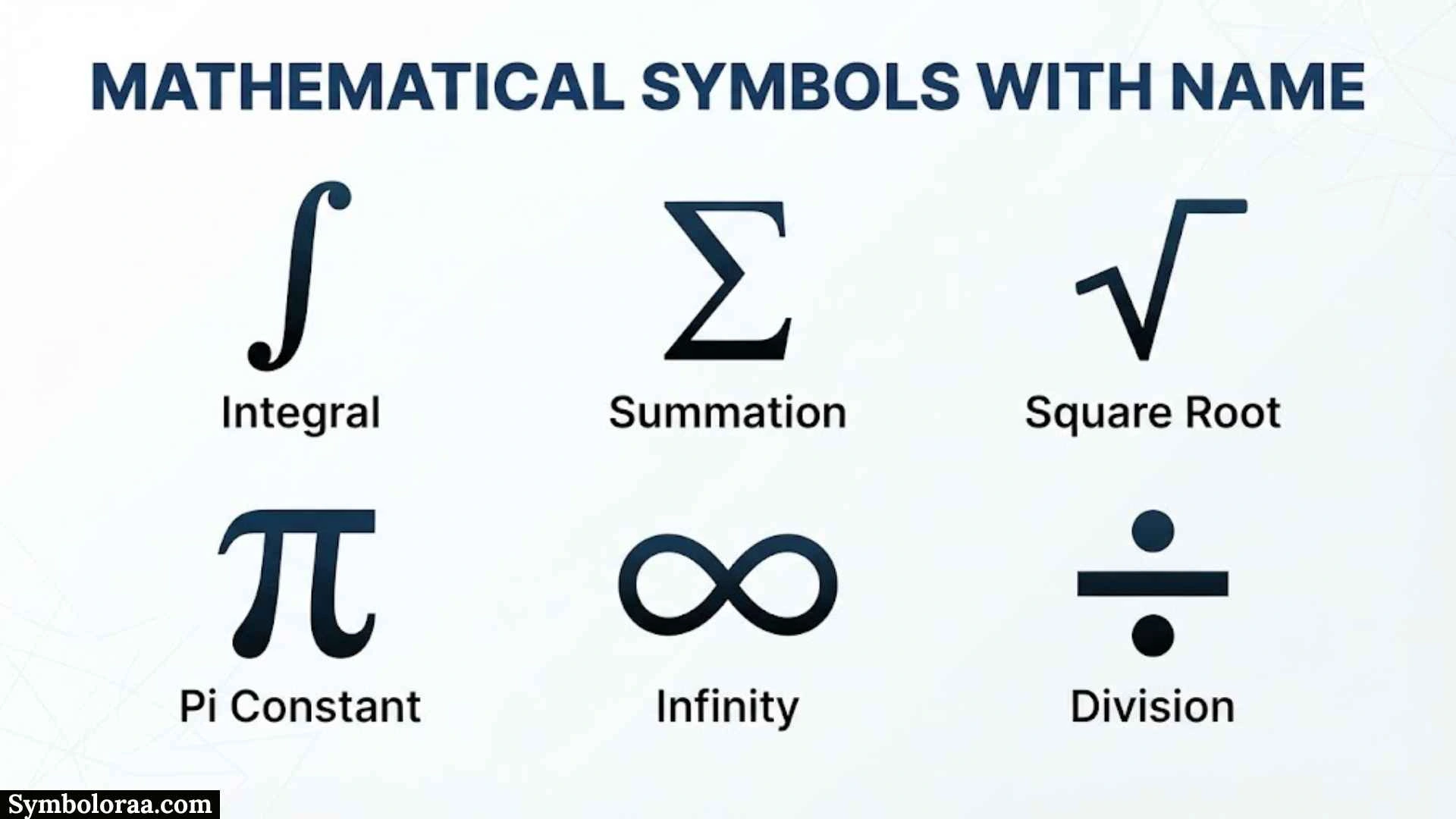
If you are searching for mathematical symbols with name, you probably want more than a simple list. You may need to know what each symbol is called, what it means, where it is used, and how to read it correctly.
Mathematical symbols provide a compact language for arithmetic, algebra, geometry, calculus, statistics, probability, set theory, logic, and many other fields. For example, + means addition, − means subtraction, × means multiplication, ÷ means division, and = means equality.
This guide provides a detailed reference to common mathematical symbols with their names, meanings, examples, categories, and practical uses. It also explains symbols that are often confused, symbols that can have different meanings depending on context, and how to choose the correct symbol when writing an equation.
Quick Answer: Mathematical Symbols With Names
The table below contains some of the most frequently used mathematical symbols.
| Symbol | Name | Meaning | Example |
| + | Plus Sign | Addition | 5 + 3 = 8 |
| − | Minus Sign | Subtraction or negative value | 9 − 4 = 5 |
| × | Multiplication Sign | Multiplication | 6 × 2 = 12 |
| ÷ | Division Sign | Division | 12 ÷ 3 = 4 |
| = | Equal Sign | Equal values | 5 + 2 = 7 |
| ≠ | Not Equal To | Values are different | 5 ≠ 6 |
| < | Less Than | Smaller than | 3 < 8 |
| > | Greater Than | Larger than | 9 > 4 |
| ≤ | Less Than or Equal To | Smaller or equal | x ≤ 10 |
| ≥ | Greater Than or Equal To | Larger or equal | x ≥ 5 |
| ≈ | Approximately Equal To | Nearly equal | π ≈ 3.14 |
| ± | Plus-Minus | Positive or negative possibility | x = ±5 |
| % | Percent Sign | Per hundred | 25% |
| √ | Square Root | Principal square root | √25 = 5 |
| ∞ | Infinity | Unbounded quantity | x → ∞ |
| ∝ | Proportional To | Proportional relationship | y ∝ x |
| π | Pi | Circle constant | C = 2πr |
| ∑ | Summation | Sum of terms | ∑x |
| ∏ | Product | Product of terms | ∏x |
| ∫ | Integral | Integration | ∫x dx |
| ∂ | Partial Derivative | Partial differentiation | ∂f/∂x |
| Δ | Delta | Change or difference | Δx |
| ∈ | Element Of | Belongs to a set | x ∈ A |
| ∉ | Not an Element Of | Does not belong to a set | x ∉ A |
| ∪ | Union | Combines sets | A ∪ B |
| ∩ | Intersection | Common elements | A ∩ B |
| ⊆ | Subset Of | One set is contained in another | A ⊆ B |
| ∅ | Empty Set | Set with no elements | A = ∅ |
| ∴ | Therefore | Logical conclusion | ∴ x = 5 |
| ∵ | Because | Gives a reason | ∵ a = b |
What Are Mathematical Symbols?
Mathematical symbols are signs, characters, letters, or notation used to represent mathematical operations, values, relationships, quantities, functions, sets, and concepts.
Consider this equation:
8 + 4 = 12
The plus sign tells us to add the two numbers, while the equal sign tells us that the expression on the left has the same value as the expression on the right.
Without symbols, the same idea would require much more text:
Eight added to four is equal to twelve.
Symbols make mathematical communication shorter and easier to interpret.
International standards recognize the importance of consistent mathematical notation. ISO 80000-2:2019 specifically specifies mathematical symbols and explains their meanings, verbal equivalents, and applications.
Why Mathematical Symbols Matter
Mathematical symbols are important because they allow people to communicate mathematical ideas across languages and disciplines.
They are used in:
- School mathematics
- Algebra
- Geometry
- Trigonometry
- Calculus
- Statistics
- Probability
- Physics
- Engineering
- Computer science
- Economics
- Finance
- Scientific research
A symbol such as ≥ can communicate “greater than or equal to” much more efficiently than writing the entire phrase every time.
Basic Arithmetic Symbols With Names
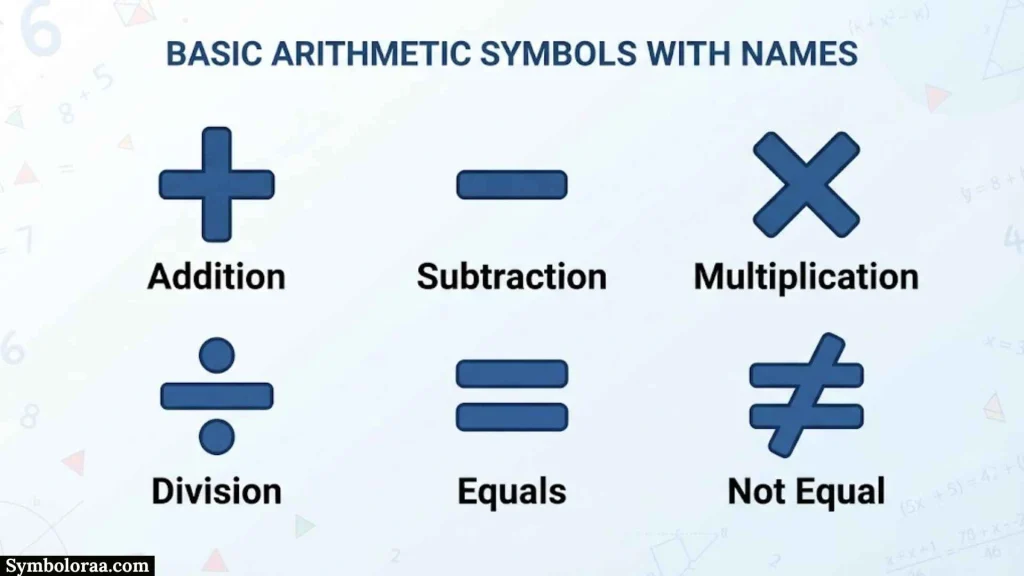
Arithmetic symbols represent the fundamental operations used to calculate with numbers.
Plus Sign (+)
The plus sign (+) represents addition.
Example:
7 + 5 = 12
Here, 7 and 5 are added together to produce 12.
Name: Plus sign or addition sign.
Common use: Addition, combining quantities, positive values in some contexts.
Minus Sign (−)
The minus sign (−) represents subtraction.
Example:
15 − 6 = 9
It can also indicate that a number is negative.
Example:
−12
The meaning depends on its position.
Name: Minus sign or subtraction sign.
When it appears immediately before a number, it can function as a negative sign.
Multiplication Sign (×)
The multiplication sign (×) indicates multiplication.
Example:
8 × 4 = 32
In algebra, multiplication is often written without the × symbol:
5x
This means 5 multiplied by x.
Name: Multiplication sign or times sign.
Division Sign (÷)
The division sign (÷) represents division.
Example:
20 ÷ 5 = 4
Division can also be represented with a fraction:
20/5 = 4
Name: Division sign or obelus.
The fraction form is particularly common in algebra and higher mathematics.
Equal Sign (=)
The equal sign (=) indicates that two expressions have the same value.
Example:
4 + 6 = 10
The equal sign does not simply mean “here comes the answer.” It expresses a relationship between the two sides.
For example:
x + 3 = 10
means that the expression x + 3 has the same value as 10.
Percent Sign (%)
The percent sign (%) means “per hundred.”
Example:
25% = 25/100 = 0.25
Percentages are used in:
- Discounts
- Taxes
- Interest
- Grades
- Statistics
- Business reports
- Financial calculations
For example, a store offering a 20% discount is describing a reduction equal to 20 parts out of every 100.
Comparison and Inequality Symbols
Comparison symbols show how two values or expressions relate to each other.
Less Than Symbol (<)
The less than symbol (<) means that the value on the left is smaller.
Example:
4 < 10
Read this as:
Four is less than ten.
Greater Than Symbol (>)
The greater than symbol (>) means that the value on the left is larger.
Example:
15 > 9
Read this as:
Fifteen is greater than nine.
Less Than or Equal To Symbol (≤)
The less than or equal to symbol (≤) means a value can be smaller than or exactly equal to another value.
Example:
x ≤ 20
Possible values include:
- 20
- 15
- 0
- −5
Greater Than or Equal To Symbol (≥)
The greater than or equal to symbol (≥) means that a value can be greater than or exactly equal to another value.
Example:
x ≥ 10
Possible values include:
- 10
- 11
- 25
- 100
Not Equal To Symbol (≠)
The not equal to symbol (≠) indicates that two values are different.
Example:
8 ≠ 10
Approximately Equal To Symbol (≈)
The approximately equal to symbol (≈) means that two values are close but not exactly equal.
Example:
π ≈ 3.14159
This is useful when a value has been rounded.
Algebraic Symbols and Their Names
Algebra uses letters, numbers, operators, and specialized notation to describe unknown quantities and relationships.
Variable
A variable is usually represented by a letter such as:
x, y, z, a, b
Example:
x + 5 = 12
Here, x represents an unknown value.
Variables are central to algebra because they allow a formula to describe many possible situations rather than just one numerical example.
Constant
A constant represents a fixed value within a particular mathematical context.
Examples include:
- π
- e
- Numerical values such as 5 or 100
For example:
y = 2x + 5
Here, 2 and 5 are constants in this equation, while x and y are variables.
Plus-Minus Symbol (±)
The plus-minus symbol (±) indicates two possible signs.
Example:
x = ±5
This represents:
x = 5
or:
x = −5
It is also used in formulas and measurements where a quantity can vary above or below a central value.
Minus-Plus Symbol (∓)
The minus-plus symbol (∓) is commonly paired with ±.
It is useful when two linked expressions require opposite signs.
For example:
a ± b
may be paired with:
c ∓ d
The exact interpretation depends on the equation.
Proportional To Symbol (∝)
The proportional-to symbol (∝) indicates that two quantities have a proportional relationship.
Example:
y ∝ x
This means that y changes in proportion to x.
A proportional relationship can be written more completely as:
y = kx
where k is the constant of proportionality.
Infinity Symbol (∞)
The infinity symbol (∞) represents an unbounded concept.
Example:
x → ∞
means that x increases without an upper bound.
Infinity is not simply another ordinary finite number such as 10 or 100.
Powers, Exponents, and Root Symbols
Mathematics uses specialized notation to express repeated multiplication and roots.
Exponent
An exponent indicates a power.
Example:
2³ = 8
The 3 tells us to multiply 2 by itself three times:
2 × 2 × 2 = 8
Square Root Symbol (√)
The square root symbol (√) is called the radical sign when referring to the broader radical notation.
Example:
√36 = 6
because:
6 × 6 = 36
Cube Root Symbol (∛)
The cube root symbol (∛) identifies a number that produces the given value when multiplied by itself three times.
Example:
∛27 = 3
because:
3 × 3 × 3 = 27
Higher Root Symbols
Higher roots use an index.
Example:
⁴√16 = 2
because:
2⁴ = 16
This notation becomes useful when working with powers, equations, and advanced algebra.
Fraction and Ratio Symbols
Fractions and ratios describe relationships between quantities.
Fraction Bar
A fraction contains a numerator above a denominator.
Example:
3/4
The top number is the numerator, and the bottom number is the denominator.
A fraction can also represent division:
3/4 = 3 ÷ 4
Ratio Symbol (:)
The colon can be used to express a ratio.
Example:
2:5
This means two parts compared with five parts.
Ratios appear in:
- Recipes
- Maps
- Finance
- Scale drawings
- Mixtures
- Probability
- Business analysis
Proportion
A proportion states that two ratios are equal.
Example:
2/4 = 3/6
Both sides represent one-half.
Geometry Symbols With Names
Geometry uses symbols to describe angles, lines, shapes, measurements, and spatial relationships.
Angle Symbol (∠)
The angle symbol (∠) is used to identify an angle.
Example:
∠ABC
Here, B is the vertex.
Degree Symbol (°)
The degree symbol (°) is commonly used for angle measurements.
Example:
90°
A 90-degree angle is a right angle.
The degree symbol is also used with temperature notation, although mathematical angle notation and temperature-unit notation should not be treated as the same concept.
Perpendicular Symbol (⊥)
The perpendicular symbol (⊥) means that two lines meet at a right angle.
Example:
l ⊥ m
This means line l is perpendicular to line m.
Parallel Symbol (∥)
The parallel symbol (∥) indicates that two lines are parallel.
Example:
l ∥ m
Triangle Symbol (△)
The triangle symbol (△) can be used to represent a triangle.
Example:
△ABC
This refers to triangle ABC.
Congruent Symbol (≅)
The congruent symbol (≅) indicates that geometric figures have the same shape and size.
Example:
△ABC ≅ △DEF
Similar Symbol (∼)
The similarity symbol (∼) is commonly used to show that figures have the same shape but may differ in size.
Example:
△ABC ∼ △DEF
Calculus Symbols With Names
Calculus introduces notation for limits, rates of change, derivatives, integrals, and accumulation.
Limit Symbol (lim)
lim represents a limit.
Example:
lim x→0 f(x)
This asks what value the function approaches as x approaches zero.
Derivative Symbol (d/dx)
The notation d/dx represents differentiation with respect to x.
Example:
d/dx(x²) = 2x
The derivative describes how a quantity changes.
Partial Derivative Symbol (∂)
The symbol ∂ is used for partial derivatives.
Example:
∂f/∂x
This is used when a function has multiple variables and the derivative is taken with respect to one of them.
Integral Symbol (∫)
The integral symbol (∫) represents integration.
Example:
∫x dx
Integration is widely used to describe accumulation, area, and relationships between quantities.
Double Integral Symbol (∬)
The double integral symbol (∬) is used for integration over a two-dimensional region.
Triple Integral Symbol (∭)
The triple integral symbol (∭) is used for integration over a three-dimensional region.
Delta Symbol (Δ)
The Greek letter Δ, called delta, is commonly used to represent a change or difference.
Example:
Δx
This can mean the change in x.
However, delta does not have only one universal meaning. Its interpretation depends on the mathematical field and context.
Summation and Product Symbols
Some mathematical symbols allow many operations to be represented compactly.
Summation Symbol (∑)
The summation symbol (∑) is capital sigma and represents the addition of a sequence of terms.
Example:
∑ᵢ₌₁ⁿ i
This means to add the values of i from 1 through n.
Summation is common in:
- Algebra
- Statistics
- Calculus
- Probability
- Data analysis
- Mathematical proofs
Product Symbol (∏)
The product symbol (∏) represents multiplication of a sequence of terms.
It works similarly to ∑, but the terms are multiplied instead of added.
This notation is useful when a long multiplication expression needs to be written compactly.
Set Theory Symbols With Names
Set theory uses symbols to describe collections and relationships between collections.
For example:
A = {1, 2, 3}
is a set containing three elements.
Element Of Symbol (∈)
The element-of symbol (∈) means that an object belongs to a set.
Example:
2 ∈ {1, 2, 3}
This means 2 is an element of the set.
Not an Element Of Symbol (∉)
The not-an-element-of symbol (∉) means that an object does not belong to a set.
Example:
5 ∉ {1, 2, 3}
Union Symbol (∪)
The union symbol (∪) combines elements from two sets.
If:
A = {1, 2, 3}
and:
B = {3, 4, 5}
then:
A ∪ B = {1, 2, 3, 4, 5}
Intersection Symbol (∩)
The intersection symbol (∩) identifies elements that two sets have in common.
Using the same sets:
A ∩ B = {3}
because 3 appears in both sets.
Subset Symbol (⊆)
The subset symbol (⊆) means that every element of one set is also contained in another set.
Example:
A ⊆ B
Proper Subset Symbol (⊂)
The proper-subset symbol (⊂) is commonly used to indicate that one set is contained in another and is not equal to it.
Notation conventions for ⊂ can vary, so the definition adopted by the particular textbook, course, or author should be checked.
Superset Symbol (⊇)
The superset symbol (⊇) indicates that one set contains all elements of another set.
Example:
B ⊇ A
Empty Set Symbol (∅)
The empty-set symbol (∅) represents a set containing no elements.
It can also be represented using empty braces:
{}
Logic Symbols With Names
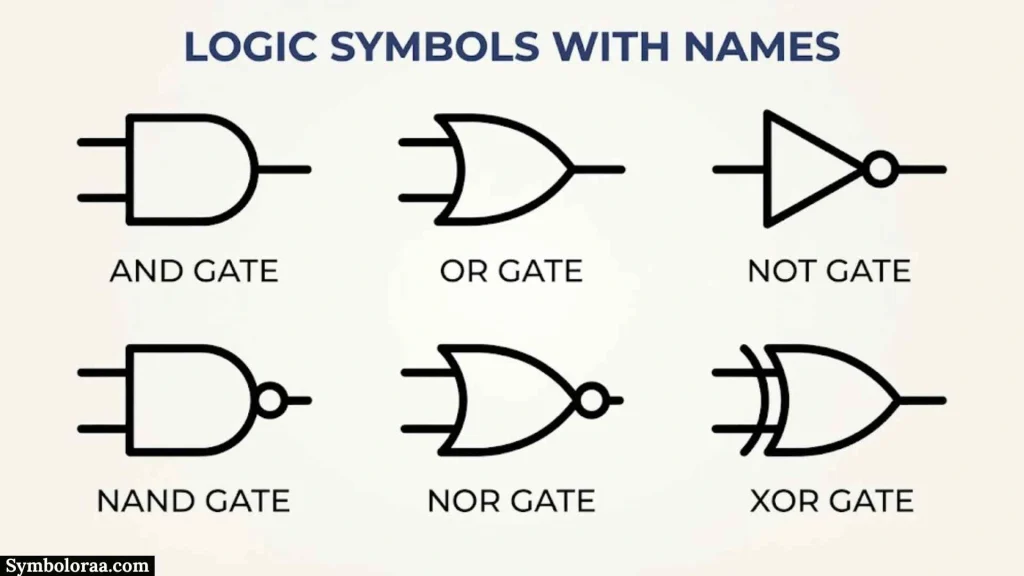
Mathematical logic uses symbols to express relationships between statements.
Not Symbol (¬)
The not symbol (¬) negates a proposition.
If P means:
It is raining.
then:
¬P
means:
It is not raining.
And Symbol (∧)
The logical AND symbol (∧) combines two propositions where both conditions are required.
Example:
P ∧ Q
can be read as “P and Q.”
Or Symbol (∨)
The logical OR symbol (∨) represents an alternative.
Example:
P ∨ Q
can be read as “P or Q.”
The exact logical interpretation depends on the formal system being used.
Implies Symbol (⇒)
The implies symbol (⇒) indicates a logical implication.
Example:
P ⇒ Q
This can be read as:
P implies Q.
If and Only If Symbol (⇔)
The if-and-only-if symbol (⇔) indicates logical equivalence.
Example:
P ⇔ Q
This means P is true if and only if Q is true.
Therefore Symbol (∴)
The therefore symbol (∴) indicates a conclusion.
Example:
a = b
b = c
∴ a = c
Because Symbol (∵)
The because symbol (∵) can introduce a reason.
Example:
x = 5 ∵ x was given as 5
Probability and Statistics Symbols
Statistics uses mathematical symbols to describe data, averages, variation, probability, and distributions.
Probability Symbol P
P is commonly used to represent probability.
Example:
P(A)
means the probability of event A.
Conditional Probability Symbol (|)
The vertical bar can mean “given” in probability.
Example:
P(A | B)
This is read as the probability of A given B.
Sample Mean Symbol (x̄)
The x-bar (x̄) commonly represents the arithmetic mean of a sample.
For three values:
x̄ = (x₁ + x₂ + x₃)/3
Population Mean Symbol (μ)
The Greek letter μ (mu) is commonly used to represent a population mean.
Standard Deviation Symbol (σ)
The Greek letter σ (sigma) commonly represents population standard deviation.
Variance Symbol (σ²)
The expression σ² commonly represents population variance.
Capital Sigma (Σ)
Capital sigma Σ is used for summation.
It appears frequently in statistical formulas.
Greek Mathematical Symbols and Their Names
Greek letters are widely used throughout mathematics and related sciences.
| Symbol | Name | Common Uses |
| α | Alpha | Angle, coefficient |
| β | Beta | Angle, coefficient |
| γ | Gamma | Angle, coefficient |
| δ | Delta | Small change |
| Δ | Capital Delta | Change or difference |
| ε | Epsilon | Small quantity |
| θ | Theta | Angle |
| λ | Lambda | Parameter, wavelength, eigenvalue |
| μ | Mu | Mean, parameter |
| π | Pi | Circle constant |
| ρ | Rho | Density, correlation |
| σ | Sigma | Standard deviation |
| Σ | Capital Sigma | Summation |
| τ | Tau | Parameter, angle, torque |
| φ | Phi | Angle, ratio |
| ω | Omega | Angular frequency |
A Greek letter should not automatically be assigned one meaning simply because it has a familiar use elsewhere.
For example, σ commonly represents standard deviation in statistics, but it can represent other quantities in mathematics, physics, or engineering.
Common Mathematical Symbols by Category
This table provides a quick reference for readers who want to find a symbol by subject.
| Category | Symbol | Name |
| Arithmetic | + | Plus |
| Arithmetic | − | Minus |
| Arithmetic | × | Multiplication |
| Arithmetic | ÷ | Division |
| Equality | = | Equal |
| Inequality | ≠ | Not equal |
| Inequality | < | Less than |
| Inequality | > | Greater than |
| Inequality | ≤ | Less than or equal to |
| Inequality | ≥ | Greater than or equal to |
| Approximation | ≈ | Approximately equal |
| Algebra | ± | Plus-minus |
| Algebra | ∝ | Proportional to |
| Algebra | ∞ | Infinity |
| Roots | √ | Square root |
| Geometry | ∠ | Angle |
| Geometry | ° | Degree |
| Geometry | ⊥ | Perpendicular |
| Geometry | ∥ | Parallel |
| Geometry | ≅ | Congruent |
| Calculus | lim | Limit |
| Calculus | ∫ | Integral |
| Calculus | ∂ | Partial derivative |
| Calculus | Δ | Change |
| Summation | ∑ | Summation |
| Product | ∏ | Product |
| Sets | ∈ | Element of |
| Sets | ∉ | Not an element of |
| Sets | ∪ | Union |
| Sets | ∩ | Intersection |
| Sets | ⊆ | Subset |
| Sets | ⊇ | Superset |
| Sets | ∅ | Empty set |
| Logic | ¬ | Not |
| Logic | ∧ | And |
| Logic | ∨ | Or |
| Logic | ⇒ | Implies |
| Logic | ⇔ | If and only if |
| Statistics | μ | Population mean |
| Statistics | σ | Standard deviation |
| Statistics | σ² | Variance |
| Statistics | x̄ | Sample mean |
Symbol, Name, Meaning, and Usage: What Is the Difference?
Knowing a symbol’s name is only the first step. A useful mathematical reference should also explain what the symbol does.
For example:
| Symbol | Name | Meaning | Typical Use | Example |
| + | Plus | Addition | Arithmetic | 5 + 2 = 7 |
| − | Minus | Subtraction | Arithmetic | 8 − 3 = 5 |
| ≠ | Not equal | Values differ | Algebra | x ≠ 0 |
| ≈ | Approximately equal | Values are close | Approximation | π ≈ 3.14 |
| ∈ | Element of | Belongs to a set | Set theory | 2 ∈ A |
| ∪ | Union | Combines sets | Set theory | A ∪ B |
| ∩ | Intersection | Shared elements | Set theory | A ∩ B |
| ∑ | Summation | Adds terms | Statistics/calculus | ∑x |
| ∫ | Integral | Integration | Calculus | ∫f(x)dx |
| ∂ | Partial derivative | Derivative of multivariable function | Calculus | ∂f/∂x |
This distinction matters because two symbols may have similar-looking appearances while serving completely different purposes.
Mathematical Symbols That Are Often Confused
Several symbols cause problems for beginners because they look similar or have related meanings.
Minus Sign vs Hyphen
The mathematical minus sign is:
−
A standard text hyphen is:
–
They may look similar on a screen, but they are different characters and serve different purposes.
Multiplication Sign vs Letter X
The multiplication sign is:
×
The variable is:
x
Compare:
5 × 4 = 20
with:
5x
The first uses the multiplication symbol. The second uses x as a variable.
Equal vs Approximately Equal
The equal sign:
=
means exact equality.
The approximately equal sign:
≈
indicates that values are close but not exactly equal.
For example:
2 + 3 = 5
but:
π ≈ 3.14
Less Than vs Greater Than
A simple way to remember < and > is to look at the open side.
In:
3 < 9
the wider opening faces 9, the larger number.
In:
9 > 3
the wider opening faces 9 again.
Union vs Intersection
The symbols:
∪
and:
∩
are frequently confused.
Think of union as bringing sets together.
Think of intersection as finding what they share.
For:
A = {1, 2, 3}
B = {3, 4, 5}
we get:
A ∪ B = {1, 2, 3, 4, 5}
while:
A ∩ B = {3}
Mathematical Symbols With Multiple Meanings
One of the most important lessons about mathematical notation is that context matters.
Delta (Δ)
Delta can represent a change or difference:
Δx
But in another context, Δ may represent a triangle or another mathematical object.
Sigma (σ)
Lowercase sigma can represent standard deviation in statistics.
Capital sigma:
Σ
represents summation.
They look related but serve different purposes.
Pi (π)
Pi is best known as the ratio of a circle’s circumference to its diameter.
For example:
C = 2πr
But Greek letters can also appear in other mathematical notation, so symbols should always be interpreted within their surrounding formula.
Mu (μ)
In statistics:
μ
commonly represents a population mean.
In another technical context, the same character may represent something entirely different.
Lambda (λ)
Lambda can represent different mathematical or scientific quantities, including parameters, eigenvalues, or wavelength depending on the field.
The key rule is simple:
Never determine a symbol’s meaning from its appearance alone. Read the surrounding equation and context.
Mathematical Symbols vs Scientific and Unit Symbols
Mathematical symbols and scientific unit symbols are related but are not the same thing.
For example:
+
is a mathematical operation symbol.
By contrast:
m
can represent the SI unit meter.
NIST distinguishes quantity symbols, unit symbols, descriptive symbols, and mathematical signs in scientific and technical documents. Quantity symbols are generally italicized, while unit symbols follow different conventions.
For example:
v = 20 m/s
contains mathematical notation and unit notation together.
Here:
- v represents a quantity.
- = represents equality.
- 20 is the numerical value.
- m/s represents meters per second.
Understanding this distinction becomes especially important in physics, engineering, chemistry, and technical writing.
Mathematical Symbols in Everyday Life
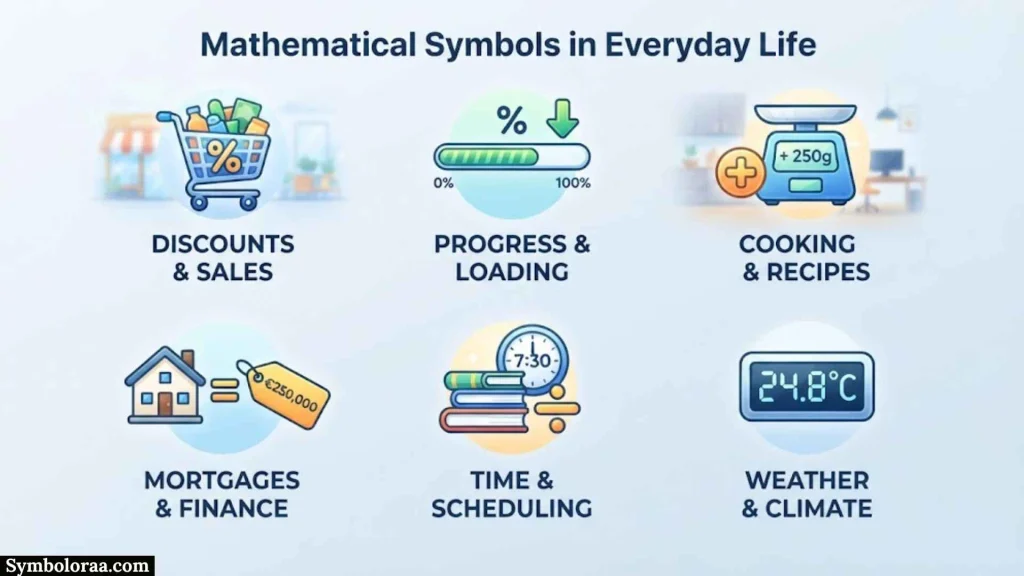
Mathematical notation is not limited to classrooms.
Shopping and Discounts
Percent signs appear constantly in shopping.
Example:
30% off
If an item costs $100, a 30% discount represents $30 off the original price.
Business and Finance
Businesses use mathematical symbols for:
- Percentages
- Growth rates
- Ratios
- Profit calculations
- Interest
- Statistical analysis
For example:
Revenue ↑ 10%
may be used informally in a report to indicate an increase, although formal mathematical writing would normally state the relationship more precisely.
Engineering
Engineers use mathematical notation to describe:
- Speed
- Force
- Energy
- Pressure
- Electrical quantities
- Geometry
- Structural measurements
NIST provides guidance for consistent scientific and technical use of symbols and quantities.
Science
Scientific formulas depend heavily on mathematical notation.
For example:
E = mc²
uses equality, multiplication by implication, an exponent, and variables to express a physical relationship.
Education
Students progressively encounter mathematical symbols in:
- Elementary arithmetic
- Pre-algebra
- Algebra
- Geometry
- Trigonometry
- Statistics
- Calculus
- Discrete mathematics
Learning symbols in this order can make advanced notation easier to understand.
How to Choose the Correct Mathematical Symbol
When you are unsure which symbol to use, identify the relationship you want to communicate first.
Decision Guide
Are you combining numbers?
↓
Use +
Are you taking one quantity away from another?
↓
Use −
Are you multiplying?
↓
Use ×, a centered dot, or appropriate algebraic notation.
Are you dividing?
↓
Use ÷, a fraction bar, or another appropriate division notation.
Are two expressions exactly equal?
↓
Use =
Are they close but not exactly equal?
↓
Use ≈
Are you comparing two values?
↓
Use <, >, ≤, ≥, or ≠
Are you describing a set relationship?
↓
Use symbols such as ∈, ∉, ∪, ∩, ⊆, or ⊇
Are you describing change?
↓
Consider Δ
Are you adding a sequence of terms?
↓
Use ∑
Are you multiplying a sequence of terms?
↓
Use ∏
Are you working with derivatives or integrals?
↓
Consider d/dx, ∂, or ∫
This approach is more useful than memorizing symbols without understanding their purpose.
How to Type Mathematical Symbols
There are several ways to use mathematical symbols in digital documents.
Copy and Paste
For frequently used symbols, you can copy them directly:
+ − × ÷ = ≠ < > ≤ ≥ ≈ ± √ ∞ ∝ π ∑ ∏ ∫ ∂ Δ ∈ ∉ ∪ ∩ ⊆ ⊇ ∅
This is useful for:
- School assignments
- Websites
- Notes
- Presentations
- Educational articles
- Documents
Unicode Characters
Many individual mathematical symbols are available as Unicode characters.
This makes it possible to display symbols such as:
√, ∞, π, ∑, ∫, ≤, ≥
as text.
However, Unicode does not replace mathematical equation markup for every situation. Complex equations often need an equation editor or mathematical typesetting system.
Equation Editors
For complicated expressions involving:
- Fractions
- Integrals
- Matrices
- Limits
- Superscripts
- Subscripts
- Large brackets
an equation editor is often more practical than manually inserting individual Unicode characters.
Common Mistakes When Using Mathematical Symbols
Using x Instead of ×
Writing:
5×4
can be confusing because x may be interpreted as a variable.
For a clear multiplication expression, use:
5 × 4
Using = for Approximation
Avoid writing:
π = 3.14
when you mean that 3.14 is a rounded approximation.
Prefer:
π ≈ 3.14
Confusing ≤ With <
These symbols are not interchangeable.
x < 10
does not include 10.
x ≤ 10
does include 10.
Confusing ∪ With ∩
Union and intersection represent different set operations.
∪ combines elements.
∩ identifies shared elements.
Assuming Every Symbol Has One Meaning
A symbol may change meaning depending on the field.
For example, μ, σ, Δ, and λ can represent different quantities in different contexts.
Ignoring Mathematical Typography
Mathematical and scientific documents use conventions for variables, functions, quantities, units, subscripts, and superscripts.
NIST guidance notes that quantity symbols are generally italicized, while unit symbols use different typographic conventions.
Following established notation makes technical writing easier to read and reduces ambiguity.
How to Learn Mathematical Symbols Faster
Trying to memorize hundreds of symbols at once is usually unnecessary.
A better approach is to learn them by category.
Step 1: Learn Arithmetic Symbols
Start with:
+ − × ÷ =
These are the foundation of basic mathematics.
Step 2: Learn Comparison Symbols
Then learn:
< > ≤ ≥ ≠ ≈
Practice them with actual numbers.
Step 3: Learn Algebraic Symbols
Move to:
± √ ∝ ∞
and learn how they appear in equations.
Step 4: Learn Geometry Symbols
Study:
∠ ° ⊥ ∥ ≅ ∼
Use diagrams when possible.
Step 5: Learn Set and Logic Symbols
Practice:
∈ ∉ ∪ ∩ ⊆ ⊇ ∅ ¬ ∧ ∨ ⇒ ⇔
Step 6: Learn Advanced Symbols
Once the basics are comfortable, study:
∑ ∏ ∫ ∂ Δ μ σ π
This category-based method connects each symbol to a practical purpose rather than requiring isolated memorization.
Best Practices for Using Mathematical Symbols
Good mathematical notation should be clear, consistent, and appropriate for the subject.
Use Standard Symbols
Prefer widely recognized notation when writing for a general audience.
Define Specialized Symbols
If an equation introduces an unfamiliar symbol, explain it.
For example:
P = probability of event A
Then use the symbol consistently.
Keep Meaning Consistent
Do not use the same symbol to represent two unrelated quantities within one equation or section unless the context clearly changes.
Explain Advanced Notation
If your readers are beginners, introduce specialized symbols before using them repeatedly.
Consider the Audience
A university mathematics paper can use advanced notation without explaining every basic symbol.
A beginner tutorial should explain notation more carefully.
Frequently Asked Questions About Mathematical Symbols
What Are the Most Common Mathematical Symbols?
Some of the most common are +, −, ×, ÷, =, <, >, ≤, ≥, ≠, √, %, and ≈.
These symbols appear frequently in arithmetic, algebra, measurements, and everyday calculations.
What Is the Symbol for Equal?
The symbol for equal is:
=
It indicates that two expressions have the same value.
What Is the Symbol for Not Equal?
The symbol is:
≠
For example:
5 ≠ 8
means 5 is not equal to 8.
What Is the Symbol for Approximately Equal?
The commonly used symbol is:
≈
It indicates that two values are close but not exactly equal.
What Is the Symbol for Infinity?
The infinity symbol is:
∞
It represents an unbounded concept rather than an ordinary finite number.
What Does ∈ Mean?
∈ means “is an element of” or “belongs to.”
Example:
3 ∈ {1, 2, 3}
What Does ∑ Mean?
∑ is the capital Greek letter sigma used as the summation symbol.
It tells you to add a sequence of terms according to specified limits or indexing.
What Does ∫ Mean?
∫ is the integral symbol.
It is used in calculus for integration and represents accumulation in many mathematical applications.
What Is the Difference Between ∪ and ∩?
∪ means union.
∩ means intersection.
Union combines the elements of sets, while intersection identifies elements shared by the sets.
What Does Δ Mean in Mathematics?
Δ is the Greek letter delta. It is often used to represent a change or difference, such as Δx for a change in x.
Its exact meaning depends on context.
Why Are Greek Letters Used in Mathematics?
Greek letters provide a large set of distinct symbols for variables, constants, parameters, angles, statistical quantities, and scientific measurements.
For example:
- π — pi
- μ — population mean in common statistical notation
- σ — standard deviation in common statistical notation
- θ — often an angle
- λ — often a parameter or eigenvalue
Their meanings depend on context.
Are Mathematical Symbols the Same Everywhere?
Many mathematical symbols are widely recognized internationally, but notation can vary between subjects, textbooks, countries, and mathematical traditions.
This is why formal standards and subject-specific conventions are useful.
ISO 80000-2 provides an international reference for mathematical symbols, meanings, verbal equivalents, and applications.
Are Mathematical Symbols the Same as Unit Symbols?
No.
A mathematical symbol such as + represents an operation, while a unit symbol such as m represents a measurement unit.
Scientific expressions often combine both.
Example:
v = 20 m/s
NIST separately describes mathematical signs, quantity symbols, and unit symbols in its guidance for scientific and technical documents.
Which Mathematical Symbols Should Students Learn First?
Students should generally begin with basic arithmetic and comparison symbols:
+ − × ÷ = < > ≤ ≥ ≠
After that, they can learn roots, powers, geometry notation, set symbols, statistics symbols, and calculus notation as their coursework requires.
Key Takeaways
- Mathematical symbols provide a compact way to communicate mathematical ideas.
- +, −, ×, and ÷ represent the basic arithmetic operations.
- =, ≠, <, >, ≤, and ≥ describe relationships between values.
- ≈ is used for approximate equality.
- ± represents plus-or-minus possibilities.
- √ represents a square root.
- ∞ represents an unbounded concept.
- ∝ indicates proportionality.
- ∠, °, ⊥, and ∥ are commonly used in geometry.
- ∫, ∂, and lim are important calculus notation.
- ∑ represents summation, while ∏ represents a product.
- ∈, ∉, ∪, ∩, ⊆, and ⊇ are important set-theory symbols.
- ¬, ∧, ∨, ⇒, and ⇔ are common logic symbols.
- Greek letters such as π, μ, σ, θ, and λ can have specialized meanings.
- A mathematical symbol’s meaning should always be interpreted in context.
- Mathematical symbols should not be confused with scientific quantity symbols or SI unit symbols.
- ISO 80000-2 provides an international reference for mathematical symbols and their meanings and applications.
- NIST provides detailed guidance on the use and presentation of mathematical and scientific symbols in technical documents.
Conclusion
A good understanding of mathematical symbols makes equations easier to read, write, and explain. The most familiar symbols, such as +, −, ×, ÷, and =, form the foundation of mathematics, while symbols such as ∑, ∫, ∂, ∈, ∪, and ⇔ become important in advanced subjects.
The most important lesson is that learning a symbol means understanding more than its name. You should know what it means, when it is used, how it is read, and whether its meaning changes with context.
For quick reference, use the symbol tables in this guide. For formal mathematical or technical writing, follow the notation conventions used in your course, field, textbook, or applicable standard.

I’m Ethan Brooks, an American writer passionate about stories that explore modern life, relationships, ambition, and personal growth. I love creating characters who feel real and face challenges readers can recognize. Through my writing, I hope to entertain, inspire, and encourage readers to see everyday experiences from a different perspective.
Three Books:
The City Between Us
After the Last Goodbye
A Different Tomorrow
 Jackson Miller
 Madison Reed