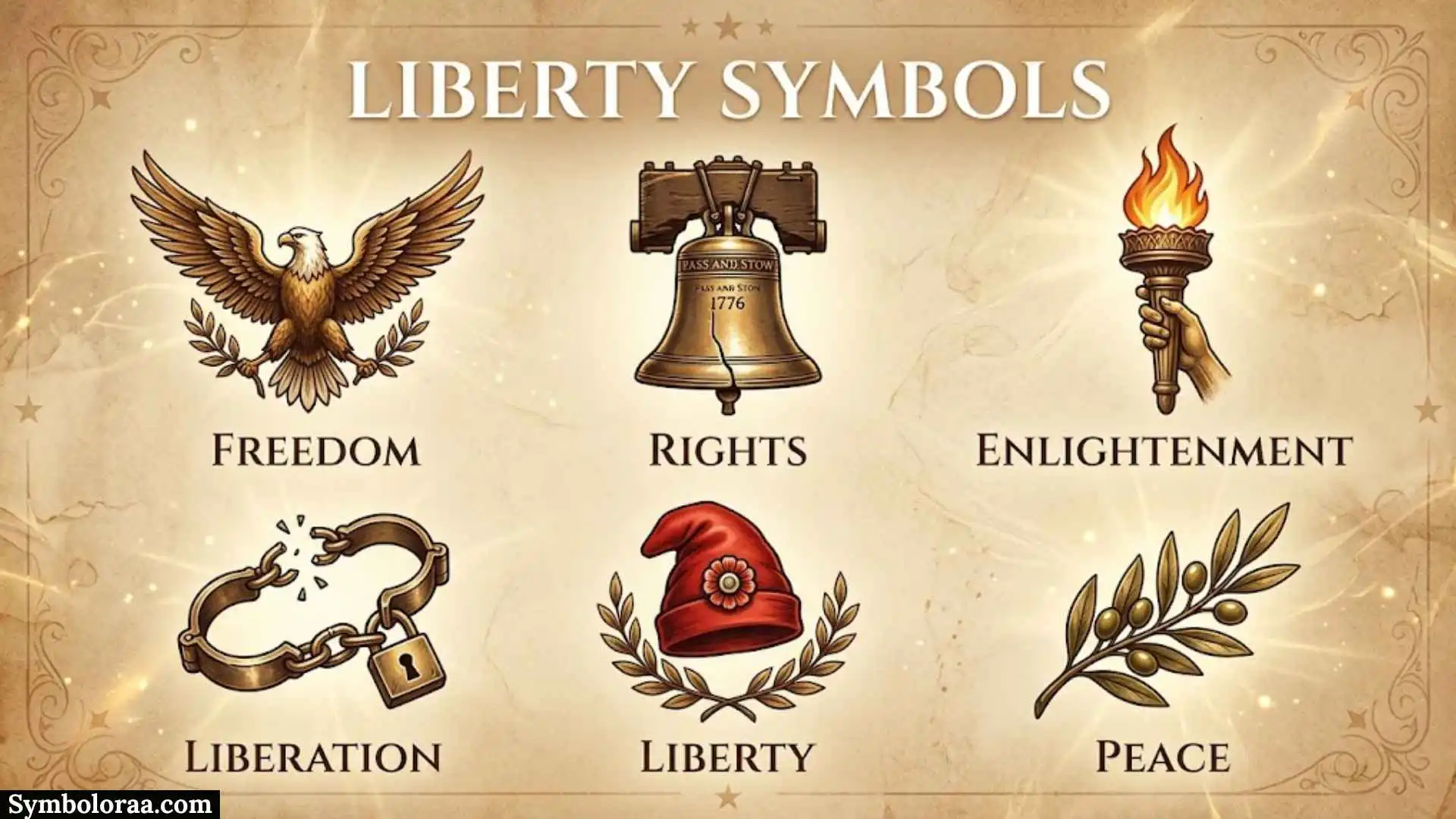
Liberty symbols are visual representations of freedom, independence, human rights, liberation, equality, and resistance to oppression. Some are famous worldwide, such as the Statue of Liberty and Liberty Bell, while others including broken chains, torches, eagles, doves, and raised fists represent specific aspects of freedom.
The meaning of a liberty symbol depends on its history and context. A broken chain usually communicates liberation from restraint, while a torch can represent enlightenment and hope. An eagle may suggest independence and sovereignty, whereas a dove is more strongly associated with peace and can represent peaceful freedom in the right context.
This guide explains the most important liberty symbols, where their meanings come from, how they differ from symbols of freedom and independence, and how to choose an appropriate symbol for a particular message.
Quick Answer: What Are Liberty Symbols?
Liberty symbols are images, objects, monuments, gestures, or artistic representations used to communicate freedom from oppression, individual rights, independence, self-government, equality, or the ability to make choices without unjust restraint.
There is no single universal liberty symbol. Different cultures, countries, historical periods, and political movements have used different imagery to express the idea of liberty.
Some of the best-known examples include:
- Statue of Liberty — liberty, enlightenment, independence, and liberation
- Liberty Bell — liberty, equality, and civic ideals
- Broken chains — liberation from bondage or oppression
- Torch or flame — enlightenment, hope, and guidance
- Eagle — independence, strength, and sovereignty
- Dove — peace and, in some contexts, peaceful freedom
- Raised fist — resistance, solidarity, and political struggle
- Personified Liberty — freedom represented as a human figure
- Open doors or gates — release, opportunity, and freedom of movement
- Birds in flight — freedom and release from confinement
The important distinction is that not every freedom-related image has exactly the same meaning. Historical context determines how a symbol should be interpreted.
Key Takeaways About Liberty Symbols
Before looking at individual symbols, several principles make their meanings easier to understand.
Liberty Is Broader Than Physical Freedom
Liberty does not simply mean being physically free.
A person can be physically unrestricted but still lack important civil or political rights. In political and legal contexts, liberty can involve rights, participation, protection under law, and freedom from unjust government interference.
That is why liberty symbols can represent much more than escape from captivity.
Symbols Can Represent Ideals Rather Than Reality
A monument or image may represent an ideal that a society is trying to achieve rather than something that has always existed perfectly.
For example, the Statue of Liberty is associated with freedom and equality, but the historical United States did not provide those ideals equally to everyone when the monument was dedicated in 1886.
This distinction matters when interpreting historical symbols. A symbol expresses an idea; history determines how successfully that idea was put into practice.
Symbolic Meanings Can Change
A symbol can acquire additional meanings over time.
The Liberty Bell is a good example. Although its original purpose was connected to civic communication, it later became strongly associated with liberty. Abolitionists and other reform movements subsequently adopted it for their own causes.
Therefore, the original meaning of a symbol and its later cultural meaning are not always identical.
The Most Famous Liberty Symbols and Their Meanings
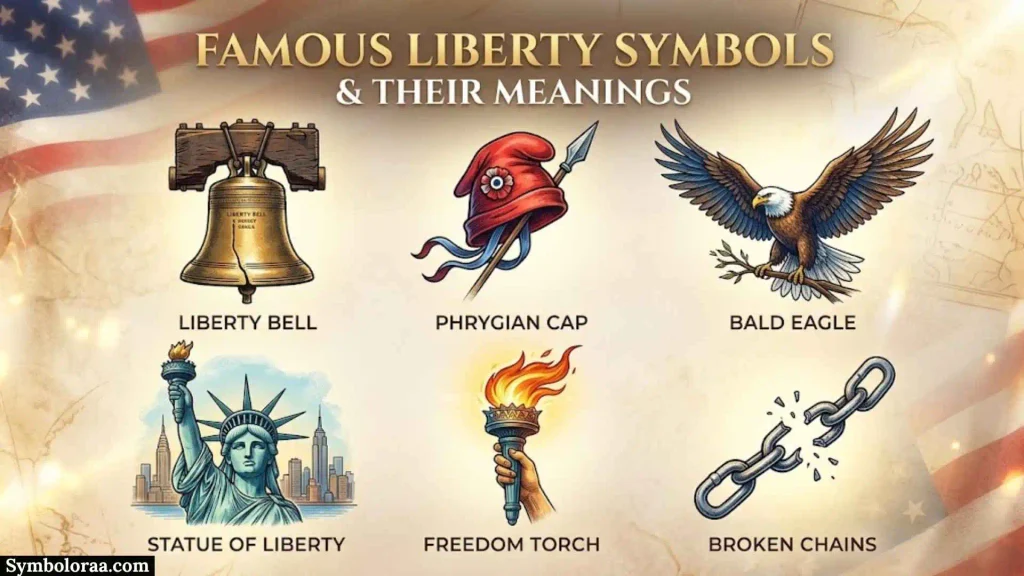
Different liberty symbols communicate different aspects of freedom. Understanding the specific symbolism behind each one is more useful than treating all of them as interchangeable.
Statue of Liberty
The Statue of Liberty is perhaps the most recognizable monument associated with liberty anywhere in the world.
Its formal name is Liberty Enlightening the World. The monument was a gift from France to the United States and was dedicated in 1886.
The National Park Service explains that the statue contains several symbolic elements, including the torch, tablet, and broken chains.
The statue’s major elements include:
- Torch — enlightenment and guidance
- Tablet — law and the American Declaration of Independence
- Broken chains and shackles — liberation from bondage
- Seven rays of the crown — traditionally interpreted as representing the seven seas and seven continents
- Female figure — personification of Liberty
The tablet is inscribed with JULY IV MDCCLXXVI, referring to July 4, 1776.
The broken chains at the statue’s feet are especially important because they represent liberation from oppression and bondage.
The monument therefore combines several related concepts rather than communicating only one meaning.
Liberty Bell
The Liberty Bell is another major symbol associated with liberty in the United States.
Its famous inscription comes from the biblical Book of Leviticus and calls for liberty to be proclaimed throughout the land. The National Park Service explains that the bell became an important symbol of liberty during the 19th century and was adopted by abolitionists and later movements.
Its symbolism includes:
- Liberty
- Equality
- Civic responsibility
- Independence
- Opposition to slavery
- Civil rights
An important historical detail is that the bell was not originally named the “Liberty Bell.” It was known as the State House Bell before its later association with liberty developed.
That evolution illustrates how public symbols can acquire new meanings through social and political movements.
Broken Chains
Broken chains are one of the easiest liberty symbols to understand.
A chain represents restraint. Breaking that chain represents release.
The image can therefore symbolize:
- Liberation from slavery
- Freedom from imprisonment
- Political liberation
- Escape from oppression
- Personal independence
- Breaking restrictive circumstances
The broken chain is also incorporated into the Statue of Liberty, where broken shackles and chains appear near the statue’s feet.
This symbol is particularly effective when the intended message is freedom from something.
Torch
A torch or flame commonly represents light overcoming darkness.
In liberty symbolism, that idea can become a metaphor for knowledge, enlightenment, hope, and guidance.
The torch held by the Statue of Liberty is one of the world’s most recognizable examples. The National Park Service connects it with enlightenment and the idea of lighting the way toward liberty.
A torch is particularly appropriate when the intended message involves:
- Enlightenment
- Knowledge
- Hope
- Progress
- Guidance
- A continuing commitment to freedom
Unlike broken chains, which emphasize liberation from restraint, a torch emphasizes the positive direction that freedom can provide.
Eagle
The eagle is frequently associated with freedom, independence, courage, strength, and sovereignty.
In the United States, the bald eagle has a particularly important national role. The Library of Congress lists the bald eagle among major symbols of the United States.
The eagle’s ability to fly contributes to its association with freedom, while its strength can suggest power and independence.
However, an eagle should not automatically be interpreted as a liberty symbol in every situation.
Depending on context, it may instead represent:
- National identity
- Military strength
- Authority
- Leadership
- Sovereignty
- Power
The surrounding imagery determines the intended meaning.
Dove
The dove is primarily a symbol of peace, not liberty.
However, peace and liberty can overlap when freedom is presented as life without violence, persecution, or conflict.
A dove flying freely may therefore communicate:
- Peace
- Hope
- Reconciliation
- Nonviolence
- Peaceful freedom
For this reason, the dove can work well in a design about peaceful liberation, but it is less precise than broken chains when the intended message is specifically freedom from oppression.
Raised Fist
The raised fist is commonly associated with resistance, solidarity, protest, and empowerment.
It has appeared in numerous political and social movements, so its meaning is highly dependent on context.
When used as a liberty symbol, it can communicate:
- Resistance to oppression
- Political freedom
- Solidarity
- Equality
- Empowerment
- Social change
The raised fist is therefore stronger as a symbol of active resistance for liberty than as a neutral representation of freedom.
Personified Liberty
Liberty has often been represented as a human figure, particularly a woman.
This tradition is much older than the Statue of Liberty. In classical and later Western art, abstract ideas such as liberty, justice, and victory were frequently represented as human figures.
The Statue of Liberty continues this tradition by presenting Liberty as a monumental female figure.
Personification is useful because it turns an abstract idea into something visually recognizable.
Instead of simply writing “freedom,” an artist can depict Liberty as a person carrying symbolic objects such as a torch, tablet, crown, or staff.
Liberty Symbols at a Glance
The following table shows the primary idea associated with several well-known symbols.
| Symbol | Main Meaning | Other Possible Meanings | Best Used For |
| Statue of Liberty | Liberty | Enlightenment, independence, liberation | General liberty |
| Liberty Bell | Liberty | Equality, civic rights, independence | Historical American liberty |
| Broken chains | Liberation | Resistance, emancipation | Freedom from oppression |
| Torch | Enlightenment | Hope, knowledge, progress | Freedom through awareness |
| Eagle | Independence | Strength, sovereignty, national identity | National liberty |
| Dove | Peace | Hope, peaceful freedom | Nonviolent freedom |
| Raised fist | Resistance | Solidarity, empowerment | Activism and struggle |
| Open door | Opportunity | Escape, new beginning | Personal freedom |
| Bird in flight | Freedom | Release, independence | Personal or artistic freedom |
| Liberty figure | Liberty | Justice, law, enlightenment | Abstract or civic ideals |
The table should be read as a guide rather than a strict dictionary. Symbols can have different meanings depending on their cultural and historical setting.
Liberty, Freedom, and Independence: What’s the Difference?
These three concepts overlap, but they are not always interchangeable.
Liberty
Liberty often emphasizes the rights and conditions that allow people to live and act without unjust restraint.
Examples include civil liberties, political liberty, and individual liberty.
Freedom
Freedom is a broader everyday term describing the ability to act, choose, or live without excessive restriction.
It can describe physical, personal, political, or social freedom.
Independence
Independence usually emphasizes freedom from external control.
A country gaining independence from another country is a classic example.
This distinction helps explain why different symbols work better for different messages.
A broken chain may communicate personal liberation, while a national flag may communicate political independence.
Liberty Symbols and Their Historical Background
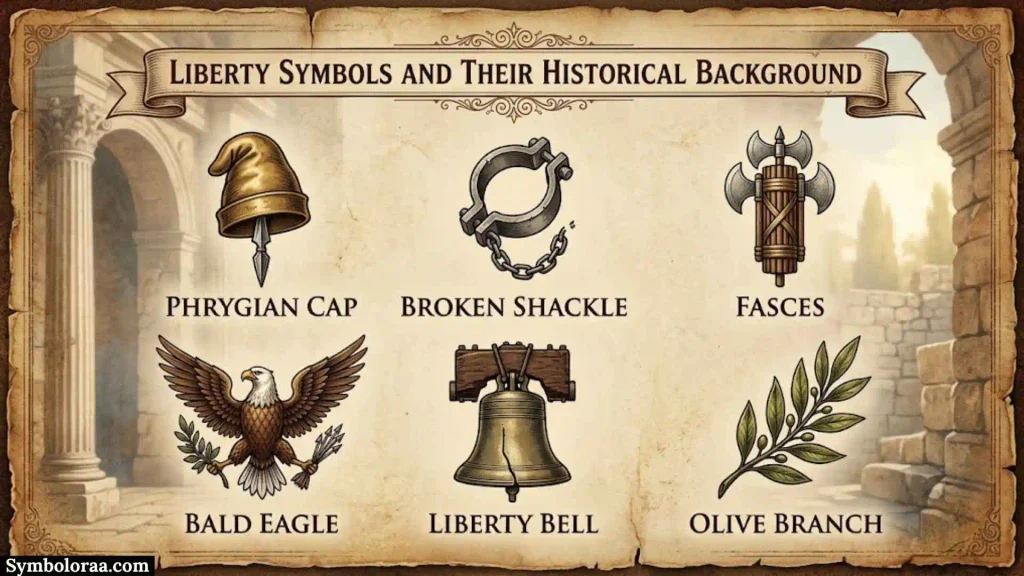
The history of liberty symbolism is closely connected with political philosophy, revolution, abolition, civil rights, and struggles against authoritarian control.
Ancient Personifications of Liberty
The practice of representing abstract political concepts as human figures has ancient roots.
Liberty could be personified as a female figure, allowing artists and governments to give a visible form to an otherwise abstract concept.
This tradition influenced later European and American representations of Liberty.
The American Revolution
The American Revolution produced an enduring collection of symbols connected with independence and self-government.
Documents, bells, flags, eagles, and other national imagery became associated with the political ideals of the new nation.
The date 1776 is especially important in American liberty symbolism because of the Declaration of Independence.
Abolitionist Movements
Liberty symbolism took on another important role during campaigns against slavery.
Images of broken chains and shackles directly communicated emancipation.
The Liberty Bell was also adopted by abolitionists, who connected its famous liberty inscription with the demand to end slavery.
This history demonstrates that liberty symbolism can become a tool for challenging the gap between a nation’s stated ideals and the lived experience of its people.
Civil Rights Movements
Liberty imagery continued to be used during struggles for civil rights and equality.
The meaning of liberty expanded beyond national independence to include questions such as:
- Who has the right to vote?
- Who receives equal protection?
- Who can participate in government?
- Who is protected from discrimination?
- Who has freedom of expression?
- Who can exercise their rights without intimidation?
As a result, liberty symbols can represent both historical independence and continuing demands for equality.
Liberty Symbols in Different Contexts
The same symbol can communicate something different depending on where and how it is used.
In National Monuments
National monuments often use liberty imagery to communicate a country’s political ideals.
The Statue of Liberty is a clear example because multiple symbols are combined into one monument.
In Political Movements
Activist movements may use broken chains, raised fists, banners, and other imagery to represent resistance.
Here the emphasis is often on achieving liberty rather than simply celebrating it.
In Education
Teachers may use liberty symbols to introduce historical concepts such as independence, abolition, civil rights, constitutional government, and democracy.
A symbol can provide students with a visual entry point into a complicated historical subject.
In Art
Artists can use liberty symbolism more creatively.
A bird leaving a cage, for example, can represent personal liberation without referring to a specific historical event.
In Tattoos
Liberty-related tattoos may represent personal independence, recovery from difficult circumstances, political beliefs, or a major life transition.
The meaning should be considered carefully because some symbols carry strong political or historical associations.
In Jewelry and Gifts
Broken chains, wings, torches, and freedom-themed designs can be used as personal reminders of independence or overcoming restrictions.
The intended meaning is often more personal than historical.
How to Choose the Right Liberty Symbol
Choosing a liberty symbol becomes easier when you first decide what kind of liberty you want to represent.
Step 1: Identify the Message
Ask what you actually want the symbol to communicate.
Is it:
- Freedom from oppression?
- Personal independence?
- National sovereignty?
- Political rights?
- Hope?
- Enlightenment?
- Peace?
- Resistance?
Step 2: Match the Symbol to the Message
Use the following quick decision guide:
Want to represent liberation from oppression?
→ Choose broken chains or shackles.
Want to represent knowledge and enlightenment?
→ Choose a torch or flame.
Want a widely recognized general symbol of liberty?
→ Consider the Statue of Liberty.
Want historical American liberty?
→ Consider the Liberty Bell.
Want national independence or sovereignty?
→ An eagle or national symbol may be more appropriate.
Want peaceful freedom?
→ Consider a dove or another peace-oriented image.
Want resistance against oppression?
→ Consider a raised fist, while recognizing its political associations.
Want a personal interpretation of freedom?
→ An open door, bird in flight, wings, or broken cage can provide a more flexible metaphor.
How to Interpret a Liberty Symbol Correctly
Symbol interpretation should follow context rather than assumptions.
Look at the Surrounding Imagery
A single eagle can mean many things. An eagle combined with a flag may emphasize national identity, while an eagle flying away from a cage could emphasize personal freedom.
Consider Historical Context
Ask when and where the symbol was created.
A symbol from an abolitionist movement may have a different emphasis than a modern commercial logo using the same image.
Separate Original Meaning From Later Meaning
Symbols often evolve.
The Liberty Bell is particularly useful for understanding this process because its association with liberty became much stronger over time.
Avoid Treating Symbolism as Universal
A symbol’s meaning can vary between cultures.
For example, an eagle can have religious, political, imperial, national, or freedom-related meanings depending on the society using it.
Common Mistakes When Choosing Liberty Symbols
Choosing a Symbol Only Because It Looks Good
Visual appeal is important in design, but symbolism matters more when the goal is to communicate a specific message.
A beautiful eagle does not necessarily communicate personal freedom.
Assuming Every Flying Bird Means Liberty
Birds can represent freedom, but different species carry different symbolic traditions.
A dove is strongly associated with peace, while an eagle may communicate strength and sovereignty.
Ignoring Political Associations
Some symbols are strongly associated with particular movements.
A raised fist, for example, may communicate resistance and solidarity rather than general, neutral freedom.
Confusing Liberty With Independence
A symbol representing national independence may not be the best choice when the intended message is personal liberty.
Clarifying the intended message prevents this mistake.
Removing Historical Context
A symbol may have a complicated history.
Using it without understanding that history can produce an inaccurate or misleading message.
Expert Tips for Using Liberty Symbols in Design
Use One Primary Message
If a design needs to communicate freedom from oppression, broken chains may be more effective than combining five unrelated symbols.
Combine Symbols When the Meanings Complement Each Other
The Statue of Liberty demonstrates how several symbols can work together.
A torch can represent enlightenment, a tablet can reference law and independence, and broken chains can represent liberation.
Consider the Audience
A symbol that is obvious to an American audience may be less obvious internationally.
If the audience is global, adding a short explanation can make the intended meaning clearer.
Check Cultural and Political Context
Before using a symbol commercially, academically, or publicly, research its historical associations.
This is particularly important for political gestures and national symbols.
Liberty Symbols vs. Freedom Symbols
The terms are often used interchangeably, but there is a useful distinction for content and design.
| Concept | Main Emphasis | Example |
| Liberty | Rights and freedom from unjust restraint | Liberty Bell |
| Freedom | Ability to choose or act without undue restriction | Bird in flight |
| Independence | Freedom from external control | National independence symbol |
| Liberation | Release from oppression or captivity | Broken chains |
| Equality | Equal status and rights | Civil-rights imagery |
| Resistance | Active opposition to oppression | Raised fist |
| Enlightenment | Knowledge supporting freedom | Torch |
| Peace | Freedom from violence and conflict | Dove |
These categories overlap. A single symbol can represent several concepts simultaneously.
Why Liberty Symbols Are Still Important Today
Liberty remains a major theme in discussions about society, government, rights, and human dignity.
Modern debates can involve:
- Freedom of expression
- Voting rights
- Civil liberties
- Equal protection
- Political participation
- Freedom of movement
- Individual autonomy
- Government authority
- Human rights
- Freedom from discrimination
Symbols make these abstract ideas easier to communicate.
A broken chain can represent liberation in a single image. A torch can suggest hope and enlightenment. A bell can evoke a historical call for liberty.
Their continuing use demonstrates that symbols can preserve historical memory while also acquiring new meanings.
Frequently Asked Questions About Liberty Symbols
What is the most famous symbol of liberty?
The Statue of Liberty is one of the world’s most recognizable symbols of liberty. Its torch, tablet, female personification of Liberty, and broken chains combine several ideas associated with freedom and liberation.
What symbol represents freedom from oppression?
Broken chains or broken shackles are among the clearest symbols of freedom from oppression because they visually represent the end of restraint or bondage.
What does the Statue of Liberty symbolize?
The Statue of Liberty symbolizes liberty and enlightenment and incorporates ideas connected with independence, law, and liberation. Its broken chains represent liberation from bondage, while its torch represents enlightenment.
What does the Liberty Bell symbolize?
The Liberty Bell is associated with liberty, equality, and civic ideals. Its later history includes use by abolitionists and other movements advocating greater freedom and rights.
Why are broken chains a symbol of liberty?
Chains traditionally represent restraint or captivity. A broken chain therefore represents release, emancipation, liberation, or freedom from oppression.
Why is a torch a symbol of freedom?
A torch can symbolize enlightenment, knowledge, guidance, and hope. These ideas connect to liberty because informed people are better able to understand and exercise their rights.
Is an eagle a symbol of freedom?
An eagle can symbolize freedom, independence, strength, and sovereignty. In the United States, the bald eagle is also an important national symbol.
Is a dove a symbol of liberty?
A dove is primarily a symbol of peace. It can represent peaceful freedom or hope in an appropriate context, but it is not as specific to liberty as broken chains or the Statue of Liberty.
What symbol represents personal freedom?
There is no single universal symbol for personal freedom. Birds in flight, open doors, broken cages, wings, and broken chains can all communicate personal liberation depending on the design.
What symbol represents independence?
Flags, eagles, declarations, national monuments, and other national imagery can represent independence. The best choice depends on whether the intended message is national sovereignty or personal independence.
What symbol represents resistance to oppression?
The raised fist and broken chains are commonly used to communicate resistance or liberation. Their precise meaning depends on the movement and historical context.
Are liberty and freedom symbols the same?
They overlap significantly, but not every freedom symbol specifically represents liberty. Liberty often emphasizes rights and protection from unjust restraint, while freedom is a broader everyday concept.
Why does the Statue of Liberty have broken chains?
The broken chains and shackles at the statue’s feet represent liberation from bondage. The National Park Service identifies them as an important part of the monument’s symbolism.
What does the torch on the Statue of Liberty represent?
The torch represents enlightenment and is intended to convey the idea of lighting the way toward liberty.
Can a liberty symbol have more than one meaning?
Yes. Symbols frequently have multiple meanings. An eagle, for example, can represent freedom, strength, sovereignty, national identity, or authority depending on its context.
References
The following authoritative sources provide historical and institutional information used to explain the major symbols discussed in this article.
- National Park Service — Statue of Liberty National Monument: historical facts and symbolism of the Statue of Liberty.
- National Park Service — Frequently Asked Questions about the Statue of Liberty: information about the torch, tablet, chains, and other features.
- National Park Service — Independence National Historical Park: history and evolving meaning of the Liberty Bell.
- Library of Congress — Symbols of the United States: information about major U.S. national symbols, including the bald eagle.
Conclusion
Liberty symbols give visual form to ideas that can otherwise be difficult to express. The Statue of Liberty combines enlightenment, independence, law, and liberation; the Liberty Bell became a lasting symbol of liberty and equality; and broken chains provide a direct image of freedom from bondage.
Other symbols communicate different aspects of the same broad idea. A torch emphasizes enlightenment and hope, an eagle can represent independence and sovereignty, a dove suggests peaceful freedom, and a raised fist can represent resistance and solidarity.
The most important lesson is that no symbol has one meaning in every situation. Historical background, cultural context, surrounding imagery, and the purpose of the person using the symbol all influence interpretation.
If you are choosing a liberty symbol for a tattoo, logo, artwork, educational project, memorial, jewelry design, or article, start with the message you want to communicate. Choose broken chains for liberation, a torch for enlightenment, the Statue of Liberty for broad liberty, the Liberty Bell for historical American liberty, and context-specific symbols for resistance, peace, or independence.

I’m Madison Reed, a contemporary American author who writes about love, family, friendship, and second chances. I’m fascinated by the choices that shape our lives and the moments that change us forever. My goal is to create honest, emotional stories with characters readers can connect with long after finishing each book.
Three Books:
When We Find Our Way
The Things We Never Said
Summer in September
 Jackson Miller