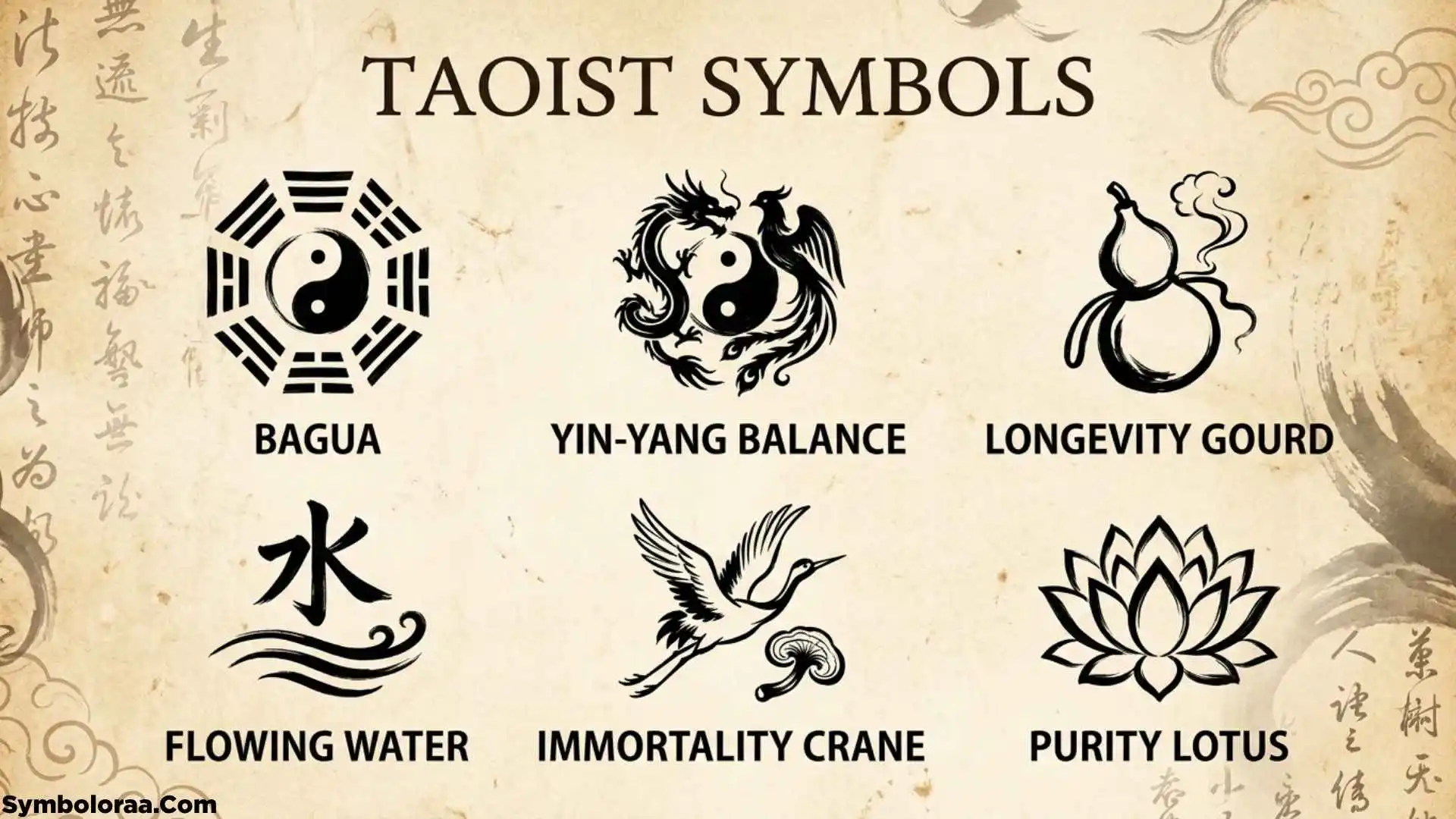
If you are looking for the meaning of Taoist symbols, the most important thing to know is that Taoism does not have one single official symbol that represents the entire tradition. The yin-yang symbol (taijitu) is the image most commonly associated with Taoism, but Taoist traditions also use the Bagua (Eight Trigrams), Five Phases, Taoist talismans, sacred animals, immortality symbols, natural imagery, diagrams, and religious objects.
These symbols communicate ideas about balance, transformation, harmony, nature, spiritual cultivation, and the relationship between visible and invisible aspects of reality. Some originated within broader Chinese philosophy and were later incorporated into Taoist traditions, while others developed specifically within religious Taoism.
This guide explains the most important Taoist symbols, what they mean, where they come from, how they are used, and which symbols are genuinely Taoist versus symbols that are more broadly Chinese. It also covers common misconceptions, modern uses such as tattoos and jewelry, and a practical way to identify Taoist imagery.
Quick Answer: What Are the Main Taoist Symbols?
The most recognizable Taoist-associated symbols include the yin-yang (taijitu), Bagua, Five Phases (wuxing), Taoist talismans (fu), the character Dao (道), and imagery associated with Taoist immortals.
However, there is an important qualification: not every symbol associated with Taoism originated as a specifically Taoist symbol. The Eight Trigrams, yin-yang theory, and Five Phases belong to a much wider history of Chinese thought and were adopted, developed, and interpreted within Taoist traditions. The Art Institute of Chicago specifically notes that the Eight Trigrams were not specific to Taoism but were absorbed into Taoism as organized religious traditions developed.
Key Takeaways
- Yin-yang (taijitu): represents the dynamic relationship of yin and yang.
- Bagua: consists of eight three-line trigrams connected with patterns of change and the Yijing.
- Five Phases (wuxing): Wood, Fire, Earth, Metal, and Water; used to classify relationships and processes.
- Taoist talismans (fu): ritual symbols and written diagrams used within religious practices.
- Dao character (道): represents the Dao, commonly translated as “the Way.”
- Gourd: frequently appears in imagery associated with Taoist immortals, longevity, medicine, and spiritual transformation.
- Crane: can symbolize longevity and immortality in Chinese and Taoist artistic contexts.
- Water, mountains, clouds, and other natural imagery: can communicate Taoist ideas about nature, transformation, stillness, and adaptability.
The key is context. A dragon, crane, cloud, or yin-yang design should not automatically be labeled “Taoist” simply because it appears in Chinese art.
What Does Taoist Symbolism Mean?
Taoist symbolism uses images and diagrams to communicate ideas that can be difficult to express through ordinary language.
At the heart of Taoist thought is the Dao (Tao), often translated as “the Way.” Classical Daoist philosophy associated with texts such as the Daodejing and Zhuangzi developed a complex understanding of how human life relates to the natural world, change, spontaneity, and the underlying course of reality. Scholars also distinguish between philosophical Daoism and the diverse traditions of organized religious Daoism that developed over later centuries.
Symbols provide another way to express these ideas.
A flowing river can suggest adaptability. A mountain can suggest stillness. Yin and yang can illustrate complementary forces. The Eight Trigrams can represent different configurations of yin and yang and patterns of change.
This is why Taoist symbolism is better understood as a network of related concepts rather than a fixed logo system.
Also Check This Post: 75+ Bravery Symbols: Powerful Designs and Their Meanings
The Yin-Yang Symbol: The Most Recognizable Taoist Symbol
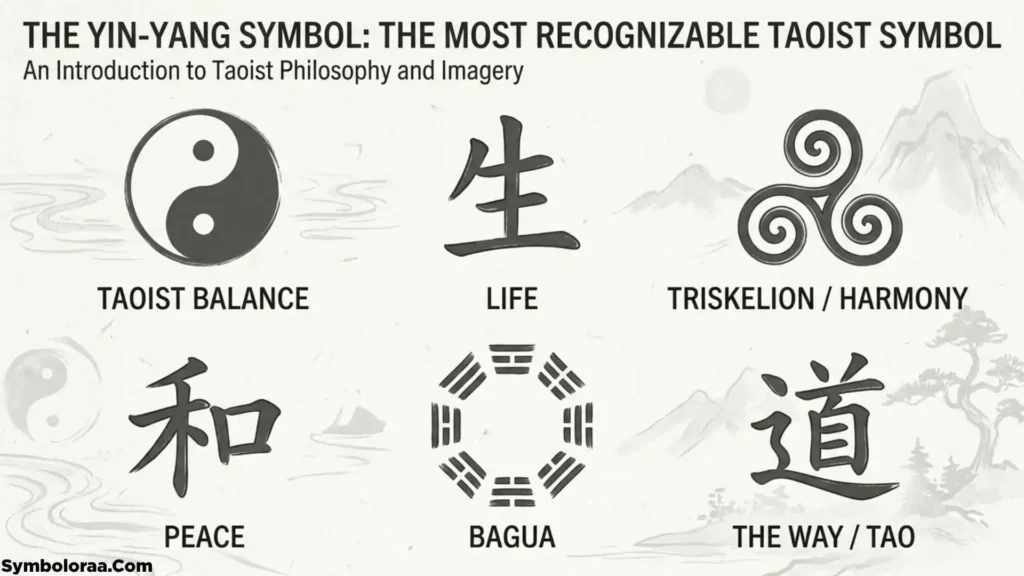
The yin-yang symbol, properly called the taijitu (太極圖) in one of its important diagrammatic forms, is probably the most recognizable image associated with Taoism.
It consists of a circular design divided into two curved sections, traditionally shown in contrasting colors. Each side contains a small portion of the opposite side.
The visual message is powerful: yin and yang are different, but they are not completely separate.
What Do Yin and Yang Mean?
Yin and yang describe complementary aspects of change and relationship.
Traditional associations may include:
| Yin | Yang |
| Dark | Light |
| Receptive | Active |
| Cool | Warm |
| Inward | Outward |
| Stillness | Movement |
| Descending | Rising |
These should not be treated as rigid categories or as a simple division between “bad” and “good.”
That is one of the most common mistakes people make when explaining the symbol.
Yin is not “evil,” and yang is not “good.” The two concepts describe complementary aspects that interact and transform. Yin-yang thought became influential across several areas of Chinese philosophy and traditional culture rather than belonging exclusively to one religious institution.
Why Are There Two Dots in the Yin-Yang Symbol?
The small contrasting circles are commonly interpreted as showing that each side contains the potential or presence of the other.
The design therefore communicates more than simple opposition.
It suggests that:
- Opposites can coexist.
- One side can contain an aspect of the other.
- Conditions change over time.
- Balance is dynamic rather than frozen.
- Extreme conditions can give rise to transformation.
This makes the symbol particularly useful for expressing a central theme found throughout Chinese cosmological thought: change is a process rather than a permanent state.
Is the Yin-Yang Symbol Exclusively Taoist?
No.
This distinction matters for accurate SEO content and, more importantly, historical accuracy.
Yin-yang theory has a long history in Chinese intellectual traditions. The familiar modern black-and-white taijitu became strongly associated with Taoism in modern popular culture, but the history of the diagram is more complicated.
The Art Institute of Chicago notes that the Taiji symbol emerged during the Song period and eventually became the best-known visual representation of yin-yang.
The Internet Encyclopedia of Philosophy likewise discusses the development of diagram traditions during the Song period and the later evolution of recognizable yin-yang imagery.
Therefore, the most accurate statement is:
The yin-yang symbol is strongly associated with Taoism, but yin-yang theory and symbolism belong to the broader history of Chinese thought.
The Bagua: The Eight Trigrams
The Bagua (八卦) means “Eight Trigrams.”
It is one of the most important symbolic systems associated with traditional Chinese cosmology and later Taoist traditions.
Each trigram contains three horizontal lines. A continuous line represents yang, while a broken line represents yin. Three positions with two possible states produce eight possible combinations.
The Art Institute of Chicago describes the Eight Trigrams as configurations of yin and yang that were later incorporated into Taoism, while also emphasizing that they were not originally specific to Taoism.
What Are the Eight Trigrams?
The eight traditional trigrams are commonly named:
| Trigram | Chinese Name | Natural Association |
| ☰ | Qian | Heaven |
| ☷ | Kun | Earth |
| ☳ | Zhen | Thunder |
| ☴ | Xun | Wind |
| ☵ | Kan | Water |
| ☲ | Li | Fire |
| ☶ | Gen | Mountain |
| ☱ | Dui | Lake |
These associations are part of a much larger symbolic system. Different traditions and applications may attach additional meanings involving directions, family relationships, seasons, qualities, and other correspondences.
The Stanford Encyclopedia of Philosophy identifies the Eight Trigrams of the Yijing as combinations of three broken or solid lines and places them within the broader cosmological framework used in religious Daoism.
What Does the Bagua Symbolize?
The Bagua is fundamentally concerned with patterns, relationships, and change.
Rather than representing eight unrelated objects, the trigrams form a symbolic language for describing different configurations of yin and yang.
The Bagua also has important connections with the Yijing (I Ching or Book of Changes).
Two trigrams can be combined to create a six-line hexagram, producing the larger system of 64 hexagrams.
This is why the Bagua should not be viewed simply as a decorative octagon.
It is part of a sophisticated system for thinking about change and relationships.
The Taiji-Bagua Symbol
A common design combines the yin-yang symbol in the center with eight trigrams around it.
This is often called a Taiji-Bagua diagram.
The design visually connects two major symbolic systems:
- Yin and yang
- The Eight Trigrams
The central taijitu expresses the relationship between complementary forces, while the surrounding trigrams expand the system into multiple patterns of change.
Why Is the Taiji-Bagua Design So Popular?
The design is visually distinctive and has been used in religious art, traditional Chinese cosmology, martial arts, feng shui-related contexts, decorative objects, and modern products.
But its meaning changes according to context.
For example, a Taiji-Bagua design on a historical religious object may have a very different function from a modern decorative pendant.
This is a useful rule when interpreting Taoist symbols:
Identify the design first, then identify the historical and cultural context.
The Five Phases: Wuxing
The Five Phases, commonly called the Five Elements, are another important part of Chinese cosmology and Taoist thought.
They are:
- Wood
- Fire
- Earth
- Metal
- Water
The Chinese term wuxing (五行) is often better translated as “Five Phases” or “Five Agents” because these concepts describe processes and relationships rather than five physical substances in the same sense as the classical Western elements.
The Stanford Encyclopedia of Philosophy describes wuxing as a classification system used to relate items across different domains and notes their role in Daoist cosmology.
What Do the Five Phases Represent?
The Five Phases can be understood as a way of organizing relationships between different aspects of the natural and human world.
For example, traditional correspondences can connect phases with:
- Seasons
- Directions
- Colors
- Organs
- Planets
- Natural processes
- Yin-yang conditions
The system is therefore much broader than simply saying “Water means emotion” or “Fire means passion.”
Those simplified interpretations may be useful in modern popular culture, but they do not capture the historical complexity of wuxing.
Why Are the Five Phases Important to Taoist Symbolism?
The Five Phases reinforce the idea that reality is dynamic and relational.
Instead of imagining nature as a collection of isolated objects, wuxing encourages attention to processes, cycles, generation, transformation, and interaction.
That makes it highly compatible with broader Taoist interest in natural patterns and change.
Taoist Talismans: Fu Symbols
One of the most distinctive forms of religious Taoist symbolism is the fu (符), often translated as a talisman.
Fu can contain unusual-looking characters, lines, seals, diagrams, and symbolic writing. To someone unfamiliar with Taoist religious traditions, they may resemble abstract calligraphy.
They are not simply decorative symbols.
Historically, fu have served functions within Taoist ritual practices. Their forms and meanings vary across traditions and historical periods.
Research published by Cambridge University Press examines the development of fu artifacts from early medieval religious objects into multipurpose ritual implements used in later Taoist liturgy.
Are Taoist Talismans Just Magical Symbols?
That description is too simplistic.
A talisman exists within a particular ritual system. Its meaning can involve written forms, divine names, cosmological concepts, ritual authority, and prescribed religious practices.
Therefore, copying an unfamiliar Chinese-looking design from the internet and calling it an “authentic Taoist talisman” can be misleading.
If historical authenticity matters, the source, tradition, inscription, and ritual context should be verified.
The Dao Character: 道
The Chinese character 道 (Dao/Tao) is directly connected with the central concept of Daoism.
It is commonly translated as:
- The Way
- The Path
- The Course
But no single English word completely captures the philosophical meaning of Dao.
In classical Daoist thought, the Dao is not simply a road that a person walks on. It refers to a profound concept concerning the way reality unfolds and the way human beings can live in accordance with that course.
Because of this, the character 道 is sometimes used as a simple visual representation of Taoism.
However, it should not be confused with an official Taoist “logo.”
Water as a Taoist Symbol
Water is one of the most useful natural images for explaining Taoist philosophy.
It flows rather than remaining rigid. It can adapt to different shapes, move around obstacles, and gradually influence even hard materials.
This makes water a powerful metaphor for qualities such as:
- Flexibility
- Adaptability
- Humility
- Persistence
- Non-forcing action
- Natural movement
Water also has an important place in the Bagua and Five Phases, where it participates in larger symbolic systems.
Why Does Water Matter So Much?
Water demonstrates an important Taoist insight: softness does not necessarily mean weakness.
A rigid object may resist change and eventually break. Water can yield while continuing to move.
This makes water especially useful when explaining the Taoist principle of wu wei, often translated as “non-action” or “effortless action.”
Wu wei does not mean sitting passively and refusing to act. It is better understood as avoiding unnecessary force and responding appropriately to circumstances.
The Gourd and Taoist Immortality
The gourd is a recurring object in Chinese art and is particularly recognizable in imagery associated with Taoist immortals.
It can be connected with:
- Medicine
- Longevity
- Immortality
- Spiritual transformation
- Powerful substances
- The alchemical tradition
Scholarly material on Taoist immortality symbolism identifies the gourd as an important object associated with immortals and notes its metaphorical connections with the alchemical furnace and the cosmos in miniature.
Why Is the Gourd Associated With Immortals?
Historically, gourds could be used as containers for medicines, herbs, liquids, and other substances.
In religious and mythological imagery, this practical function developed symbolic associations with healing and longevity.
The gourd is therefore a good example of how Taoist symbolism can develop from an ordinary physical object into a much richer religious image.
The Crane and Longevity
The crane is another important symbol in traditional Chinese art and can appear in Taoist contexts associated with longevity and immortality.
Cranes are often portrayed with Taoist immortals or in scenes emphasizing long life and spiritual refinement.
However, just as with the dragon, the crane is not exclusively Taoist.
It is part of a much broader Chinese symbolic tradition.
This distinction is important because modern websites sometimes classify every culturally significant Chinese animal as a Taoist symbol. A better approach is to say that the crane has strong associations with longevity and Taoist immortality imagery while recognizing its wider cultural significance.
The Peach of Immortality
The peach has a famous connection with longevity and immortality in Chinese mythology.
In stories surrounding the Queen Mother of the West and the legendary peaches of immortality, the fruit becomes a powerful symbol of exceptionally long life.
Because Taoist traditions developed extensive ideas about immortals, longevity, spiritual transformation, and methods of extending life, peach imagery became strongly associated with Taoist immortality culture.
A peach symbol can therefore communicate:
- Longevity
- Immortality
- Good fortune
- Vitality
- Spiritual aspiration
But its meaning should be interpreted within the story or artistic context in which it appears.
Dragons and Tigers in Taoist Symbolism
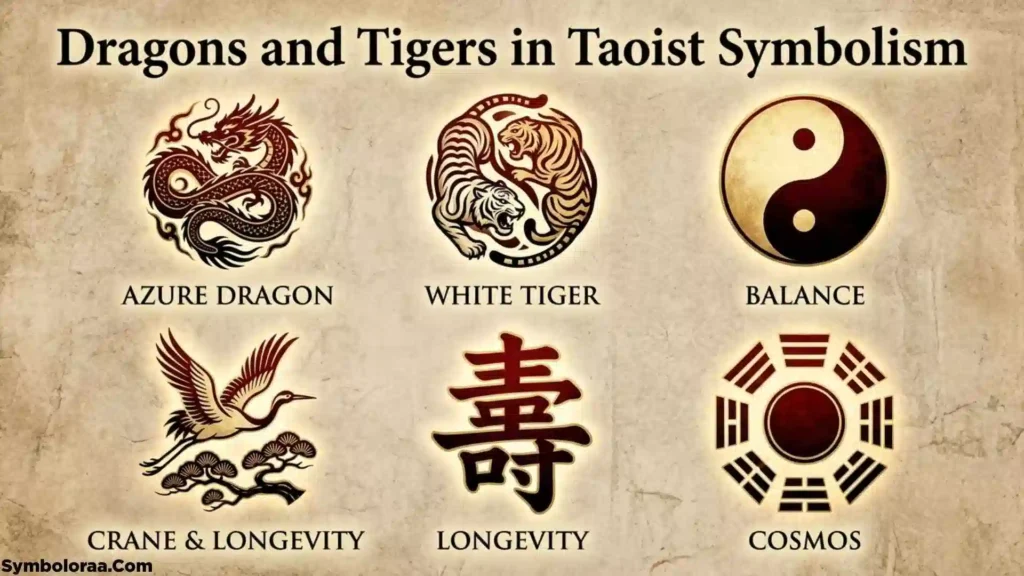
The dragon and tiger are among the most recognizable animals in Chinese religious and philosophical imagery.
They can represent complementary forces and appear in Taoist visual culture, internal alchemy, martial arts traditions, and broader Chinese symbolism.
The important point is that neither animal is exclusively Taoist.
Dragon Symbolism
The dragon can be associated with:
- Water
- Rain
- Weather
- Power
- Transformation
- Celestial forces
In a Taoist context, its interpretation may depend on the religious artwork or cosmological system in which it appears.
Tiger Symbolism
The tiger can represent:
- Strength
- Protection
- Ferocity
- Earthly power
- Military or martial qualities
Dragon-and-tiger imagery can also become part of symbolic systems involving complementary forces.
This is another example of why context is essential when interpreting Taoist symbols.
Also Check This Post: 63+ Antique Symbols Stamped on Jewelry: The Best Guide for Collectors
Mountains, Clouds, and Nature Symbols
Taoist art frequently draws attention to the natural world.
Mountains, rivers, clouds, trees, rocks, water, and animals can all carry symbolic meaning.
Mountains
Mountains may suggest:
- Stability
- Stillness
- Spiritual retreat
- Sacred space
- Connection between earth and heaven
Clouds
Clouds can suggest:
- Heaven
- Movement
- Transformation
- Spiritual realms
- The meeting of different levels of existence
Rivers and Water
Rivers can communicate:
- Flow
- Adaptability
- Natural movement
- Transformation
- The passage of time
A landscape painting with mountains, mist, water, and distant figures can therefore communicate philosophical ideas without using a single written religious symbol.
Taoist Symbols and Taoist Philosophy
Understanding the symbols becomes easier when you understand the ideas behind them.
Several concepts repeatedly appear in Taoist symbolism.
Dao
The Dao is the “Way” or natural course of reality.
Yin and Yang
Yin and yang describe complementary aspects of change and relationship.
Qi
Qi (氣) is commonly translated as vital energy, breath, or vital force, although its meaning varies across historical contexts.
Wu Wei
Wu wei describes action that does not rely on unnecessary force or resistance.
Ziran
Ziran (自然) is often translated as “naturalness” or “so-of-itself,” emphasizing spontaneous and natural unfolding.
Wuxing
The Five Phases provide a framework for understanding relationships and transformations.
These concepts help explain why Taoist symbolism repeatedly returns to movement, cycles, balance, nature, emptiness, flexibility, and transformation.
Taoist Symbols vs. Chinese Symbols: What Is the Difference?
This is one of the most important sections for anyone researching the topic.
Not every Chinese symbol is Taoist.
Chinese culture has developed over thousands of years and includes many overlapping traditions, including:
- Confucianism
- Buddhism
- Taoism
- Chinese folk religion
- Imperial traditions
- Local customs
- Philosophical schools
- Traditional medicine
- Martial arts
A symbol can therefore appear in more than one tradition.
| Symbol | Strong Taoist Association? | Exclusive to Taoism? |
| Yin-yang | Yes | No |
| Bagua | Yes | No |
| Five Phases | Yes | No |
| Taoist fu | Yes | More specifically religious Taoist |
| Dao character | Yes | No |
| Dragon | Yes in some contexts | No |
| Crane | Yes in immortality imagery | No |
| Gourd | Yes in immortal imagery | No |
| Peach | Yes in immortality traditions | No |
| Water | Strong philosophical association | No |
| Mountain | Strong natural/religious association | No |
This distinction improves both historical accuracy and reader understanding.
Common Misconceptions About Taoist Symbols
Misconception 1: Yin-Yang Means Good vs. Evil
This is probably the most common misunderstanding.
Yin and yang are not simply good and evil.
They describe complementary aspects of reality that interact and transform.
Misconception 2: Taoism Has One Official Logo
Taoism does not have one universally authoritative logo equivalent to a modern corporate brand.
The yin-yang is widely recognized, but Taoist symbolism is much broader.
Misconception 3: Every Bagua Design Is a Taoist Religious Symbol
The Bagua has deep connections with the Yijing, Chinese cosmology, divination, feng shui, martial arts, and other traditions.
Its presence alone does not prove that an object belongs to a specific Taoist religious tradition.
Misconception 4: Every Chinese Character Is a Taoist Symbol
Chinese characters are a writing system, not automatically religious symbols.
The character 道 has a special connection with Daoism because of its meaning, but ordinary Chinese writing should not automatically be described as Taoist.
Misconception 5: Taoist Symbols Always Have One Fixed Meaning
Meaning depends on context.
A gourd in a painting of an immortal may suggest longevity or medicine. A gourd used as an everyday container obviously has a different meaning.
How to Identify a Taoist Symbol
If you encounter an unfamiliar Chinese symbol and want to know whether it is Taoist, use this simple process.
Step 1: Identify the Basic Design
Ask whether it is:
- A yin-yang diagram
- Eight trigrams
- A talisman
- A Chinese character
- An animal
- A natural object
- A deity-related object
- A cosmological diagram
Step 2: Look for Combinations
A single symbol may be difficult to identify.
A yin-yang center surrounded by eight trigrams is much easier to recognize as a Taiji-Bagua design.
A gourd beside a recognizable immortal figure provides a different kind of contextual clue.
Step 3: Check the Historical Context
Ask where the symbol came from.
A museum artifact, Taoist temple object, historical manuscript, modern tattoo, and commercial decoration should not automatically receive the same interpretation.
Step 4: Check the Source
For religious talismans especially, look for information about:
- The Taoist tradition
- Historical period
- Inscription
- Ritual purpose
- Original artifact
- Scholarly interpretation
Step 5: Avoid Automatic Labels
If the evidence only shows that an image is Chinese, describe it as Chinese rather than automatically calling it Taoist.
This simple rule prevents many common identification errors.
Which Taoist Symbol Should You Choose?
The right symbol depends on what you want it to represent.
Choose Yin-Yang If You Mean Balance
The yin-yang design is the clearest choice if your intended meaning is:
- Balance
- Complementary opposites
- Harmony
- Transformation
- Interdependence
Choose Bagua If You Mean Change and Cosmology
The Bagua is more appropriate when your interest is:
- Chinese cosmology
- The I Ching
- Yin-yang relationships
- Patterns of change
- Traditional metaphysics
Choose a Gourd If You Mean Longevity
A gourd is particularly suitable for themes involving:
- Longevity
- Medicine
- Immortality
- Taoist immortals
Choose Water If You Mean Adaptability
Water works well as a philosophical metaphor for:
- Flexibility
- Humility
- Natural action
- Persistence
- Adaptation
This decision guide is more useful than simply choosing the symbol that looks most attractive.
Taoist Symbols in Tattoos and Jewelry
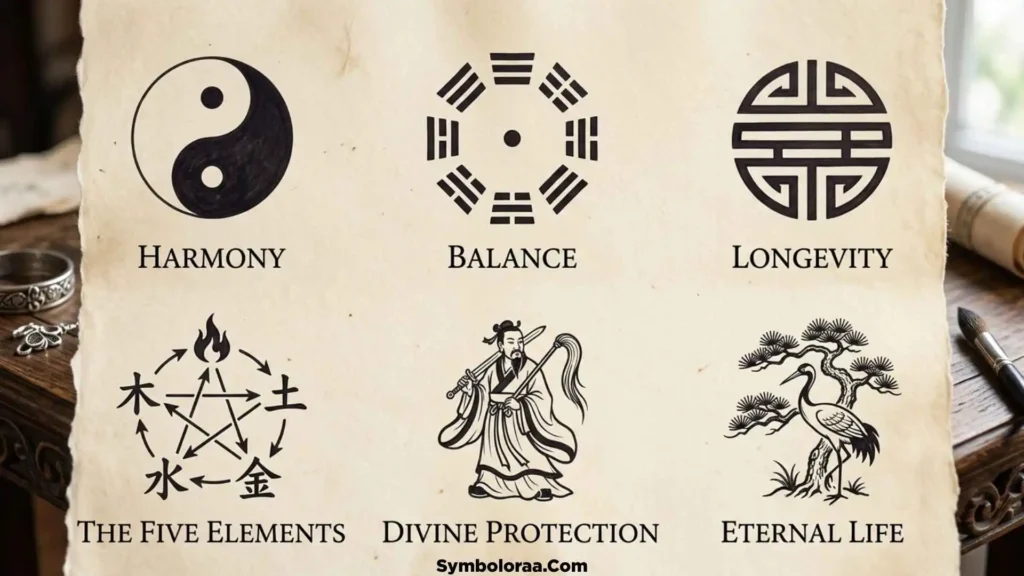
Taoist-associated designs are common in modern tattoos, pendants, bracelets, wall art, and other decorative products.
The most popular choices include:
- Yin-yang
- Bagua
- Dragon
- Tiger
- Tao character
- Taoist-inspired talismans
- Gourd
- Crane
What Should You Check Before Using a Taoist Design?
If cultural or religious accuracy matters to you, check:
- The exact symbol
- Its traditional meaning
- Its historical background
- Whether it is specifically Taoist
- Whether the design is modern or historical
- Whether Chinese characters are spelled and oriented correctly
This is especially important with talismans.
A random internet design labeled “ancient Taoist protection symbol” may be a modern invention rather than a historically documented religious symbol.
A Practical Decision Tree for Taoist Symbol Meanings
Use this quick guide when you need to identify the likely meaning of a design:
Does the design show two curved black-and-white halves?
→ Yes: It is likely a yin-yang/taijitu design.
→ Think of balance, complementary forces, and transformation.
Does it contain eight groups of three broken or solid lines?
→ Yes: It is likely a Bagua/Eight Trigrams design.
→ Think about yin-yang patterns, cosmology, and change.
Does it look like unusual Chinese writing with seals and strange line patterns?
→ Yes: It may be a Taoist fu talisman.
→ Check its historical and ritual source before assigning a meaning.
Does it show a gourd with an immortal or religious figure?
→ Yes: It may relate to longevity, medicine, immortality, or Taoist immortal traditions.
Does it show a dragon, crane, tiger, cloud, or peach alone?
→ Do not automatically call it Taoist.
→ Check the surrounding artwork and cultural context.
Why Context Matters More Than Appearance
A symbol’s appearance can provide a clue, but it does not always provide the complete answer.
Consider a dragon.
A dragon on a Taoist temple may have a religious and cosmological interpretation. A dragon on a Chinese New Year decoration may have a broader cultural meaning. A dragon in a modern fantasy movie may have an entirely different meaning.
The same principle applies to yin-yang, cranes, peaches, clouds, mountains, and other images.
This is why a strong interpretation asks:
What is the symbol? Where is it found? Who used it? When was it created? And what purpose did it serve?
That approach produces a much more reliable answer than assigning one universal meaning to every image.
Frequently Asked Questions About Taoist Symbols
What is the main symbol of Taoism?
The yin-yang or taijitu is the symbol most commonly associated with Taoism. It represents the dynamic relationship between yin and yang. However, Taoism does not have one universally exclusive official symbol.
What are the most important Taoist symbols?
Important Taoist-associated symbols include the yin-yang, Bagua, Five Phases, Taoist talismans, Dao character, gourd, crane, water, and imagery of Taoist immortals. Their meanings vary according to historical and religious context.
What does the yin-yang symbol represent?
It represents the relationship between yin and yang—complementary aspects that interact, depend on one another, and transform. It does not simply mean good versus evil.
Is yin-yang a Taoist symbol?
The yin-yang symbol is strongly associated with Taoism, but yin-yang theory has a much broader history in Chinese thought. The recognizable taijitu developed through a longer history of Chinese diagram traditions.
What are the Eight Trigrams?
The Eight Trigrams, or Bagua, are eight three-line configurations made from broken and continuous lines representing yin and yang. They are closely connected with the Yijing and were incorporated into Taoist cosmology and religious traditions.
What does Bagua mean in Taoism?
Bagua can represent patterns of yin and yang, natural forces, and processes of change. Its meaning is connected to a broader Chinese cosmological and Yijing tradition rather than being exclusive to Taoism.
What are Taoist talismans?
Taoist talismans, or fu, are ritual objects or written/diagrammatic forms used in religious Taoist practices. Their forms and functions vary across historical periods and Taoist traditions.
What does the Taoist gourd symbolize?
The gourd can represent longevity, medicine, immortality, and spiritual transformation, particularly when shown with Taoist immortals. Historical studies of Taoist immortality symbolism identify the gourd as an important image in this tradition.
What does water symbolize in Taoism?
Water is commonly used as a metaphor for flexibility, humility, adaptability, and action that does not depend on unnecessary force. It also has a formal place in systems such as the Five Phases and Eight Trigrams.
Are dragons Taoist symbols?
Dragons appear in Taoist art and symbolism, but they are not exclusively Taoist. They are also important throughout Chinese mythology, religion, art, and culture.
Are cranes Taoist symbols?
Cranes have strong associations with longevity and immortality and can appear in Taoist art. However, they are part of broader Chinese symbolism as well.
Is the Bagua the same as yin-yang?
No. Yin-yang represents the relationship between two complementary principles, while the Bagua consists of eight three-line trigrams built from yin and yang configurations.
What does the Dao character mean?
The character 道 is pronounced Dao and is commonly translated as “Way” or “Path.” In Daoist philosophy, the Dao refers to a much deeper concept concerning the course or way of reality.
What is the difference between Taoism and Daoism?
“Taoism” and “Daoism” are two English spellings of the same Chinese tradition. “Daoism” more closely reflects modern Mandarin pronunciation, while “Taoism” is the older English spelling.
Are Taoist symbols used for protection?
Some religious Taoist talismans and ritual objects have historically been used within protective practices. However, it is misleading to claim that every Taoist-looking symbol automatically provides supernatural protection.
Can Taoist symbols be used in tattoos?
Yes, people use Taoist-associated designs as tattoos, but anyone choosing one should research the specific symbol and its cultural context. This is particularly important when using Chinese characters or historical talismanic designs.
Conclusion
Taoist symbols are more than beautiful Chinese images. They represent important ideas such as balance, transformation, nature, harmony, and spiritual growth. While the yin-yang is the best-known symbol, the Bagua, Five Phases, talismans, and natural images like mountains, water, clouds, and cranes also have important meanings.
To understand Taoist symbols, it helps to look at their history, use, and cultural context rather than their appearance alone. Together, these symbols reflect a central Taoist idea: living in harmony with nature, accepting change, and following the Way.
Also Check This Post: Faith Symbols: Exploring Belief, Hope, and Spiritual Meaning

I’m Madison Reed, a contemporary American author who writes about love, family, friendship, and second chances. I’m fascinated by the choices that shape our lives and the moments that change us forever. My goal is to create honest, emotional stories with characters readers can connect with long after finishing each book.
Three Books:
When We Find Our Way
The Things We Never Said
Summer in September
 Jackson Miller