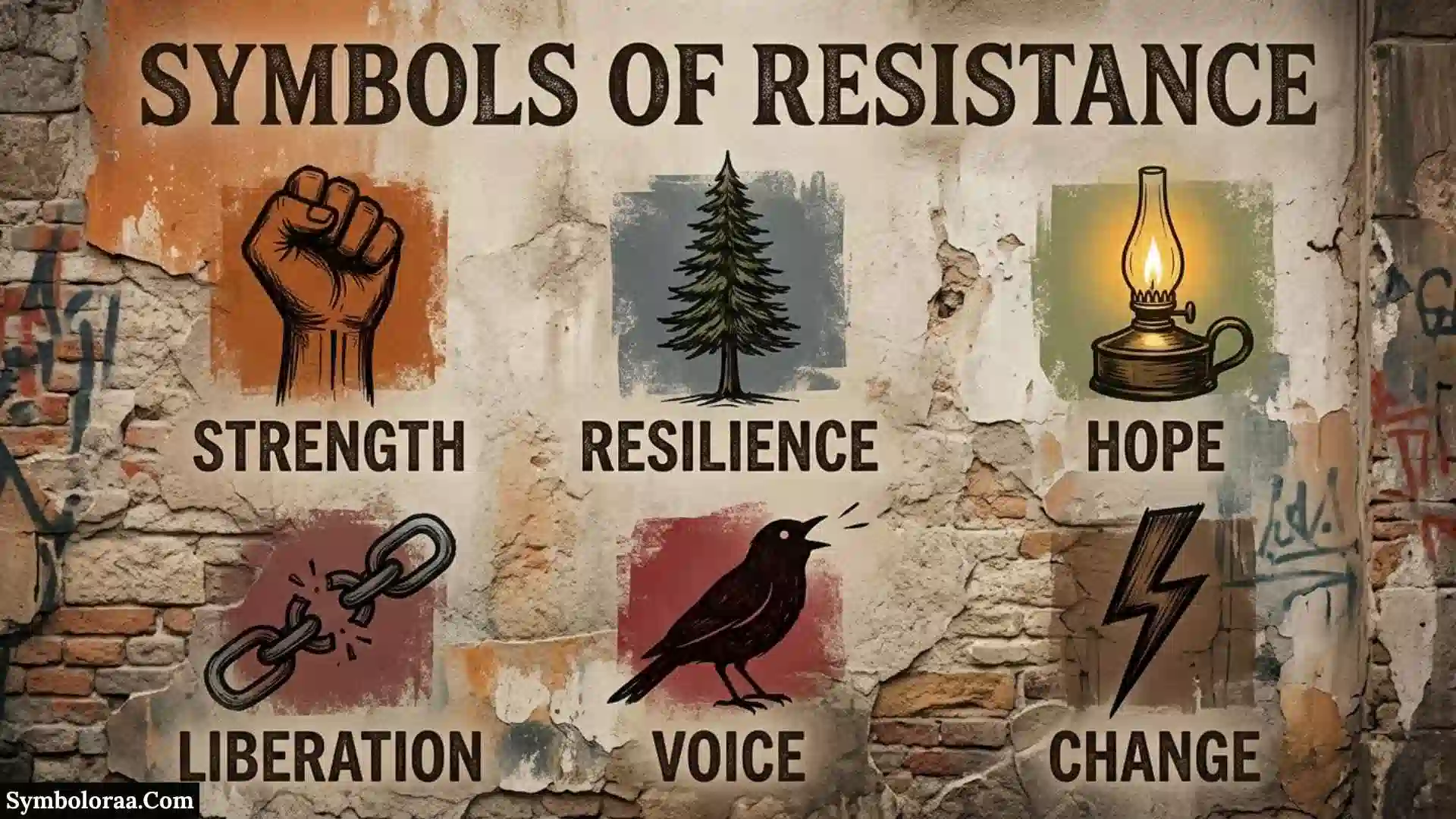
Symbols of resistance turn complex ideas into images people can recognize quickly. A raised fist, a peace symbol, a broken chain, a protest banner, or a simple color can communicate solidarity, freedom, equality, opposition, or a demand for change without a long explanation.
But there is an important point: there is no single universal list of symbols of resistance, and a symbol does not always have the same meaning in every place or period. Its meaning depends on the movement, historical setting, people using it, and message surrounding it.
This guide explains the most important symbols associated with resistance and protest, including their meanings, historical contexts, and modern uses. It also looks at nonviolent resistance, civil rights, labor activism, anti-war movements, political protest, and visual communication.
Quick answer:
Symbols of resistance are visual signs, gestures, objects, colors, or designs used to express opposition, solidarity, freedom, equality, liberation, or a demand for social and political change. Some, such as the raised fist, became strongly associated with particular historical movements, while others have meanings that vary across cultures and time.
What Are Symbols of Resistance?
A resistance symbol is a visual or physical representation used to communicate opposition to an established condition, authority, injustice, or system. It can appear on a poster, flag, piece of clothing, piece of artwork, building, social-media graphic, protest sign, or even as a gesture.
The power of a symbol comes from its ability to communicate quickly. Someone may understand a clenched fist as a message of strength or solidarity without reading a paragraph explaining the idea.
Symbols can also create a shared identity. When many people use the same image, color, gesture, or emblem, the symbol can become a visual marker of belonging.
Why Symbols Matter in Resistance Movements
Resistance is not always expressed through physical confrontation. Many movements have relied on demonstrations, boycotts, marches, strikes, speeches, art, clothing, music, and other forms of public expression.
The Library of Congress describes the U.S. civil rights movement as a coordinated campaign for racial justice and documents demonstrations, boycotts, and other forms of protest.
Symbols are useful within these movements because they can:
- Create a recognizable identity
- Express solidarity
- Preserve historical memory
- Make a protest visually understandable
- Unite people around a shared message
- Turn an individual action into a collective statement
- Communicate resistance without lengthy text
A symbol therefore does more than decorate a poster. It can become part of the movement’s language.
How a Symbol Gains Its Meaning
Symbols rarely become powerful overnight. Their meanings are often built through repeated use.
A gesture may become associated with a movement after a famous protest. A color may become meaningful because activists repeatedly use it. A particular image may spread through posters, newspapers, photographs, artwork, clothing, and eventually digital media.
This process also means that meanings can change. A symbol used by one group in one historical period may later be adopted by another group for a related or entirely different purpose.
That is why historical context matters when interpreting resistance symbols.
The Most Recognizable Symbols of Resistance
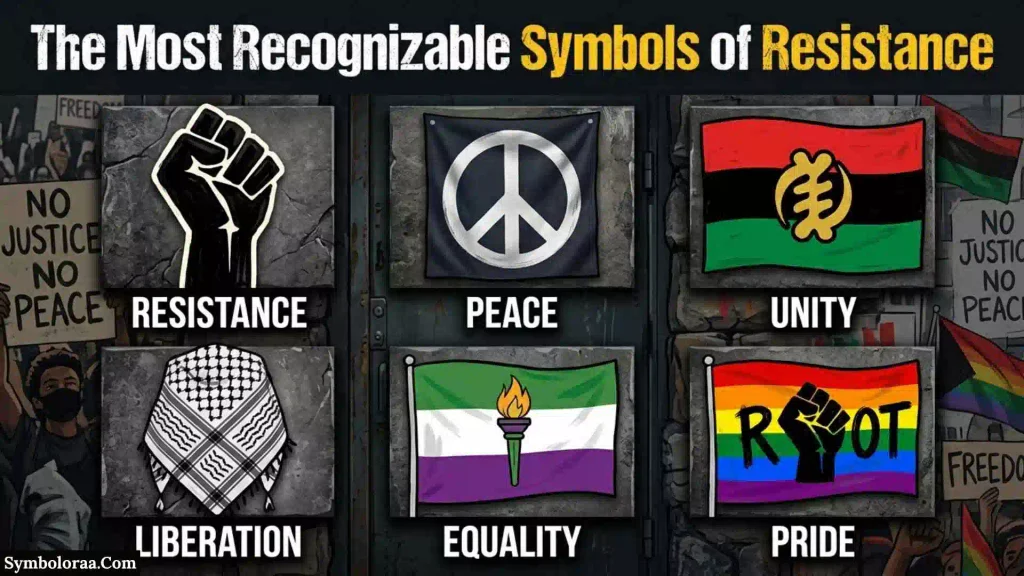
Some symbols have become strongly associated with resistance, protest, solidarity, or social change. Their meanings should still be interpreted in context rather than treated as fixed definitions.
The Raised Fist
The raised clenched fist is one of the most recognizable resistance symbols.
It can communicate strength, unity, solidarity, determination, and resistance. The Smithsonian notes that the closed raised fist has been used by Black Arts and Black Power movements and has subsequently been adopted by various movements and organizations to represent solidarity and resistance.
One of its most famous appearances occurred at the 1968 Olympic Games in Mexico City.
American athletes Tommie Smith and John Carlos raised their gloved fists during the medal ceremony for the 200-meter race. The Smithsonian describes the gesture as a salute symbolizing power and unity and identifies the raised fists as an enduring symbol of resistance in American history.
The meaning of that moment went beyond the gesture itself. Smith and Carlos also used clothing and other visual details to communicate messages concerning racial discrimination, poverty, workers, and victims of lynching.
Today, a raised fist may appear in many different contexts. It can represent solidarity, equality, human rights, political activism, or resistance to oppression.
The Peace Symbol
The familiar peace symbol is another important example of protest imagery.
It was designed in 1958 by British artist Gerald Holtom for the Campaign for Nuclear Disarmament. According to the Campaign for Nuclear Disarmament, the design incorporated the semaphore letters N and D for “nuclear disarmament.” It later became more broadly recognized internationally as a peace symbol.
This history makes the symbol particularly relevant to anti-war and nuclear-disarmament movements.
Its modern meaning can include:
- Peace
- Nuclear disarmament
- Opposition to war
- Nonviolence
- Human cooperation
A key lesson is that a symbol can begin with a specific political purpose and later acquire a broader cultural meaning.
Broken Chains
Broken chains commonly represent freedom from oppression or captivity.
The underlying visual idea is simple: a chain restricts movement, while a broken chain suggests liberation.
This imagery can therefore be used when discussing:
- Freedom
- Emancipation
- Liberation
- Ending oppression
- Breaking restrictive systems
- Independence
However, a broken-chain image should not automatically be assigned to one particular historical movement. Different cultures and movements have used similar imagery to communicate liberation.
Protest Signs and Placards
A protest sign may seem less symbolic than an emblem or logo, but signs are among the most direct forms of resistance communication.
A short phrase combined with a powerful image can turn an individual opinion into a public statement.
The Library of Congress preserves examples of modern protest posters and documents how protest art has been used to address social justice, political protest, mourning, and institutional injustice.
The strength of a protest sign often comes from its combination of:
Words + image + location + timing + collective action
A sentence that seems ordinary on its own can become historically important when photographed during a major demonstration.
Black Clothing and Visual Simplicity
Black clothing can sometimes function as a symbol of mourning, solidarity, opposition, or protest. Its meaning is highly dependent on context.
A useful historical example comes from the 1968 Olympic protest. Smith and Carlos wore black socks without shoes to represent African American poverty. The Smithsonian also records that Carlos opened his tracksuit jacket in solidarity with blue-collar workers and that both athletes wore beads in remembrance of people who had been lynched.
This example shows why resistance symbolism should not be reduced to isolated objects. Several visual elements can work together to form a larger message.
Symbols of Resistance in Major Historical Movements
Resistance symbols become easier to understand when viewed alongside the movements that used them.
Civil Rights and Racial Justice
The civil rights movement in the United States produced some of the most recognizable imagery associated with racial justice and protest.
The raised fist became especially powerful through Black Power and later social movements. The Smithsonian’s Cooper Hewitt notes that the clenched fist has been used in movements including Black Lives Matter and traces its visual development through different periods of activism.
The 1968 Olympic protest provides a particularly well-documented example. Tommie Smith and John Carlos used their international platform to protest racial discrimination, while Australian athlete Peter Norman supported them by wearing an Olympic Project for Human Rights badge.
This is an important lesson in visual history: the meaning of a symbol is often strengthened by the action connected to it.
Anti-War and Nuclear Disarmament Movements
The peace symbol is closely linked to nuclear disarmament because of its original creation for the British Campaign for Nuclear Disarmament.
The symbol later became much broader than its original organizational context and is now widely recognized as a representation of peace.
This makes it a good example of how a movement-specific symbol can become part of global visual culture.
Labor and Workers’ Movements
Resistance imagery also appears in labor activism.
Workers have historically used banners, signs, badges, clothing, colors, and other visual elements to communicate collective identity.
The 1968 Olympic protest again provides an interesting example. John Carlos opened his tracksuit to show solidarity with blue-collar workers.
The broader principle is important: resistance symbolism can connect different groups by emphasizing shared concerns such as dignity, economic fairness, and collective power.
Contemporary Social Justice Movements
Modern movements continue to use both older symbols and newly created visual identities.
The Library of Congress, for example, preserves protest artwork associated with Black Lives Matter and identifies it within categories including social justice and protest movements.
Contemporary resistance symbolism is especially flexible because images can spread rapidly through:
- Posters
- Murals
- Street art
- T-shirts
- Social media
- Digital illustrations
- Profile graphics
- Hashtags
- Videos
This has made visual symbolism an important part of modern protest culture.
Symbols of Resistance by Meaning
Instead of memorizing symbols individually, it is often easier to organize them by the message they communicate.
| Symbol or visual form | Common association | Important context |
| Raised fist | Strength, solidarity, resistance | Used by multiple movements across different periods |
| Peace symbol | Peace, disarmament, anti-war activism | Originally created for nuclear disarmament |
| Broken chain | Freedom, liberation | Meaning varies by historical context |
| Protest sign | Opposition, demands, public expression | Usually depends on its words and setting |
| Black clothing | Mourning, solidarity, protest | Meaning changes by movement and culture |
| Movement badge | Group identity, solidarity | Often connected to a specific organization |
| Banners and flags | Collective identity | Meaning depends on colors, designs, and group |
| Murals and street art | Public protest, memory, social commentary | Often tied to a specific place or event |
The table should be treated as a starting point rather than a universal dictionary. A symbol’s precise meaning can change depending on who uses it and why.
How Resistance Symbols Differ From Ordinary Symbols
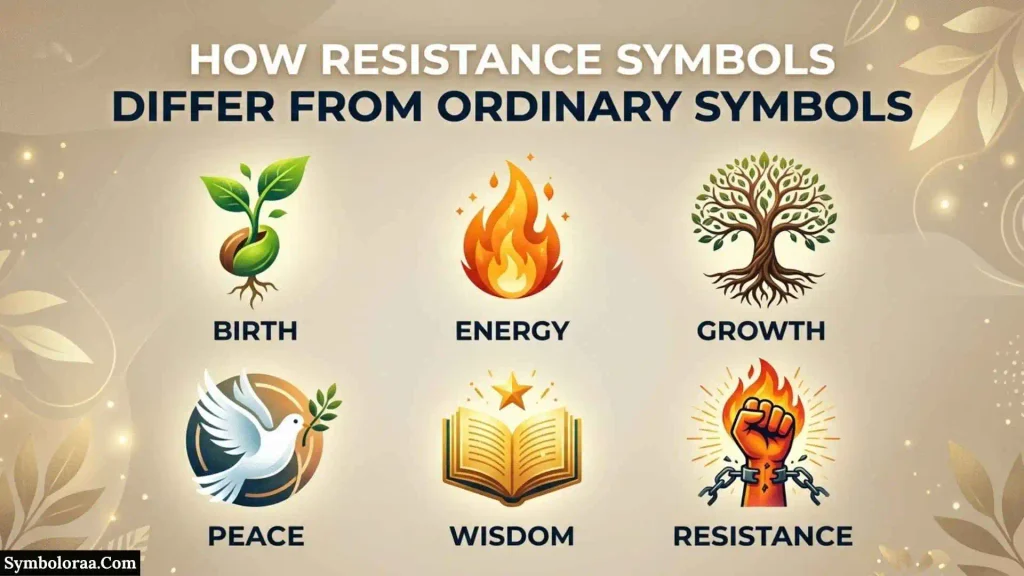
Not every powerful image is a resistance symbol.
A national flag, religious emblem, company logo, or decorative pattern may communicate identity without expressing resistance.
A resistance symbol usually gains its meaning from a relationship between the symbol and an issue, conflict, injustice, demand, or movement.
Resistance Symbol vs. Political Symbol
These categories can overlap.
A political symbol may represent a political party, ideology, candidate, or government. A resistance symbol usually emphasizes opposition, protest, liberation, or social change.
One symbol can perform both functions depending on the context.
Resistance Symbol vs. Peace Symbol
Peace and resistance are not opposites.
Some resistance movements use peaceful imagery to oppose violence, war, or oppression. The peace symbol is a good example because it originated in nuclear-disarmament activism and later developed a much wider meaning.
Resistance Symbol vs. Rebellion Symbol
“Resistance” and “rebellion” are related but not identical.
Resistance can describe organized opposition to injustice or authority and may be nonviolent. Rebellion often carries a stronger implication of revolt against established authority.
The visual symbol alone does not always tell you which meaning is intended.
How to Interpret a Resistance Symbol Correctly
If you encounter an unfamiliar symbol, do not rely only on its appearance.
Use a simple research process.
Step 1: Identify the Symbol
Determine exactly what you are looking at.
Is it:
- A hand gesture?
- A flag?
- A logo?
- A letter or abbreviation?
- A color combination?
- A historical emblem?
- A piece of clothing?
- A poster?
- A piece of street art?
Small visual differences can matter.
Step 2: Identify the Context
Ask where the symbol appeared.
Was it used:
- At a demonstration?
- On a historical document?
- In a museum?
- On social media?
- During a labor strike?
- In a civil rights campaign?
- During an anti-war protest?
- In an artwork?
The surrounding context can change the interpretation.
Step 3: Identify Who Used It
The same visual form may be used by unrelated groups.
Find out whether the symbol belongs to:
- A particular movement
- An organization
- A historical group
- A political campaign
- A community
- An artist
- A specific event
Step 4: Check Historical Sources
For historically important symbols, prioritize museums, libraries, archives, universities, government collections, and original organizational records.
The Smithsonian and Library of Congress are particularly useful for studying American protest imagery because they preserve primary materials and historical objects.
Step 5: Separate Original Meaning From Modern Meaning
Ask two different questions:
What did the symbol mean when it was first used?
and
What does it mean to people using it today?
These answers may not be identical.
A Practical Decision Guide for Choosing a Resistance Symbol
If you are creating artwork, educational material, a poster, or another visual project, start with the message rather than the image.
What message do you want to communicate?
↓
Freedom or liberation?
→ Consider imagery such as broken chains or open barriers.
Strength and solidarity?
→ A raised fist may communicate collective determination, but check the cultural and political context first.
Peace or opposition to war?
→ The peace symbol is a historically established choice, especially when nuclear disarmament is part of the subject.
A specific historical movement?
→ Use a symbol documented as belonging to that movement rather than selecting a generic protest icon.
A modern social issue?
→ Research the visual language actually used by the relevant community or movement.
The safest approach is to match the symbol to the historical context instead of choosing an image simply because it looks rebellious.
Common Mistakes When Using Resistance Symbols
Assuming Every Raised Fist Has the Same Meaning
The raised fist has been adopted by different groups and movements. Its meaning can range from solidarity and racial justice to broader political resistance.
The Smithsonian specifically documents its adoption across multiple movements.
Ignoring Historical Context
A symbol may look simple today because decades of history have been compressed into one image.
The 1968 Olympic raised-fist protest, for example, involved racial discrimination, human rights, poverty, workers, and remembrance of lynching victims.
Using only the label “protest symbol” misses much of its historical meaning.
Treating Modern Internet Lists as Historical Authority
Online symbol lists can be useful for discovering terminology, but they should not automatically be treated as historical evidence.
For research, compare claims against:
- Museum collections
- National libraries
- University archives
- Government historical resources
- Primary documents
- Oral histories
- Original organizations
Assuming a Symbol Is Universal
Symbols can have different meanings across countries and cultures.
Before using a symbol in an educational, commercial, or public setting, check its local meaning and history.
Using a Symbol Without Understanding Its Association
A symbol can carry political or historical associations that the creator did not intend.
Researching the image before using it is especially important for logos, tattoos, merchandise, educational projects, and public-facing designs.
How Artists and Designers Use Resistance Symbolism
Resistance imagery is not limited to demonstrations.
Artists have used symbols to preserve memory, challenge dominant narratives, and make political ideas visible.
The Smithsonian’s collection includes Barbara Jones-Hogu’s work, in which the closed raised fist represented cohesion of purpose within Black Arts and Black Power movements.
The Smithsonian also documents contemporary artist Glenn Kaino’s collaboration with Tommie Smith in Bridge, showing how a historical gesture can be transformed into new artwork decades later.
For designers, the important lesson is that visual simplicity does not mean historical simplicity.
A small icon can carry decades of associations.
Why the Raised Fist Became So Powerful
The raised fist deserves special attention because it demonstrates how an ordinary human gesture can become an international symbol.
A clenched hand suggests physical strength. Raising it above the head makes the gesture visible to others. When many people repeat the same gesture, it can communicate collective identity.
Its historical power also comes from documented public moments.
At the 1968 Olympics, Tommie Smith and John Carlos performed the gesture in front of an international audience. Their protest was photographed and preserved in museums and archives, helping the image become part of historical memory.
The gesture later appeared in other movements, which gave it additional layers of meaning.
This is an important principle of visual culture:
A symbol becomes powerful not only because of what it looks like, but because of what people do with it.
Why the Peace Symbol Has a Different Kind of Power
The peace symbol demonstrates another route to symbolic power.
Unlike the raised fist, whose modern associations developed through multiple movements and highly visible political moments, the peace symbol has a documented designer and a specific original purpose.
Gerald Holtom created it in 1958 for the Campaign for Nuclear Disarmament. Its design used semaphore representations of the letters N and D. It subsequently became widely recognized as a general peace symbol.
This makes it useful when explaining the difference between:
- A symbol created for one organization
- A symbol adopted by many organizations
- A symbol whose meaning expands over time
Resistance Symbols in Education and Historical Research
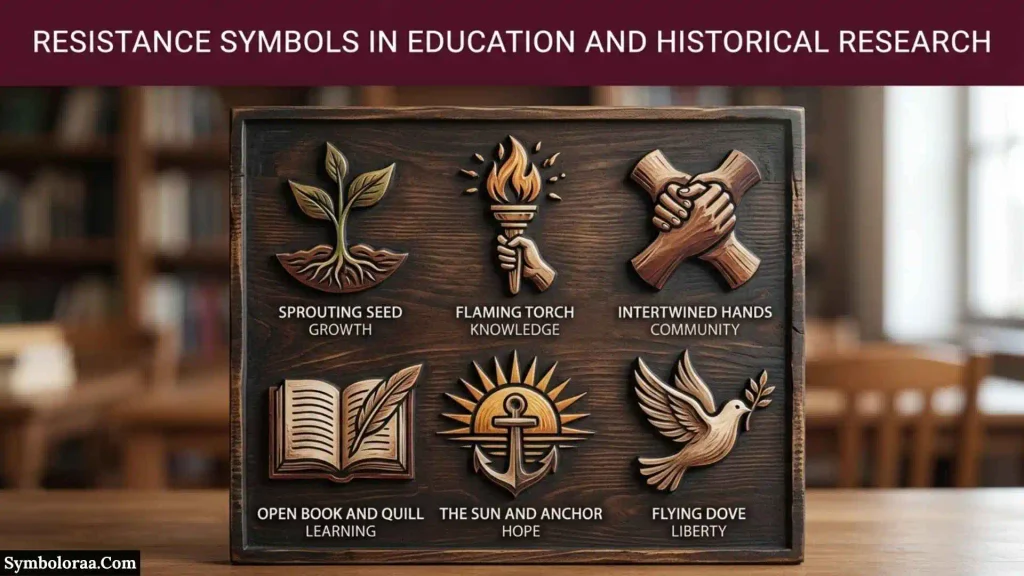
Resistance symbols can be useful teaching tools because they allow students to connect visual culture with history.
For example, instead of simply asking students to memorize that Tommie Smith and John Carlos raised their fists in 1968, a stronger research activity could ask:
- What happened?
- What did the gesture communicate?
- What other symbols were present?
- Who supported the protest?
- How did audiences respond?
- How has the image been interpreted since then?
The Library of Congress oral history collection includes John Carlos discussing the 1968 protest and the symbols used by him and Tommie Smith.
That type of primary-source material is more valuable than relying on a generic symbol list.
A Checklist for Researching Resistance Symbols
Before publishing an article, creating an infographic, or using a resistance symbol in a design, check:
- Is the symbol correctly identified?
- Is its historical origin documented?
- Do reliable sources support the claimed meaning?
- Is the symbol associated with a particular movement?
- Has its meaning changed over time?
- Could the symbol have different meanings in another culture?
- Is the modern interpretation different from the original one?
- Have you separated fact from interpretation?
- Are historical examples supported by primary or authoritative sources?
- Have you avoided claiming that one meaning is universal?
This checklist helps prevent one of the most common problems in symbol research: turning a complicated history into a simplistic definition.
Frequently Asked Questions
What is the most famous symbol of resistance?
The raised clenched fist is among the most recognizable symbols associated with resistance and solidarity. Its modern history includes Black Power and Black Arts movements and the famous 1968 Olympic protest by Tommie Smith and John Carlos.
What does the raised fist symbolize?
Depending on context, the raised fist can symbolize strength, unity, solidarity, resistance, racial justice, or political activism. Its meaning is not limited to one movement.
What does the peace symbol represent?
The peace symbol is associated with peace and nuclear disarmament. It was designed by Gerald Holtom in 1958 for the Campaign for Nuclear Disarmament and later became a broader international symbol of peace.
Is a broken chain a symbol of resistance?
A broken chain commonly represents liberation, freedom, or release from oppression. However, the precise historical meaning depends on where and how the image is used.
Can colors be symbols of resistance?
Yes. Colors can become associated with particular movements, causes, identities, or historical events. However, color meanings are especially dependent on culture and context, so a color should not be assigned one universal resistance meaning.
Are protest signs considered resistance symbols?
Yes. A protest sign can function as both a communication tool and a resistance symbol. Its meaning usually comes from the combination of its words, imagery, creator, location, and historical moment.
Why is historical context important when interpreting symbols?
Because symbols can change meaning. An image that represented one movement decades ago may later be adopted by another group or acquire a broader cultural meaning.
What is the difference between resistance and protest symbols?
The terms overlap. A protest symbol generally communicates opposition or a demand for change, while a resistance symbol can have a broader association with sustained opposition, liberation, solidarity, or defiance.
Are resistance symbols always political?
No. Resistance can involve social, cultural, labor, civil-rights, environmental, or other forms of collective action. The meaning depends on the issue and context.
Where can I find reliable information about historical resistance symbols?
Start with museum collections, national libraries, university archives, government historical resources, and primary-source collections. The Smithsonian and Library of Congress are strong starting points for researching American protest history and visual culture.
Conclusion
Symbols of resistance are powerful because they compress complex ideas into recognizable visual forms. A raised fist can communicate solidarity and strength. A peace symbol can evoke disarmament and opposition to war. Broken chains can suggest liberation, while protest posters can turn words and images into public demands.
Yet the most important lesson is that symbols do not have meanings in isolation. Their significance develops through people, movements, historical events, culture, and repeated use.
For anyone researching or using symbols of resistance, the best approach is simple: identify the symbol, investigate its historical context, determine who used it, compare reliable sources, and distinguish its original meaning from later interpretations. That produces a more accurate understanding and a much stronger piece of historical, educational, or visual work.

I’m Jackson Miller, an American author inspired by mystery, adventure, and the unpredictable nature of life. I enjoy writing fast-moving stories filled with memorable characters, unexpected choices, and meaningful moments. Through my books, I want readers to experience new worlds while discovering something about courage, determination, and themselves.
Three Books:
The Edge of Tomorrow
Under a Broken Sky
The Road We Chose
 Ethan Brooks