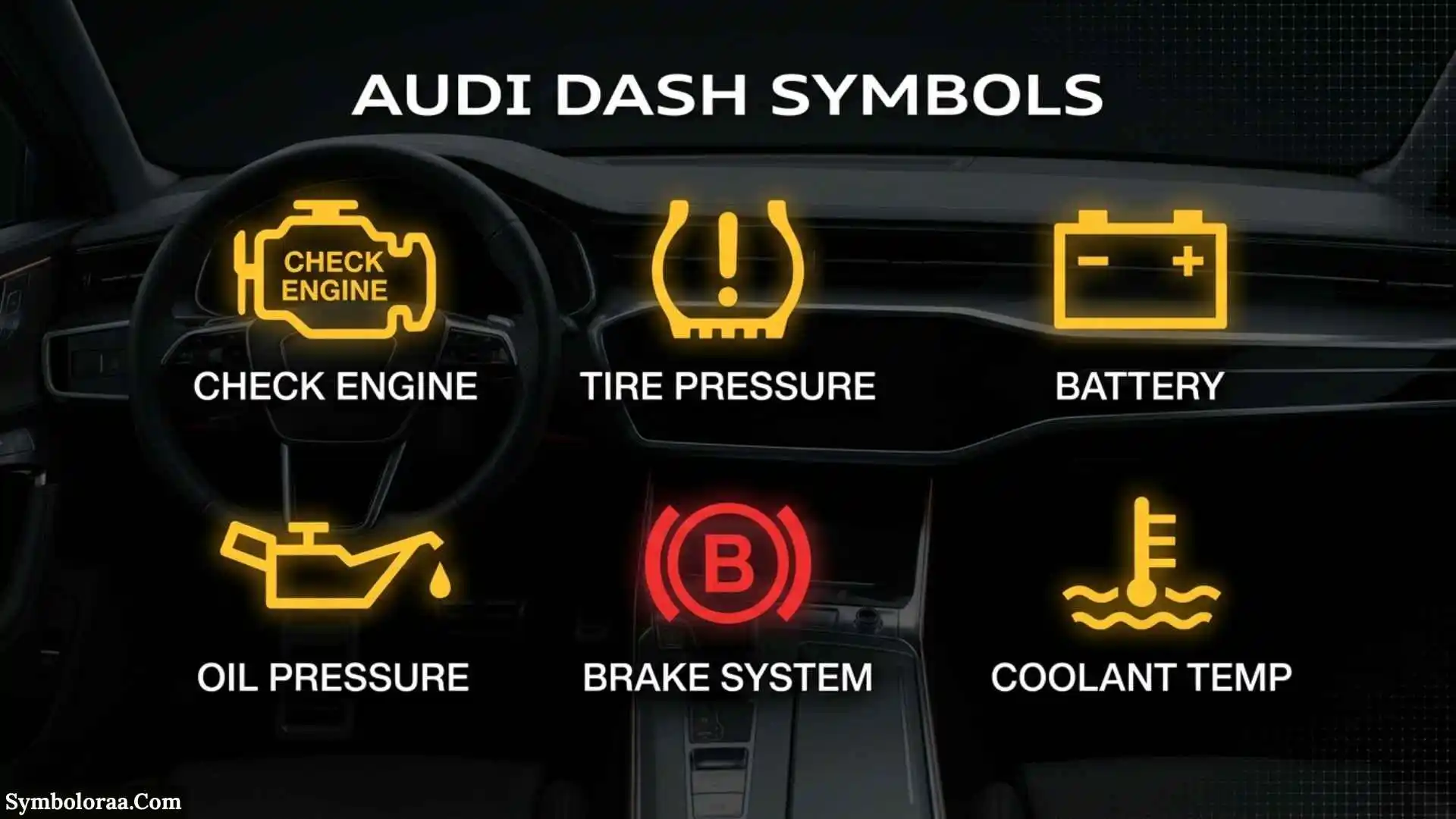
If an Audi dash symbol appears on your instrument cluster, the most important question is usually simple: What does this warning light mean, and can I keep driving?
Audi dashboards can display warning lights, indicator lights, driver-assistance symbols, messages, and information icons. Their appearance and meaning can change between models, model years, engines, equipment levels, and electric vehicles. Audi’s official online Owner’s Manual provides vehicle-specific information for Audi models from model year 2008 onward and can be accessed by VIN or by selecting the vehicle model.
As a quick rule, red warnings usually deserve immediate attention, while yellow or amber warnings generally indicate a condition that needs investigation or service. However, color alone should never replace the actual warning message or your Audi’s Owner’s Manual.
This guide explains the most common Audi dash symbols, what they generally mean, how to judge urgency, how Audi Virtual Cockpit and MMI warnings work, and what to do when a warning appears.
Quick Answer: What Do Audi Dash Symbols Mean?
Audi dash symbols are visual messages from the vehicle that communicate warnings, system status, driver assistance activity, or normal operating conditions.
Common examples include:
| Audi dash symbol category | General meaning | Typical response |
| Engine/oil warning | Possible engine lubrication or powertrain problem | Check the message and stop if instructed |
| Coolant/temperature warning | Engine temperature or cooling-system issue | Stop safely if overheating is indicated |
| Brake warning | Brake system, parking brake, or brake-related issue | Treat seriously; follow the displayed instruction |
| ABS warning | ABS or related braking-system fault | Drive cautiously and arrange inspection |
| Tire-pressure symbol | Low tire pressure or TPMS issue | Check pressures and system status |
| Airbag warning | Possible restraint-system fault | Arrange inspection promptly |
| Battery/charging warning | Charging-system or electrical problem | Check the message and seek service |
| Steering warning | Power steering or steering-system issue | Treat as a safety concern |
| ESC/traction symbol | Stability or traction control active/limited/faulted | Check whether it is flashing or remains illuminated |
| Check-engine symbol | Engine/emissions-related fault | Check message; service may be required |
| Driver-assistance symbol | Assistance system active, unavailable, or warning | Follow the system message and remain attentive |
| Turn signal/high beam | Normal lighting operation | Usually no action required |
| Low-fuel symbol | Fuel level is low | Refuel |
| Washer-fluid symbol | Washer fluid is low | Refill when practical |
These are general categories, not universal Audi instructions. Audi specifically directs owners to use the warning and indicator lights together with the vehicle-specific Owner’s Manual.
Why Audi Dash Symbols Matter
A dashboard warning is more than a decorative icon. It is part of the vehicle’s communication system.
Modern Audi vehicles can combine the instrument cluster with the Audi virtual cockpit, MMI, head-up display, acoustic warnings, and driver-assistance systems. Depending on the vehicle, information about assistance systems can appear in different displays.
This means the symbol itself may not tell the entire story.
For example, a warning icon may be accompanied by a message explaining whether:
- a system is active;
- a system has been temporarily limited;
- a sensor is blocked;
- a fault has been detected;
- a service appointment is recommended;
- the vehicle should be stopped;
- or the warning is simply informing you about normal operation.
The safest approach is therefore to read the symbol + color + accompanying message + vehicle behavior together.
Audi Warning Light Colors Explained
Color is one of the fastest ways to judge a dashboard warning, but it should be treated as an initial clue rather than a complete diagnosis.
Red Audi Dash Symbols
A red warning generally indicates a potentially serious condition that may require immediate attention.
Examples can include warnings associated with:
- braking systems;
- engine temperature;
- oil pressure;
- steering;
- serious electrical or charging problems;
- other critical vehicle conditions.
If a red warning appears while driving, reduce risk first. Safely pull over when appropriate, read the accompanying message, and follow the instructions in the vehicle’s Owner’s Manual.
Do not assume that every red symbol means exactly the same thing across all Audi models.
Yellow or Amber Audi Dash Symbols
Yellow or amber warnings commonly indicate that a system requires attention, inspection, or service.
Examples can include:
- engine/emissions warnings;
- ABS or stability-system faults;
- tire-pressure warnings;
- airbag-related warnings;
- driver-assistance limitations;
- sensor or camera restrictions.
A yellow warning does not automatically mean the car must stop immediately. The correct response depends on the exact symbol, message, vehicle behavior, and model.
Green Audi Symbols
Green symbols generally indicate that a function is operating or switched on.
Examples can include:
- turn signals;
- cruise-control-related status;
- certain lighting functions;
- active assistance features.
A green symbol is normally informational rather than a fault warning.
Blue Audi Symbols
Blue symbols are commonly used for information about certain vehicle functions, particularly lighting or operating status.
For example, a blue high-beam indicator can tell the driver that the high beams are active.
Again, exact indicators vary by Audi model.
The Most Important Audi Dash Symbols and Their Meanings
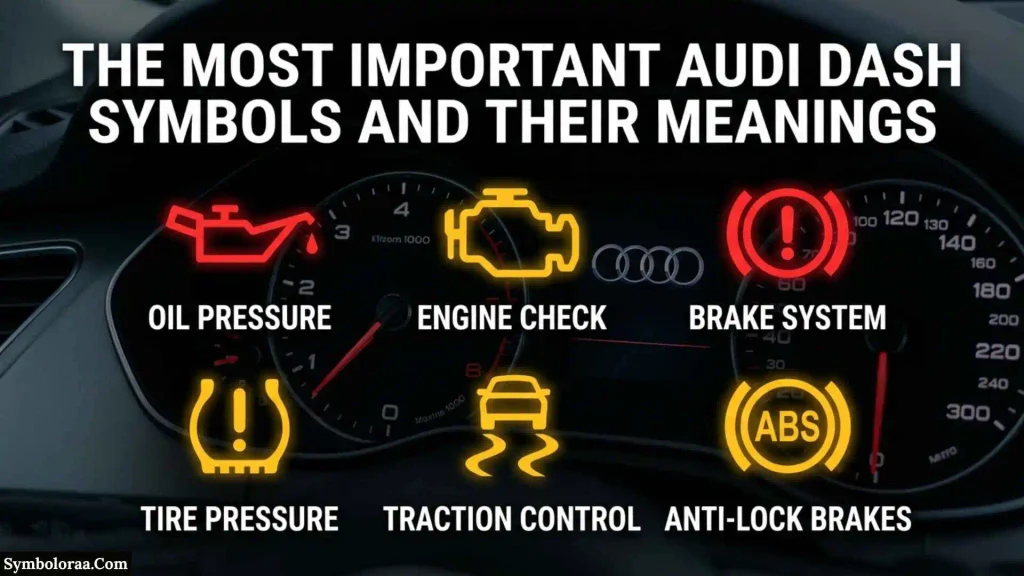
The following categories cover many of the dashboard warnings Audi owners commonly search for. They are intentionally described as general categories because the exact symbol and response can vary by vehicle.
Audi Engine Temperature or Coolant Warning
A temperature or coolant-related warning can indicate that the engine is too hot or that the cooling system requires attention.
Possible causes can include:
- overheating;
- insufficient coolant;
- cooling-system problems;
- sensor-related issues.
If the vehicle reports an overheating condition, continuing to drive can cause serious engine damage.
What to do: Safely stop when required, switch off the engine if the vehicle’s instructions tell you to do so, and consult the Owner’s Manual. Do not open a hot cooling system simply because a warning appears.
Audi Oil Pressure Warning
An oil-related warning is one of the dashboard messages that should be treated seriously.
Oil pressure is essential because the engine’s moving components depend on proper lubrication.
If the vehicle displays a critical oil-pressure warning, do not treat it as a routine reminder to change the oil. A pressure warning can indicate a more urgent lubrication problem.
What to do: Follow the exact message in your Audi’s Owner’s Manual. If the warning instructs you to stop, do so safely rather than continuing to drive.
Audi Brake Warning Light
A brake-related symbol can have several meanings depending on the Audi model.
It may be associated with:
- the braking system;
- parking brake status;
- brake-system malfunction;
- brake fluid or another brake-related condition.
Because braking is a primary safety function, brake warnings should never be ignored.
If a brake warning appears together with unusual pedal behavior, reduced braking performance, or another serious message, stop driving when it is safe to do so and seek professional assistance.
Audi ABS Warning Light
ABS, or the anti-lock braking system, helps prevent wheel lock during certain braking conditions.
An ABS warning can indicate that the ABS system has detected a fault or that its functionality is limited.
This does not necessarily mean that the vehicle has lost all braking ability, but it can mean that an important braking-assistance function is unavailable.
Best practice: Drive cautiously only if the vehicle remains safe to operate and follow the vehicle’s warning message. Arrange professional inspection rather than assuming the warning will disappear permanently.
Audi Tire Pressure Warning
The tire-pressure symbol is one of the most common Audi dash symbols.
Audi’s service information explains that the tire-pressure indicator can inform the driver about low tire pressure, a TPMS malfunction, or an issue such as the system not being reset correctly. Audi also notes that temperature changes can affect tire pressure and therefore influence TPMS warnings.
If the tire-pressure warning appears:
- Check the tires as soon as practical.
- Compare their pressures with the vehicle’s recommended values.
- Look for visible damage or a puncture.
- Correct the pressure if necessary.
- Follow your Audi’s procedure for resetting or storing tire-pressure information, if applicable.
- If the warning remains, have the system checked.
A cold morning can sometimes cause pressure to fall enough to trigger a warning, but you should not assume temperature is the only cause.
Audi Check Engine Light
The check-engine symbol indicates that the vehicle has detected a problem related to engine management, emissions, or another monitored powertrain function.
A steady warning and a flashing warning can have different implications depending on the Audi model.
The most important point is this:
The check-engine symbol does not identify one specific failed component.
A diagnostic scan may be necessary to identify the stored fault code, and even a fault code does not automatically mean that the named component should simply be replaced.
A proper diagnosis considers:
- the fault code;
- live vehicle data;
- symptoms;
- wiring;
- sensors;
- mechanical condition;
- related systems.
Audi Airbag Warning Light
An airbag or restraint-system warning can indicate a problem within the vehicle’s supplemental restraint system.
Possible systems involved may include:
- airbags;
- seat-belt pretensioners;
- occupant detection;
- related restraint electronics.
Because restraint systems are safety equipment, this warning should not be ignored.
Audi also advises owners to consult their vehicle-specific Owner’s Manual for information about airbag-related indicators and warnings.
Audi Seat-Belt Warning
A seat-belt warning usually indicates that a seat belt has not been fastened when the vehicle determines it should be.
Depending on the vehicle, additional warnings may be displayed for occupants or rear-seat conditions.
Modern Audi systems can provide visual and acoustic warnings, and some models have expanded occupant-detection functions. Audi’s newer A5, for example, can display rear-seat warnings and, when equipped with additional sensors, can detect occupants in the rear.
Audi Steering Warning Light
A steering-related symbol can indicate a problem with the steering system or its assistance.
Because steering directly affects vehicle control, a serious steering warning should be treated as a safety issue.
If the steering suddenly becomes unusually heavy, inconsistent, or difficult to control, do not continue driving simply because the vehicle is still moving.
Follow the warning message and seek assistance when necessary.
Audi Battery or Charging-System Warning
A battery-shaped symbol is generally associated with the vehicle’s electrical charging system rather than simply telling you that the battery is old.
Potential causes can involve:
- charging-system faults;
- alternator-related problems on combustion vehicles;
- electrical-system issues;
- battery-management problems.
The correct diagnosis depends heavily on the Audi model and powertrain.
If the warning remains illuminated while driving, consult the vehicle’s instructions rather than assuming that replacing the battery will solve the problem.
Audi ESC or Traction-Control Symbol
ESC stands for Electronic Stabilization Control.
A stability-control symbol can behave differently depending on whether it is:
- flashing;
- continuously illuminated;
- accompanied by a message.
A flashing stability/traction symbol can indicate that the system is actively intervening. A continuously illuminated warning may indicate that the system has been switched off, restricted, or detected a fault, depending on the vehicle.
Do not automatically interpret every ESC symbol as a mechanical failure.
Audi Parking Brake Symbol
An electronic parking brake symbol can indicate that the parking brake is engaged or that the system requires attention.
If the symbol appears unexpectedly or is accompanied by a warning message, consult the Owner’s Manual for your exact vehicle.
Never assume that a parking-brake warning is harmless if the vehicle is not behaving normally.
Audi Diesel Glow Plug Symbol
Diesel Audi models can display a glow-plug-related indicator.
During normal starting conditions, the indicator can be part of the diesel engine’s starting process. If it remains illuminated, flashes, or appears together with another warning, the vehicle may be reporting a fault that requires further investigation.
Exact behavior differs by model and engine.
Audi Low-Fuel Symbol
The low-fuel indicator is normally an information warning telling you that the fuel level is low.
Unlike a critical engine or brake warning, it generally does not indicate a mechanical fault.
However, the remaining driving range should not be treated as an exact guarantee. Traffic, driving style, temperature, terrain, and vehicle condition can affect fuel consumption.
Audi Washer-Fluid Symbol
The washer-fluid symbol indicates that windshield washer fluid is low.
This is normally a maintenance reminder rather than a serious mechanical warning.
Refill the reservoir using a suitable washer fluid and follow the vehicle’s maintenance guidance.
Audi Door, Hood, or Trunk Warning
A door, hood, or luggage-compartment symbol can indicate that a body opening is not fully closed.
Do not ignore this warning while driving.
Stop safely and check the indicated opening.
Audi Dash Symbols for Driver Assistance Systems
Modern Audi vehicles contain far more than traditional warning lights.
Many newer models can display symbols and warnings associated with driver-assistance systems.
These can include:
- adaptive cruise control;
- lane-departure warning;
- lane guidance;
- side assist;
- exit warning;
- rear cross-traffic assistance;
- parking assistance;
- emergency assist;
- Audi pre sense;
- night vision;
- traffic-sign recognition;
- intersection assistance.
Audi explains that its assistance systems can provide visual, acoustic, and other warnings and that their availability varies by vehicle and equipment. Audi also emphasizes that assistance systems support the driver rather than replacing attentive driving.
Audi Side Assist Symbol
Audi side assist monitors areas beside and behind the vehicle on equipped models.
A warning can appear through an indicator in or around the exterior mirror, depending on the system.
Audi explains that when the system detects a vehicle in a relevant blind-spot area, it can provide a visual warning, with stronger signaling when the driver indicates a lane change toward the detected vehicle.
The system should be treated as an additional aid, not as a replacement for checking mirrors and blind spots.
Audi Lane Departure or Lane Guidance Symbol
Lane-related symbols can indicate that a system is active, detecting lane markings, providing guidance, or warning about an unintended lane departure.
On some Audi vehicles, warnings can appear visually in the MMI and acoustically through a warning tone.
If the system becomes unavailable, conditions such as road markings, weather, sensor visibility, or system limitations may be relevant.
Audi Pre Sense Warning
Audi pre sense is a family of preventive safety technologies.
Depending on the vehicle and equipment, Audi systems can warn the driver about potential hazards and may perform additional protective actions.
Audi describes modern active-safety functions as combining warnings with interventions such as braking or evasive assistance in certain situations.
Therefore, a pre sense message should not automatically be interpreted as a mechanical fault. It may indicate that a safety system has detected a situation or that the system itself requires attention.
Audi Parking Assistance Symbols
Parking systems can use visual symbols to represent:
- detected obstacles;
- distance;
- steering guidance;
- parking-space information;
- system availability.
For example, Audi describes parking assistance displays that use visual and acoustic information to show detected obstacles and their relationship to the vehicle’s path.
The driver must still monitor the surroundings directly.
Audi Rear Cross-Traffic Warning
Rear cross-traffic assistance can warn about vehicles approaching from the side while reversing.
Audi explains that equipped systems can provide visual and acoustic warnings and, in some circumstances, can intervene with braking.
This is an assistance function, not permission to reverse without checking the surroundings.
Audi Virtual Cockpit Symbols and Messages
The Audi virtual cockpit changes the way drivers interact with dashboard information.
Instead of relying only on traditional physical gauges, many Audi vehicles use digital displays to present:
- speed;
- engine information;
- navigation;
- driver-assistance information;
- warning messages;
- vehicle status;
- other system information.
Audi explains that the information shown in the virtual cockpit depends on the model and equipment.
This creates an important distinction:
Not every symbol appearing in the virtual cockpit is a warning light.
Some are:
- navigation instructions;
- active-system indicators;
- efficiency information;
- assistance-system graphics;
- temporary notifications;
- status information.
Always read the accompanying text before assuming that an icon represents a fault.
Audi MMI Warning Messages
The MMI can provide additional information that is not obvious from the dashboard symbol alone.
For example, a driver-assistance system may show a visual warning in the MMI while simultaneously providing an acoustic alert.
Audi’s current assistance technology documentation describes this combination of visual and acoustic communication for several systems.
When a warning appears:
- Read the complete message.
- Identify whether it says fault, unavailable, active, limited, or another status.
- Note whether the warning disappears or remains.
- Check whether the vehicle’s driving behavior has changed.
- Consult the vehicle-specific manual.
Audi Electric and e-tron Dash Symbols
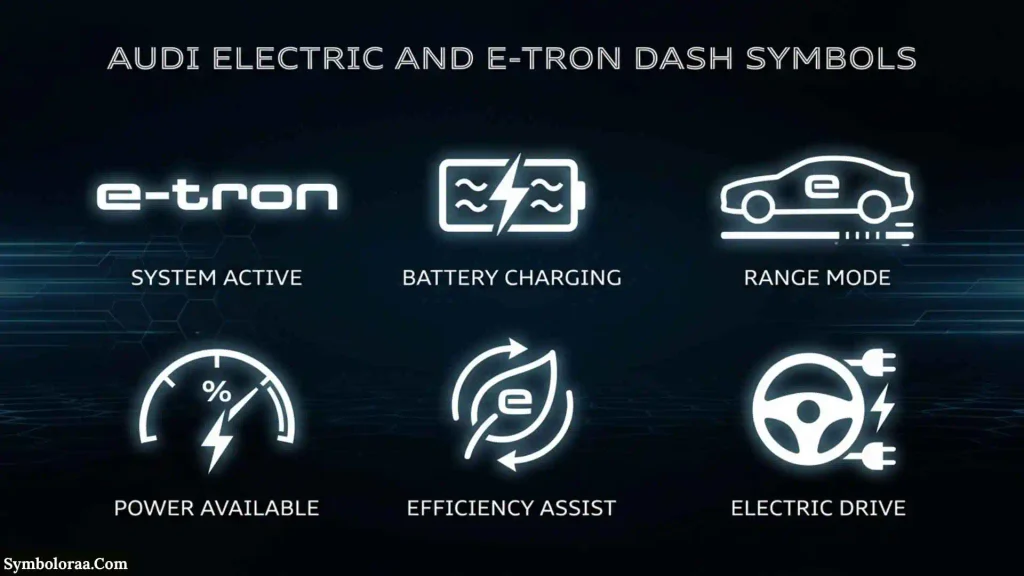
Electric Audi models add another layer of dashboard information.
Depending on the model, an electric Audi can display information related to:
- battery state;
- charging;
- available range;
- regenerative braking;
- electric drive operation;
- charging faults;
- high-voltage system status;
- driver-assistance systems.
Audi states that electric vehicles can show charging capacity, regenerative-braking information, range, and other vehicle-specific information through their displays.
Newer electric Audi models can also use advanced lighting and communication systems to display warning information externally. For example, Audi describes digital OLED rear-light communication functions on vehicles such as the Q6 e-tron for situations involving hazards, emergency assistance, and other safety-related conditions.
High-voltage warnings should be treated particularly carefully. Owners should not attempt to diagnose or work on high-voltage components themselves unless properly qualified.
Why Audi Model and Year Matter
One of the biggest mistakes people make when searching for Audi dash symbols is assuming that one symbol chart applies to every Audi.
It does not.
A dashboard on an:
- Audi A3;
- Audi A4;
- Audi A5;
- Audi A6;
- Audi A7;
- Audi A8;
- Audi Q3;
- Audi Q5;
- Audi Q7;
- Audi Q8;
- Q4 e-tron;
- Q6 e-tron;
- or another Audi
may have different displays, equipment, warning messages, and assistance functions.
Audi’s official Owner’s Manual system lets owners search by VIN or select their model and provides manuals for model year 2008 and newer.
This is why a generic internet symbol chart should be treated as a starting point, not the final authority.
How to Identify Any Audi Dash Symbol
When you do not recognize a symbol, use this framework.
Step 1: Identify the Color
Determine whether the symbol is:
- red;
- yellow/amber;
- green;
- blue;
- or another display color.
Color provides an initial indication of urgency.
Step 2: Identify the Shape
Look closely at the actual icon.
Ask whether it resembles:
- an engine;
- oil can;
- thermometer;
- tire;
- steering wheel;
- battery;
- brake symbol;
- person with a belt;
- airbag;
- triangle;
- vehicle;
- lane markings;
- light;
- or another recognizable object.
Step 3: Read the Message
If the Audi displays text alongside the symbol, read the complete message.
The message may provide more useful information than the icon itself.
Step 4: Check Whether It Is Flashing
A symbol that flashes can communicate something different from one that remains continuously illuminated.
Do not assume flashing simply means “more serious” in every case, but pay attention to the difference.
Step 5: Notice How the Car Behaves
Ask:
- Is the engine running normally?
- Is the steering normal?
- Are the brakes normal?
- Is the vehicle overheating?
- Has power been reduced?
- Are unusual noises present?
- Has the vehicle entered a restricted operating mode?
Vehicle behavior can help determine how urgently the warning needs attention.
Step 6: Check the Owner’s Manual
Use the exact Audi manual for your model and year.
Audi’s official online Owner’s Manual can be selected using the VIN or model.
Step 7: Decide Whether to Continue Driving
Do not make this decision based on the icon alone.
Consider the complete warning, vehicle behavior, and instructions provided by Audi.
What to Do When an Audi Warning Light Appears
Use this simple process.
If the Warning Is Red
- Stay calm.
- Avoid sudden braking or steering unless necessary for safety.
- Find a safe place to stop when appropriate.
- Read the warning message.
- Follow the Owner’s Manual instructions.
- If the vehicle indicates that you should stop or the car is unsafe, do not continue driving.
- Contact roadside assistance or qualified service if required.
If the Warning Is Yellow
- Read the message.
- Check whether the car is driving normally.
- Look for additional warnings.
- Consult the Owner’s Manual.
- Arrange inspection if the warning remains or returns.
If It Is a Green or Blue Indicator
Determine whether it is simply showing that a normal vehicle function is active.
For example, lighting or turn-signal indicators are generally informational rather than fault warnings.
Real-World Audi Dash Symbol Scenarios
Understanding realistic situations makes dashboard warnings easier to interpret.
Scenario 1: Red Oil Warning While Driving
You are driving normally when a red oil-related warning appears.
The wrong response is:
“I’ll drive home and check it later.”
The better response is to safely reduce risk, read the message, and follow the Audi instruction regarding stopping and engine operation.
The important lesson is that a critical oil-pressure warning is not the same thing as a routine oil-change reminder.
Scenario 2: Tire Symbol Appears on a Cold Morning
You start the Audi on a cold morning and the tire-pressure warning appears.
Temperature can affect tire pressure, and Audi confirms that weather and temperature changes can influence TPMS readings.
Check the actual tire pressures rather than simply resetting the warning.
Scenario 3: Yellow Engine Symbol Appears but the Car Feels Normal
The Audi continues to drive normally, but the check-engine symbol remains illuminated.
Do not assume:
“The car drives fine, so there is no problem.”
A warning means the vehicle has detected something that should be evaluated.
A diagnostic scan can help identify the stored fault information, but proper diagnosis may require more than replacing whichever component a generic code description mentions.
Scenario 4: Driver-Assistance Symbol Appears
A lane-related or side-assist symbol appears.
Before treating it as a fault, check whether the system is:
- active;
- warning you about another vehicle;
- temporarily unavailable;
- limited by conditions;
- or reporting a malfunction.
Modern Audi systems can communicate system status through visual and acoustic warnings.
Warning Light vs Indicator Light vs Information Message
These terms are often mixed together, but they are not always the same.
| Type | Purpose | Example |
| Warning light | Alerts driver to a condition requiring attention | Brake warning |
| Indicator light | Shows that a function is operating | Turn signal |
| Status symbol | Communicates system state | Assistance system active |
| Information message | Provides additional vehicle information | Maintenance or system message |
| Driver-assistance warning | Alerts to a detected situation | Side-assist warning |
| Fault message | Indicates a detected system problem | Assistance system unavailable |
This distinction is important for SEO searches as well as real-world troubleshooting because someone searching “Audi dash warning light” may actually be looking for an indicator or information symbol.
Common Mistakes Audi Owners Make
Ignoring a Warning Because the Car Still Drives
A vehicle can continue to move even when an important system has reported a problem.
Driving normally is not proof that everything is functioning correctly.
Looking Only at the Color
Color is useful, but the message matters too.
A yellow symbol can represent anything from a maintenance-related issue to a driver-assistance limitation.
Assuming Every Audi Uses the Same Symbols
Different generations and equipment packages can use different symbols and displays.
Resetting the Warning Without Finding the Cause
Clearing a warning does not necessarily repair the underlying problem.
If the warning returns, the vehicle is telling you that the condition has not been resolved.
Replacing Parts Based Only on a Diagnostic Code
A diagnostic code can identify an area of concern, but diagnosis is not always the same as parts replacement.
Professional diagnosis should consider the entire system.
Ignoring Driver-Assistance Limitations
If a camera or radar-based assistance system becomes unavailable, do not assume that the car will continue providing the same assistance.
Audi explicitly notes that driver-assistance functions have system limitations and vary according to vehicle equipment.
When Should You Stop Driving an Audi?
There is no single universal rule for every Audi dash symbol.
However, stopping and seeking assistance becomes especially important when:
- the vehicle explicitly tells you to stop;
- a serious red warning appears;
- braking performance changes;
- steering becomes abnormal;
- the engine appears to be overheating;
- there is a critical oil-pressure warning;
- the vehicle loses significant power;
- smoke, burning smells, or unusual mechanical noises appear;
- the car becomes difficult to control;
- an electric vehicle displays a serious high-voltage or drive-system warning.
When in doubt, prioritize safety over reaching your destination.
Audi Dash Symbol Decision Tree
Use this quick decision process when a warning appears:
Does the symbol appear?
→ No: Continue normal driving.
→ Yes: Read the symbol and message.
Is it red or accompanied by an instruction to stop?
→ Yes: Safely stop as instructed and consult the Owner’s Manual.
→ No: Continue to the next question.
Is it yellow or amber?
→ Yes: Check the message and determine whether the vehicle is operating normally.
Is the vehicle behaving abnormally?
→ Yes: Reduce driving risk and arrange professional assistance.
→ No: Consult the Owner’s Manual and schedule inspection if the warning remains.
Is it green or blue?
→ Usually check whether it represents a normal active function rather than a fault.
This decision tree is a practical starting point, but the vehicle-specific Audi manual takes priority.
Audi Dash Symbols: A Better Interpretation Framework
For difficult or unfamiliar warnings, use this professional-style framework:
Symbol → Color → Message → Behavior → Model → Action
Symbol
What exactly does the icon look like?
Color
What color is displayed?
Message
What additional words appear in the instrument cluster or MMI?
Behavior
Has the vehicle changed how it drives?
Model
Which Audi model, year, engine, and equipment package is involved?
Action
What does the official manual instruct you to do?
This approach is more reliable than searching for an icon in a generic “Audi warning lights” image and assuming the first result is correct.
How Audi Dash Symbols Differ From Fault Codes
A dashboard symbol is designed primarily for the driver.
A diagnostic trouble code is designed to provide technical information to diagnostic equipment and technicians.
They serve different purposes.
For example, an engine warning symbol may tell you that the vehicle has detected a problem, while a diagnostic scan can reveal stored fault information that helps narrow down the system involved.
Neither should be treated as a complete diagnosis by itself.
How to Use the Audi Owner’s Manual Correctly
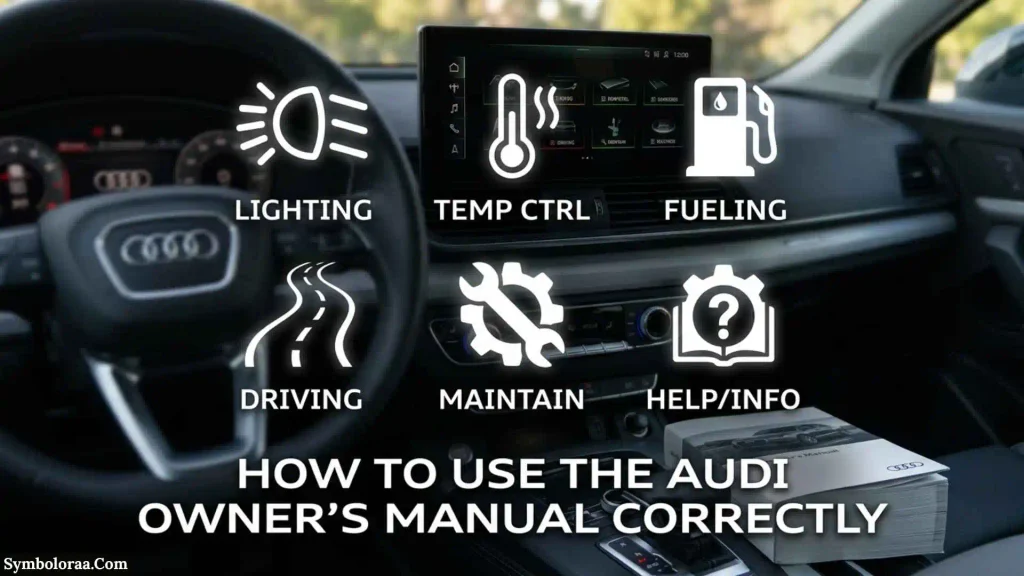
Audi’s official online Owner’s Manual is the best starting point when you need the exact meaning of a dashboard warning for your vehicle.
The official system allows selection by VIN or model and covers Audi vehicles from model year 2008 onward.
When searching the manual:
- Identify your exact model.
- Identify the model year.
- Search for warning and indicator lights.
- Search the exact wording of the dashboard message.
- Check the instructions associated with the warning.
- Follow any stop-driving or service instructions.
Audi’s support documentation also states that the Owner’s Manual is the main resource for comprehensive information and warnings about the vehicle.
Frequently Asked Questions About Audi Dash Symbols
What do Audi dash symbols mean?
Audi dash symbols communicate warnings, system status, active functions, driver-assistance information, and other vehicle information. Their exact meaning depends on the Audi model, model year, equipment, symbol color, and accompanying message.
What is the most serious Audi dashboard warning?
There is no single universal “most serious” symbol for every Audi. Red warnings associated with critical systems such as braking, oil pressure, overheating, or steering can require immediate attention. Always follow the exact vehicle message and Owner’s Manual.
Can I drive with a yellow Audi warning light?
Sometimes, but it depends on the symbol and the vehicle’s behavior. A yellow warning often indicates that attention or service is required, but it does not automatically mean that continued driving is safe. Read the message and consult the Owner’s Manual.
Can I drive with a red Audi warning light?
Do not assume that you can. Some red warnings require the vehicle to be stopped safely. Follow the specific warning message and the instructions for your Audi.
Why does my Audi show a tire-pressure warning?
The tire-pressure system can warn about low pressure, a TPMS malfunction, or an issue with the system’s reset/status. Temperature changes can also affect tire pressure and TPMS readings.
Why is my Audi check-engine light on?
The check-engine light means the vehicle has detected a monitored engine, emissions, or powertrain-related condition. It does not identify one specific failed part. Diagnostic testing may be necessary.
What does the Audi ESC symbol mean?
ESC refers to Electronic Stabilization Control. Depending on its behavior and the model, the symbol can indicate that the system is intervening, has been switched off, is limited, or has detected a fault.
What does an Audi airbag warning mean?
It can indicate a possible problem with the vehicle’s restraint system. Because airbags and related restraint equipment are safety systems, an airbag warning should be investigated according to the vehicle’s Owner’s Manual.
Why does my Audi show a driver-assistance warning?
A driver-assistance warning may mean the system is active, detecting a hazard, temporarily unavailable, limited by conditions, or experiencing a fault. Audi assistance systems vary by model and equipment.
Are Audi Virtual Cockpit symbols different from normal dashboard lights?
They can be. The virtual cockpit can display traditional warnings as well as navigation, assistance, status, and other information. The exact display depends on the Audi model and equipment.
Are Audi e-tron dash symbols different?
Yes. Electric Audi models can display additional information related to battery charge, range, regenerative braking, charging, and electric-drive systems. Exact symbols depend on the model.
Can I reset an Audi warning light myself?
Some maintenance or system indicators may have specific reset procedures, but resetting a warning does not necessarily fix the underlying problem. For safety-related warnings, identify and address the cause before simply clearing the message.
Where can I find the exact Audi dashboard symbol for my car?
Use Audi’s official Owner’s Manual and select your vehicle by VIN or model. Audi provides online manuals for model year 2008 and newer.
Key Takeaways
- Audi dash symbols are not all warning lights. Some are indicators, status icons, or information messages.
- Red warnings can require immediate attention, especially when accompanied by instructions to stop.
- Yellow or amber warnings generally require investigation or service, but urgency depends on the exact system.
- Green and blue symbols are often normal operating indicators.
- The Audi Virtual Cockpit and MMI can provide additional information beyond the basic symbol.
- Driver-assistance symbols can indicate an active function, detected hazard, system limitation, or fault.
- Audi e-tron models have additional electric-drive and charging information.
- The same-looking symbol should not automatically be assumed to have identical behavior across every Audi.
- Your model, model year, equipment, message, and vehicle behavior all matter.
- Audi’s vehicle-specific Owner’s Manual should be the final reference for interpreting an unfamiliar warning.
Conclusion
Understanding Audi dash symbols is less about memorizing one giant list of icons and more about learning how to interpret the information your Audi is giving you.
Start with the symbol and color, then read the complete dashboard or MMI message. Consider whether the symbol is flashing, check how the vehicle is behaving, and identify the exact model and year. Most importantly, use the vehicle-specific Audi Owner’s Manual before deciding whether a warning can safely be ignored or whether the car needs immediate attention.
Modern Audi vehicles combine traditional warning lights with digital instrument displays and sophisticated driver-assistance systems. That makes dashboard communication more useful, but it also makes generic symbol charts less reliable. The most accurate interpretation is always the one matched to your exact Audi and its equipment.

I’m Madison Reed, a contemporary American author who writes about love, family, friendship, and second chances. I’m fascinated by the choices that shape our lives and the moments that change us forever. My goal is to create honest, emotional stories with characters readers can connect with long after finishing each book.
Three Books:
When We Find Our Way
The Things We Never Said
Summer in September
 Ethan Brooks
 Jackson Miller