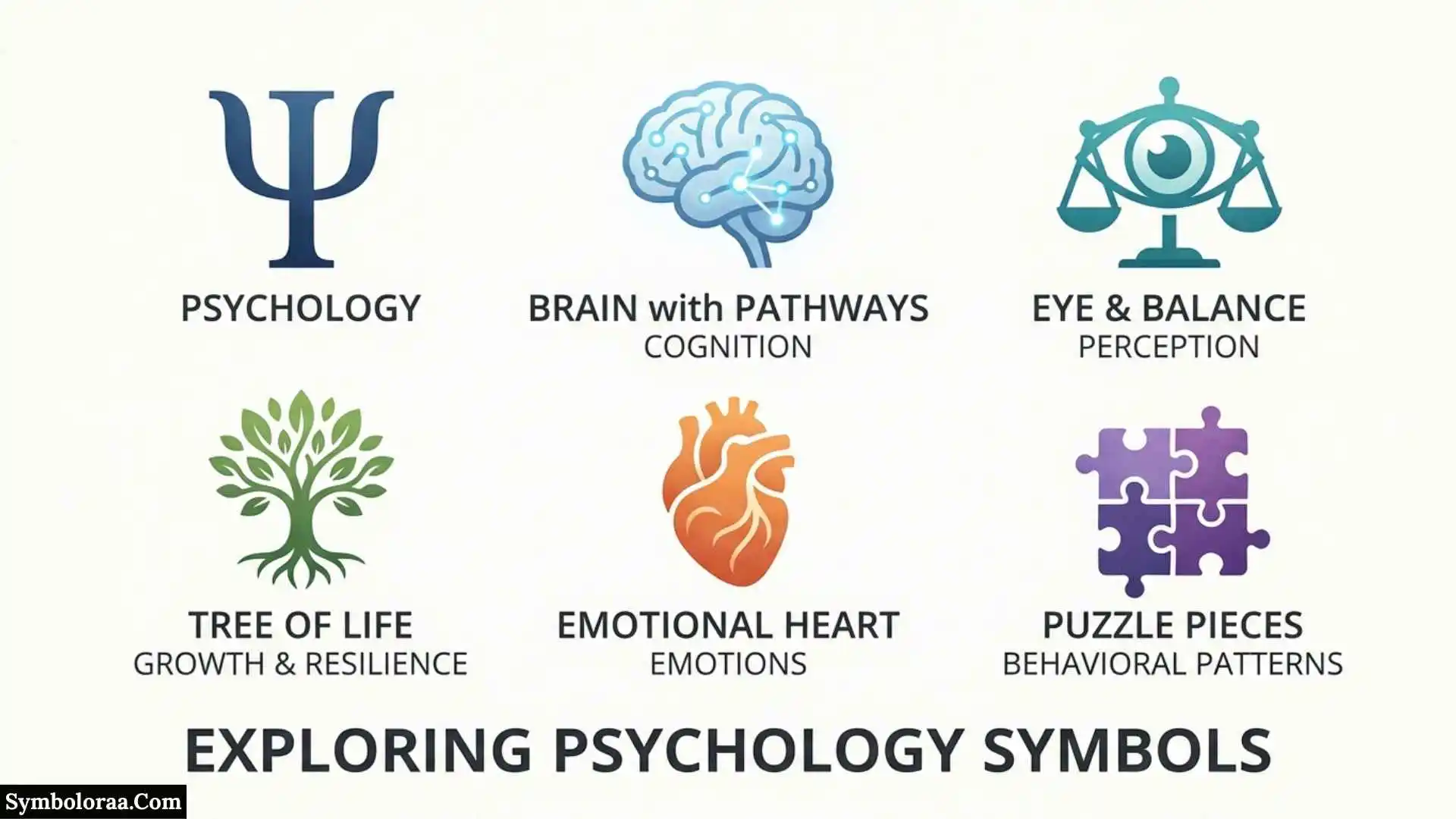
If you are searching for psychology symbols, the most important answer is Ψ (psi). The Greek letter psi is widely used to symbolize psychology, and the American Psychological Association’s Dictionary of Psychology specifically identifies ψ as a Greek letter often used to symbolize psychology.
However, psychology symbols are not limited to one character. Brain images, human profiles, eyes, butterflies, trees, hearts, spirals, labyrinths, and other visual forms are often used to represent ideas such as cognition, personal growth, perception, emotion, identity, and self-discovery.
The important distinction is that Ψ has a conventional connection to psychology, while many other images are metaphorical or context-dependent. There is no single universal list in which every brain, butterfly, or heart has an official psychological meaning.
This guide explains the main psychology symbol, where Ψ comes from, what different psychology-related symbols can represent, how symbolic meaning differs from scientific terminology, how Jungian psychology approaches symbols, and how to choose the right symbol for a logo, tattoo, educational project, artwork, or website.
Quick Answer: What Is the Psychology Symbol?
The most widely recognized symbol for psychology is Ψ, called psi.
According to the APA Dictionary of Psychology, psi is the Greek letter ψ and is often used to symbolize psychology.
What Does Ψ Mean?
Ψ represents psychology as a field of study and professional discipline.
It is commonly seen in:
- Psychology departments
- University programs
- Psychology textbooks
- Student organizations
- Academic publications
- Psychology-related websites
- Educational materials
- Psychology logos and merchandise
The symbol itself should not be interpreted as meaning only mental illness, therapy, intelligence, or the brain. Psychology is much broader. The APA describes psychology as a science-based discipline with applications involving behavior, mental processes, research, health, education, organizations, and many other settings.
Is Ψ the Official Logo of Every Psychology Organization?
No.
This is an important distinction.
Ψ is a conventional symbol associated with psychology, not one universal logo that every psychology organization must use.
Individual universities, professional associations, clinics, researchers, and businesses can have their own logos.
What Is a Psychology Symbol?
A psychology symbol is a visual mark, image, object, letter, or design used to communicate an idea related to psychology, the mind, behavior, cognition, emotion, development, identity, or psychological experience.
But there are different levels of symbolism.
Conventional Symbols
A conventional symbol has a widely recognized connection with a field.
The clearest example is:
Ψ → psychology
Conceptual Symbols
These represent a particular psychological concept rather than psychology as a whole.
For example:
Brain → cognition
Eye → perception
Heart → emotion
Metaphorical Symbols
These communicate an idea through analogy.
For example:
Butterfly → transformation
Tree → growth
Labyrinth → self-exploration
These meanings can be useful, but they are not official definitions.
Theory-Specific Symbols
Some symbols have meaning within a particular psychological theory.
Jungian psychology, for example, uses concepts such as archetypes, the shadow, the persona, and the Self. The APA Dictionary describes Jungian archetypes as symbols representing aspects of the psyche within analytical psychology.
This classification is useful because it prevents a common mistake: treating every attractive psychology-related image as an official symbol of the discipline.
The Main Psychology Symbol: Ψ Psi
The psi symbol (Ψ) is the strongest answer to the question, “What is the symbol for psychology?”
What Is Psi?
Psi is a letter of the Greek alphabet.
It appears in two common forms:
Uppercase: Ψ
Lowercase: ψ
The uppercase form is the version most people recognize when it is used as a visual symbol for psychology.
The APA Dictionary directly identifies ψ as a Greek letter often used to symbolize psychology.
Why Is Psi Associated With Psychology?
The connection is related to the Greek word psyche and the historical development of the word psychology.
However, it is better to avoid an oversimplified claim that “Ψ was originally created as the symbol of psychology.” Psi existed as a Greek letter long before modern psychology became an academic discipline.
Its later association with psychology developed because of the Greek linguistic roots connected with psyche and the word psychology.
Does Ψ Mean the Soul?
Historically, Greek concepts associated with psyche included ideas such as life, breath, spirit, or soul, depending on context and period.
Modern psychology is not simply the study of a “soul.” It is a scientific discipline concerned with behavior and mental processes, among many related areas. The APA describes psychology as a science-based discipline with both research and applied functions.
So a historically informed explanation should separate:
Ancient concepts of psyche
from
modern scientific psychology.
Psychology Symbols and Their Meanings
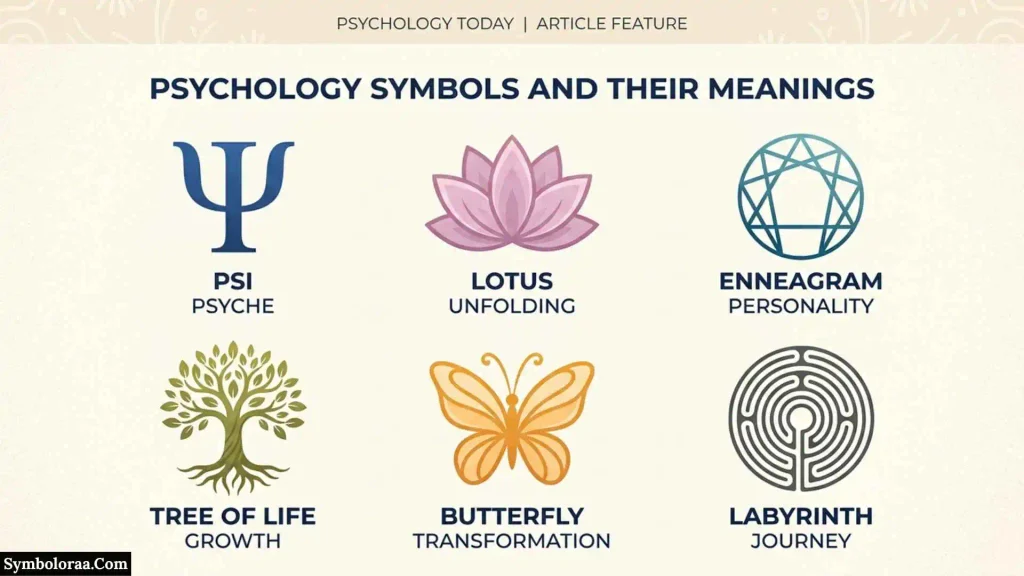
Different images can communicate different psychological concepts. The following list separates conventional symbolism from broader metaphorical use.
1. Ψ Psi — Psychology
Primary meaning: Psychology as a discipline.
Best for:
- Psychology education
- Psychology departments
- Academic psychology
- Professional psychology
- Psychology websites
- Psychology-themed designs
Status: Conventional and widely recognized.
This is the best choice if you want someone to immediately understand that a design represents psychology itself.
2. Brain — Cognition and Mental Processes
A brain is one of the most common images associated with psychology.
It can represent:
- Thinking
- Memory
- Learning
- Intelligence
- Cognition
- Decision-making
- Perception
- Mental processes
- Neuroscience
But the brain is not the universal symbol of psychology.
That distinction matters because psychology studies behavior and mental processes across many contexts, while neuroscience focuses more directly on the nervous system and brain.
Example:
A brain icon would make sense on a website about memory research.
A Ψ symbol would be more appropriate for a general university psychology department.
3. Human Head or Profile — The Mind and Identity
A human head containing thoughts, neural patterns, symbols, or abstract shapes can represent the inner mental world.
It may communicate:
- Self-awareness
- Identity
- Thoughts
- Consciousness
- Personality
- Internal experience
- Mental activity
This image is particularly useful in educational graphics because it connects the person with psychological processes.
4. Butterfly — Transformation and Personal Growth
The butterfly is often used as a metaphor for transformation.
It can represent:
- Personal change
- Growth
- Development
- Recovery
- Transformation
- New beginnings
- Freedom
However, it is important not to call the butterfly an official psychology symbol.
Its meaning is metaphorical and context-dependent.
For example, a therapist’s website might use a butterfly to communicate personal transformation, while a psychology department would normally use more direct academic imagery such as Ψ.
5. Eye — Perception and Awareness
An eye can symbolize:
- Perception
- Observation
- Attention
- Awareness
- Vision
- Conscious experience
This makes it especially relevant to topics involving perception and attention.
For example, an eye illustration could work well in an article about visual perception.
But an eye does not automatically mean “psychology.” Its meaning depends on context.
6. Tree — Growth and Development
A tree is often used as a visual metaphor for development.
It can represent:
- Personal growth
- Human development
- Stability
- Family relationships
- Identity
- Life stages
- Roots and history
A tree can therefore be particularly useful when discussing developmental psychology.
For example, a developmental psychology presentation might use a tree to visually communicate how experiences accumulate over time.
7. Heart — Emotion and Relationships
The heart is commonly associated with:
- Love
- Emotion
- Compassion
- Attachment
- Relationships
- Emotional well-being
Psychology studies emotion and relationships, so heart imagery can appear in psychology-related communication.
But the heart is much broader than psychology.
A heart by itself usually communicates emotion, not specifically psychology.
8. Spiral — Change and Complexity
Spirals can be used as metaphors for:
- Development
- Change
- Complexity
- Repeated patterns
- Self-exploration
- Psychological processes
The meaning is highly dependent on the design.
A spiral does not have one universally accepted psychological definition.
9. Labyrinth — Self-Exploration
A labyrinth can represent an inner journey.
It may suggest:
- Self-discovery
- Searching for meaning
- Confusion
- Problem-solving
- Inner exploration
- Personal development
This makes the labyrinth useful in artistic or therapeutic contexts.
However, it is a metaphor rather than an official psychology emblem.
10. Path or Journey — Personal Development
A road, pathway, or journey can represent psychological change.
Possible meanings include:
- Therapy
- Recovery
- Self-discovery
- Personal development
- Life transitions
- Goal-setting
This symbol is especially useful when the central message is that psychological change is a process rather than a single event.
11. Puzzle Pieces — Complexity
Puzzle imagery may communicate:
- Complex problems
- Different aspects of identity
- Problem-solving
- Individual differences
- Putting information together
But puzzle symbolism requires context.
It should not be treated as a universal symbol for psychology, and its use can carry different meanings in disability and neurodiversity discussions. Therefore, designers should consider the audience and subject before choosing it.
Official, Conventional, and Metaphorical Psychology Symbols
One of the easiest ways to understand psychology symbols is to divide them into categories.
| Symbol | Typical Meaning | Symbol Type |
| Ψ | Psychology | Conventional |
| Brain | Cognition and mental processes | Conceptual |
| Human head | Mind and identity | Conceptual |
| Eye | Perception and awareness | Conceptual |
| Heart | Emotion and relationships | Metaphorical/conventional cultural imagery |
| Butterfly | Transformation | Metaphorical |
| Tree | Growth and development | Metaphorical |
| Spiral | Change and complexity | Metaphorical |
| Labyrinth | Self-exploration | Metaphorical |
| Path | Personal journey | Metaphorical |
| Puzzle | Complexity | Metaphorical |
Why This Classification Matters
Suppose someone asks:
“What is the psychology symbol?”
The strongest answer is:
Ψ.
But suppose they ask:
“What symbol represents personal growth in therapy?”
A butterfly or tree may be more appropriate.
The correct symbol therefore depends on whether the reader wants to represent psychology itself or a specific psychological idea.
Psychology Symbols vs. Mental Health Symbols
These terms are often mixed together online, but they are not identical.
Psychology
Psychology is a broad scientific discipline concerned with behavior and mental processes. It includes research and applications in areas such as education, health, organizations, clinical work, and more.
Common symbol: Ψ
Mental Health
Mental health concerns psychological and emotional well-being and can involve many aspects of daily functioning.
There is not one universal symbol that represents every mental-health organization, condition, or campaign.
Different organizations use different visual identities.
Psychotherapy
Psychotherapy refers to psychological treatment approaches used for mental and emotional difficulties and other concerns.
Therapy-related designs may use:
- Conversation imagery
- Human figures
- Paths
- Growth symbols
- Abstract shapes
- Hearts
- Butterflies
But none of these is universally required.
Psychiatry
Psychiatry is a medical specialty, whereas psychology is a broader scientific and professional discipline.
This is why a medical symbol should not automatically be labeled the official psychology symbol.
Psychology Symbols vs. Psychiatry Symbols
This distinction is especially important for readers researching logos or professional identities.
| Psychology | Psychiatry |
| Broad scientific discipline | Medical specialty |
| Studies behavior and mental processes | Medical specialty focused on mental disorders and related care |
| Ψ is widely associated with psychology | No single equivalent symbol is universally used in the same way |
| Includes research and many applied areas | Operates within medicine and healthcare |
The fields overlap, but they are not interchangeable.
Calling every mental-health symbol a “psychology symbol” can therefore create confusion.
Symbol vs. Sign in Psychology
The words symbol and sign are often used as if they mean exactly the same thing, but the distinction becomes important when discussing psychological symbolism.
A sign generally points toward or communicates something relatively specific.
A symbol can carry broader layers of meaning.
For example:
A red traffic light → stop
This functions primarily as a sign within an established system.
A butterfly → transformation is more symbolic because the meaning comes from metaphor, culture, and interpretation rather than a single standardized instruction.
This distinction becomes particularly important in depth psychology and symbolic interpretation.
Psychological Symbolism and Carl Jung
Carl Jung gave symbols an important role in his theory of analytical psychology.
Jung explored the relationship between conscious experience, unconscious processes, myths, dreams, religious imagery, and recurring psychological patterns.
The APA Dictionary describes archetypes in Jungian psychology as symbols representing aspects of the psyche within the framework of analytical psychology.
Routledge’s Encyclopedia of Philosophy describes Jung as a major figure in depth psychology and explains his theory of archetypes and the collective unconscious.
What Is a Jungian Symbol?
In Jungian thought, symbols can communicate psychological material that is not fully captured by a simple literal description.
This is different from saying:
“Every butterfly always means transformation.”
Jungian interpretation is much more contextual.
The same image can carry different meanings depending on:
- The person
- The situation
- The dream or artwork
- Cultural background
- Personal history
- Emotional associations
What Are Jungian Archetypes?
Jung’s analytical psychology includes concepts such as:
- Shadow
- Persona
- Self
- Anima
- Animus
- Hero
- Mother
- Wise old figure
The APA Dictionary identifies examples including the anima, animus, persona, shadow, and hero.
These concepts belong to Jung’s theoretical framework. They should not be presented as if every modern psychologist accepts Jung’s interpretations as established scientific laws.
Psychology Symbols in Dreams
Dream symbolism is another major reason people search for psychology symbols.
Someone may ask:
- What does water symbolize psychologically?
- What does a house mean in a dream?
- What does a snake represent?
- What does a butterfly mean in a dream?
- What does a labyrinth symbolize?
The most important caution is this:
There is no universally accepted scientific dictionary in which every dream image has one fixed psychological meaning.
Different psychological traditions interpret dreams differently.
Jungian analysis may approach a dream symbol differently from psychoanalytic theory, cognitive theories of dreaming, or modern clinical approaches.
Therefore, statements such as:
“A snake always means X.”
should be treated with caution.
A more responsible approach is:
“A snake may have different meanings depending on the person’s associations, cultural background, dream context, and theoretical framework.”
Why Context Changes Symbolic Meaning
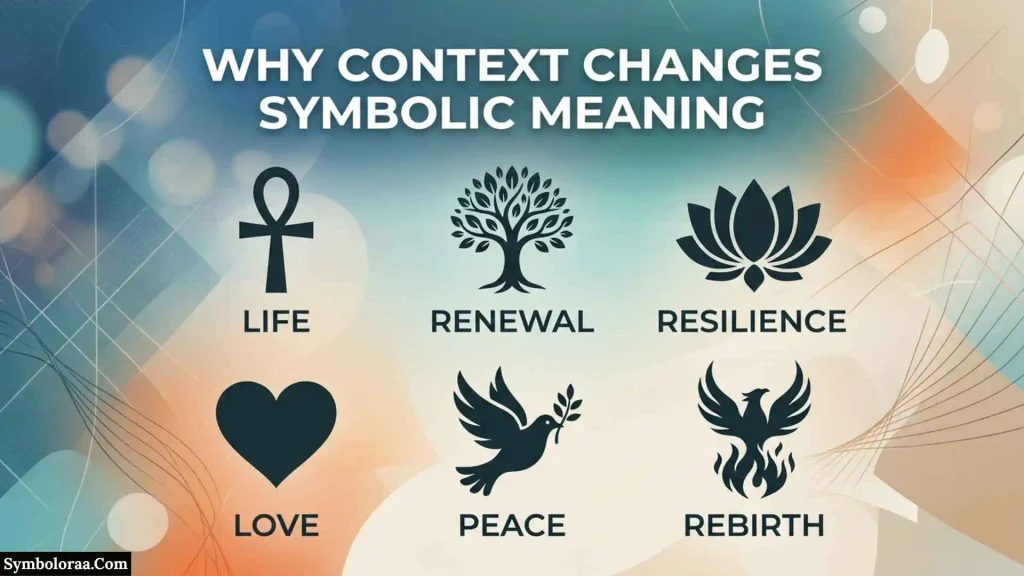
A symbol is not interpreted in isolation.
Consider the heart.
In one context:
Heart → love
In another:
Heart monitor → medical care
In another:
Broken heart → emotional pain
The visual object is similar, but the surrounding context changes the meaning.
The same principle applies to psychology.
A butterfly on a therapy website may suggest transformation.
A butterfly in a biology textbook represents an organism.
A butterfly in ancient mythology may have a different cultural or religious meaning.
This is why responsible symbolic interpretation always asks:
Who is using the symbol, where is it being used, and what idea is it meant to communicate?
Historical Development of Psychology and Its Symbolism
The history of psychology helps explain why its symbolism is connected to Greek terminology but is now used in a modern scientific context.
Ancient Greek Thought
Greek philosophers discussed questions about the mind, perception, knowledge, behavior, and the nature of the person long before psychology became a modern scientific discipline.
These historical discussions contributed to the intellectual background from which later psychological thought developed.
The Emergence of Modern Psychology
Modern psychology gradually developed as an independent scientific field during the nineteenth century.
The American Psychological Association was founded in 1892. APA’s historical records state that the organization began with 31 members and was established during the emergence of psychology as an academic discipline.
The history of psychology therefore extends beyond one symbol.
Its development involved:
- Philosophy
- Physiology
- Experimental research
- Observation
- Measurement
- Behavior research
- Cognitive science
- Clinical practice
- Social science
The symbol Ψ is a visual shorthand for this broad field, not a complete representation of everything psychology studies.
Psychology Symbols by Branch of Psychology
Different branches can use different imagery depending on the concept being communicated.
Cognitive Psychology
Best visual associations:
- Brain
- Head
- Thought patterns
- Memory imagery
- Eye
These can represent:
- Memory
- Attention
- Perception
- Learning
- Decision-making
Clinical Psychology
Possible symbolic imagery:
- Ψ
- Human figures
- Conversation
- Growth
- Support
- Well-being
The exact visual choice depends on whether the focus is clinical assessment, psychotherapy, research, or mental health.
Developmental Psychology
Useful metaphors include:
- Tree
- Growing person
- Life stages
- Pathway
These can communicate development across childhood, adolescence, adulthood, or aging.
Social Psychology
Possible visual ideas include:
- Groups of people
- Connected circles
- Networks
- Relationships
These emphasize interaction between people rather than the isolated individual.
Educational Psychology
Useful symbols include:
- Brain
- Book
- Student
- Learning pathway
- Lightbulb
These can communicate learning, memory, teaching, and educational development.
Personality Psychology
Possible imagery includes:
- Human profile
- Multiple faces
- Identity shapes
- Individual silhouettes
These can represent personality, identity, traits, and individual differences.
Best Psychology Symbols for Different Purposes
The best symbol depends on the message.
| Your Purpose | Strong Symbol Choice | Why |
| Represent psychology generally | Ψ | Direct association with psychology |
| Psychology student project | Ψ | Clear academic connection |
| Cognitive psychology | Brain | Represents cognition |
| Memory project | Brain or head | Suggests mental processing |
| Perception project | Eye | Represents perception |
| Child development | Tree or growth imagery | Communicates development |
| Personal transformation | Butterfly | Strong metaphor for change |
| Emotional relationships | Heart | Common emotional association |
| Self-discovery | Labyrinth or path | Suggests inner journey |
| Psychology logo | Ψ with simple supporting imagery | Clear and recognizable |
| Therapy website | Human/growth imagery | Can communicate support and change |
| Academic psychology department | Ψ | Direct disciplinary identity |
Psychology Symbols for Logos
If you are creating a psychology logo, clarity should come before decoration.
Best Choice for a General Psychology Logo
Ψ is usually the clearest starting point.
You can combine it with:
- A simple human profile
- A brain outline
- Circular shapes
- Minimal geometric forms
- An abstract representation of connection
Avoid combining too many unrelated symbols.
A logo containing a brain, heart, butterfly, tree, eye, puzzle, spiral, and Ψ may communicate too many ideas at once.
Minimalist Psychology Logo
For a minimalist design, consider:
Ψ + clean typography
or
Ψ + simple human profile
This immediately communicates the field without requiring a complicated explanation.
Psychology Symbols for Tattoos
People sometimes choose psychology symbols for tattoos because they want to represent:
- Their profession
- A psychology degree
- Personal growth
- Self-understanding
- Therapy
- Mental-health awareness
- A personal transformation
Ψ Tattoo Meaning
A Ψ tattoo can represent:
- Psychology
- Interest in psychological science
- Academic psychology
- A personal connection to the field
Butterfly Tattoo Meaning
A butterfly may communicate:
- Transformation
- Growth
- Change
- New beginnings
The important point is that a butterfly tattoo does not automatically mean psychology. Its meaning depends on the person’s intention.
Psychology Symbols for Educational Projects
Students can use symbols to make psychology presentations easier to understand.
For example:
Memory presentation → brain + memory imagery
Development presentation → tree or life-stage diagram
Perception presentation → eye
Psychology introduction → Ψ
Personality presentation → human profile
A good educational design uses symbols to reinforce the concept rather than replace the explanation.
Real-World Examples of Psychology Symbol Use
Example 1: University Psychology Department
A university wants a visual mark for its psychology department.
Best choice: Ψ
Why?
Because the goal is to identify the academic discipline rather than one specific psychological process.
Example 2: Cognitive Psychology Presentation
A student is presenting research about memory.
Best choice: Brain imagery.
Why?
The topic is cognition rather than psychology as a whole.
Example 3: Therapy Practice Website
A counseling practice wants its branding to communicate personal change.
Possible choice: Butterfly or growth imagery.
Why?
The intended message is transformation rather than academic psychology.
Example 4: Developmental Psychology Poster
A researcher creates a poster about human development across the lifespan.
Possible choice: Tree or pathway.
Why?
Both can communicate growth and progression.
Example 5: Psychology Student Tattoo
A psychology student wants a simple symbol that clearly identifies their field.
Best choice: Ψ.
Why?
It has a much more direct connection to psychology than a generic brain or heart.
How to Choose the Right Psychology Symbol
Use this five-question framework before choosing a symbol.
Step 1: What Are You Representing?
Ask:
Psychology itself?
Choose Ψ.
A specific psychological process?
Choose a concept-related image.
Step 2: What Is the Main Concept?
- Cognition → brain
- Perception → eye
- Emotion → heart
- Development → tree
- Transformation → butterfly
- Self-exploration → labyrinth
- Psychology generally → Ψ
Step 3: Who Is the Audience?
A university audience may understand Ψ immediately.
A general audience may understand a brain or human figure more quickly.
Step 4: Is the Meaning Official or Metaphorical?
This is critical.
If you are writing educational content, clearly state whether the symbol is:
- Conventional
- Conceptual
- Metaphorical
- Theory-specific
Step 5: Could the Symbol Be Misunderstood?
Before publishing a logo, tattoo, poster, or article, ask:
Could someone reasonably interpret this symbol differently?
If yes, add text or context.
Psychology Symbol Decision Tree
Use this quick guide:
Do you want to represent psychology as a field?
↓ Yes
Choose Ψ (psi).
Do you want to represent thinking, memory, or cognition?
↓ Yes
Choose brain imagery.
Do you want to represent perception or awareness?
↓ Yes
Consider an eye.
Do you want to represent personal growth?
↓ Yes
Consider a tree or butterfly.
Do you want to represent emotion or relationships?
↓ Yes
Consider a heart.
Do you want to represent self-discovery?
↓ Yes
Consider a labyrinth or pathway.
This decision tree prevents one of the most common errors: choosing a symbol because it “looks psychological” without considering what the design is actually supposed to communicate.
Common Misconceptions About Psychology Symbols
Misconception 1: The Brain Is the Official Psychology Symbol
Not exactly.
The brain is strongly associated with cognition and psychological processes, but Ψ is the conventional symbol most directly associated with psychology. The APA Dictionary explicitly supports the use of psi as a symbol for psychology.
Misconception 2: Every Butterfly Represents Psychology
No.
A butterfly can symbolize transformation, but its meaning is metaphorical.
Misconception 3: Ψ Means Mental Illness
No.
Ψ represents psychology broadly. Psychology includes normal and abnormal functioning, research, education, organizations, behavior, cognition, health, and many other areas.
Misconception 4: Psychology and Psychiatry Have the Same Symbol
They are related fields but not identical professions.
Misconception 5: Every Dream Symbol Has One Meaning
There is no universal scientific dictionary assigning one fixed meaning to every dream image.
Misconception 6: Jungian Archetypes Are Universal Scientific Laws
Jungian archetypes are part of analytical psychology. They are important historically and theoretically, but they should be identified as part of Jung’s framework rather than presented as universally established scientific facts.
How to Research a Psychology Symbol Before Using It
If accuracy matters, use this checklist.
Symbol Research Checklist
Before publishing an article or designing a graphic:
- Identify the symbol.
- Determine whether it is conventional or metaphorical.
- Check its historical origin.
- Look for cultural meanings.
- Identify the psychological theory if relevant.
- Check whether a professional organization actually uses it.
- Avoid presenting folklore as scientific fact.
- Distinguish psychology from psychiatry and mental health.
- Explain uncertainty when interpretations vary.
- Use authoritative sources for factual claims.
This method is especially useful for educational websites and SEO content because it prevents attractive but inaccurate claims from being repeated.
Why Symbolic Meanings Should Not Be Overstated
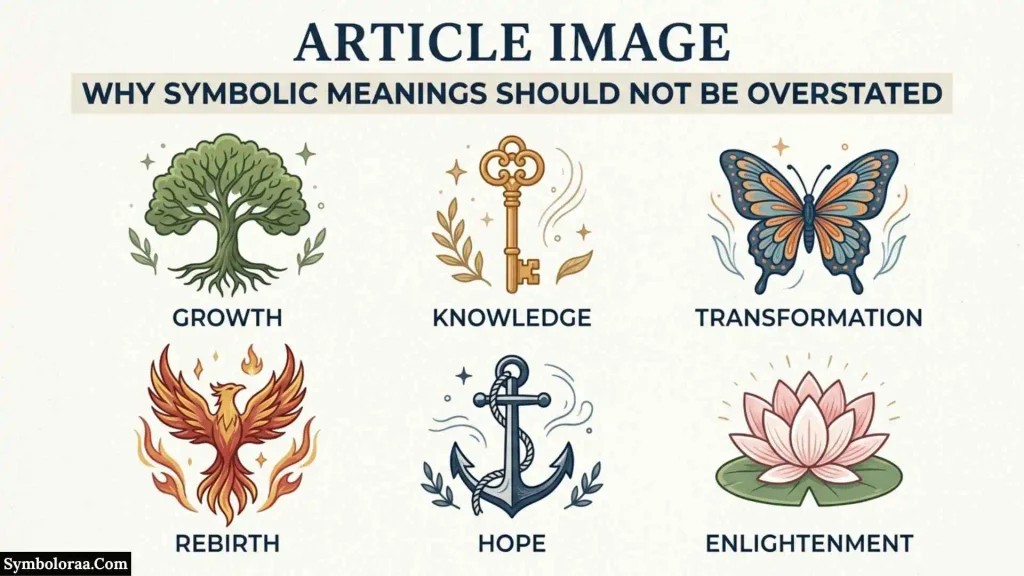
A common problem with online symbolism articles is certainty.
For example:
Weak claim:
“An eye always represents consciousness.”
Better claim:
“An eye can represent perception, observation, or awareness depending on the context.”
The second statement is more useful because it acknowledges that symbolism is interpretive.
The same principle applies to:
- Butterflies
- Trees
- Hearts
- Spirals
- Labyrinths
- Animals
- Colors
- Dream images
Psychological interpretation is not the same as decoding a universal symbol dictionary.
Frequently Asked Questions About Psychology Symbols
What is the main symbol of psychology?
The main conventional symbol associated with psychology is Ψ (psi). The APA Dictionary of Psychology states that the Greek letter ψ is often used to symbolize psychology.
What does Ψ stand for in psychology?
Ψ is the Greek letter psi and is widely used as a visual symbol for psychology.
How do you type the psychology symbol?
You can copy and paste the symbol:
Ψ
The lowercase version is:
ψ
Is Ψ the Greek symbol for psychology?
Ψ is a Greek letter called psi. Its use as a symbol for psychology comes from its association with Greek terminology connected to psyche and psychology.
What does the psychology symbol look like?
The uppercase Ψ resembles a central vertical stem with two upper branches. The lowercase version is ψ.
Is the brain a psychology symbol?
The brain is a common image associated with psychology, particularly cognition, memory, learning, and mental processes. However, Ψ is the more direct conventional symbol for psychology itself.
What animal represents psychology?
There is no single universally recognized animal that represents psychology. Butterflies are sometimes used metaphorically to communicate transformation and personal growth.
What flower symbolizes psychology?
There is no universally accepted official flower of psychology. Flowers can be used metaphorically for growth, healing, development, or well-being.
What symbol represents mental health?
There is no single universal symbol for all mental health. Different organizations, campaigns, and communities use different visual symbols and logos.
What does a butterfly symbolize psychologically?
A butterfly can symbolize transformation, growth, change, and personal development. These are metaphorical associations rather than an official definition within psychology.
What does a tree symbolize in psychology?
A tree can represent growth, development, stability, identity, roots, family, or different stages of life, depending on the context.
What does an eye symbolize psychologically?
An eye can represent perception, attention, observation, awareness, or vision. Its meaning depends on the context in which it is used.
What does a heart symbolize in psychology?
A heart commonly represents emotion, affection, attachment, compassion, and relationships. It is not an exclusive psychology symbol.
What does a labyrinth symbolize in psychology?
A labyrinth can be used as a metaphor for self-discovery, inner exploration, complexity, searching, or personal development.
What are Jungian symbols?
Jungian symbols are symbols considered within Carl Jung’s analytical psychology. Jung connected symbolic imagery with concepts such as archetypes and the unconscious.
What are Jungian archetypes?
In Jung’s analytical psychology, archetypes are recurring patterns or symbolic representations associated with aspects of the psyche and the collective unconscious. The APA Dictionary identifies examples such as the shadow, persona, anima, animus, and hero.
Is psychology the study of the soul?
Historically, the Greek term psyche had meanings associated with life, breath, spirit, and soul. Modern psychology, however, is a scientific discipline concerned with behavior and mental processes.
What is the difference between psychology and psychological symbolism?
Psychology is a scientific and professional field. Psychological symbolism refers to the use and interpretation of images, objects, or concepts that carry psychological meaning.
Are psychology symbols scientifically proven?
Some symbols have conventional or historical associations, such as Ψ with psychology. Other symbolic meanings are metaphorical or theory-specific and should not be treated as scientifically proven universal rules.
Key Takeaways
- Ψ (psi) is the most widely recognized conventional symbol of psychology.
- The APA Dictionary of Psychology specifically identifies ψ as a Greek letter often used to symbolize psychology.
- A brain usually represents cognition, memory, learning, or mental processes.
- An eye can represent perception and awareness.
- A heart can represent emotion and relationships.
- A tree can symbolize growth and development.
- A butterfly can represent transformation and personal change.
- A labyrinth can represent self-exploration or an inner journey.
- Not every psychology-related image is an official symbol of psychology.
- Psychology symbols can be divided into conventional, conceptual, metaphorical, and theory-specific categories.
- Psychology, psychiatry, psychotherapy, and mental health are related but distinct concepts.
- Jungian symbolism belongs to a specific theoretical tradition and should be presented in that context.
- Dream symbols do not have one universally accepted scientific meaning.
- Context, culture, personal experience, and intended use can change the meaning of a symbol.
Conclusion
The simplest answer to “What is the psychology symbol?” is Ψ (psi). It is the most widely recognized conventional symbol associated with psychology, and the APA Dictionary of Psychology explicitly identifies the Greek letter ψ as a symbol often used for the field.
But a complete understanding of psychology symbols requires more than memorizing Ψ.
The brain can communicate cognition. The eye can suggest perception. The heart can represent emotion. A tree can express development. A butterfly can symbolize transformation. A labyrinth can represent self-exploration. These images can be powerful, but their meanings are usually contextual or metaphorical rather than official.
The most reliable way to interpret a psychology symbol is therefore to ask four questions:
What does the symbol normally represent?
Is that meaning conventional, metaphorical, or theory-specific?
What context is the symbol being used in?
Could another culture, audience, or psychological tradition interpret it differently?
That approach produces a more accurate understanding of psychological symbolism and avoids the common mistake of presenting every symbolic association as a scientific fact.

I’m Ethan Brooks, an American writer passionate about stories that explore modern life, relationships, ambition, and personal growth. I love creating characters who feel real and face challenges readers can recognize. Through my writing, I hope to entertain, inspire, and encourage readers to see everyday experiences from a different perspective.
Three Books:
The City Between Us
After the Last Goodbye
A Different Tomorrow
 Jackson Miller