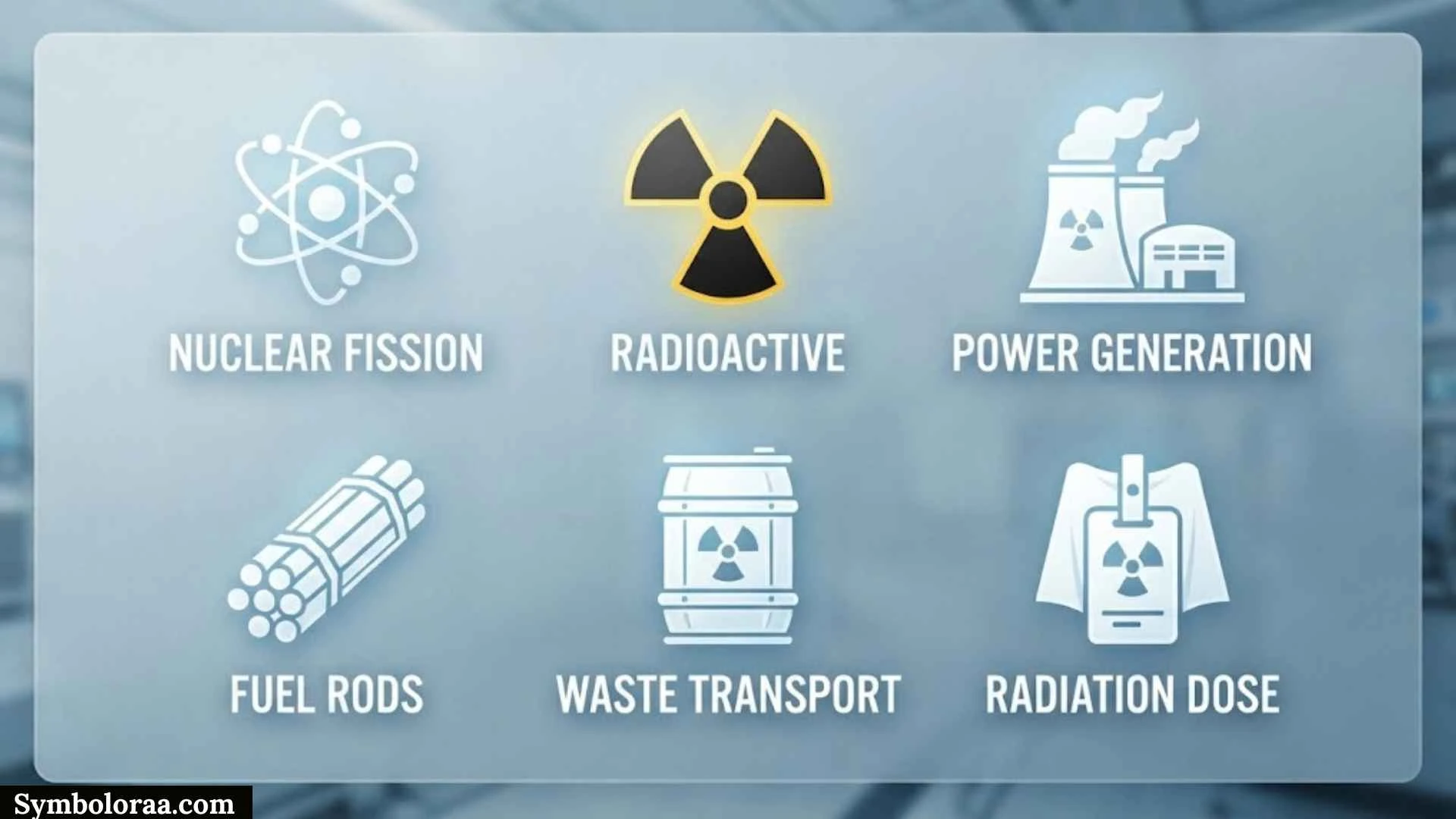
Nuclear symbols provide a simple way to identify an element and show important information about its nucleus. They are widely used in chemistry, nuclear chemistry, physics, isotope studies, and classroom worksheets. A standard nuclear symbol can tell you the element, mass number, and atomic number at a glance.
This guide covers the main search intents around nuclear symbols, including nuclear symbols in chemistry, isotope notation, nuclear symbols for elements, how to write and read them, uranium examples, and the difference between related nuclear and radiation symbols. You will also find useful copy-and-paste characters such as ☢, ⚛, α, β, and γ.
If you are studying chemistry, completing a nuclear symbols worksheet, preparing notes, or looking for an easy explanation of isotope notation, the examples below will help you understand how the system works and how to apply it correctly.
What are Nuclear Symbols
A nuclear symbol, also called nuclide notation, identifies a particular type of atomic nucleus using an element symbol together with its mass number and atomic number. The standard form is:
ᴬZX
Here:
- A = mass number
- Z = atomic number
- X = chemical symbol of the element
The mass number is the total number of protons and neutrons in the nucleus. The atomic number is the number of protons. Therefore:
Mass number = protons + neutrons
Neutrons = mass number − atomic number
For example:
¹⁴₆C
represents carbon-14. Carbon has atomic number 6, so it has 6 protons. Its mass number is 14, meaning it has 14 total protons and neutrons. Therefore, carbon-14 contains 8 neutrons.
The atomic number is sometimes left out because the element symbol already identifies the element. For example, ¹⁴C is enough to identify carbon-14 in many chemistry contexts.
Nuclear Symbols Chemistry
Nuclear symbols are important in chemistry because they connect an element’s identity with the structure of its nucleus. Students commonly use them when learning about atoms, isotopes, atomic numbers, mass numbers, and nuclear reactions.
Consider this example:
²³₁₁Na
The symbol Na identifies sodium. The number 11 is its atomic number, so every sodium atom has 11 protons. The number 23 is the mass number.
To find the neutrons:
23 − 11 = 12 neutrons
Another example is:
³⁵₁₇Cl
This represents chlorine-35.
- Protons: 17
- Neutrons: 18
- Mass number: 35
- Atomic number: 17
Nuclear notation is especially useful for isotopes because the same element can have different numbers of neutrons while keeping the same atomic number.
Nuclear Symbols Copy and Paste
If you need nuclear-related symbols for notes, school projects, websites, documents, or social media, these characters can be copied directly:
| Symbol | Name or common use |
| ☢ | Radioactive sign |
| ⚛ | Atom symbol |
| α | Greek alpha |
| β | Greek beta |
| γ | Greek gamma |
| → | Right arrow |
| ↑ | Up arrow |
| ↓ | Down arrow |
| ⁰ | Superscript zero |
| ¹ | Superscript one |
| ² | Superscript two |
| ³ | Superscript three |
| ⁴ | Superscript four |
| ⁵ | Superscript five |
| ⁶ | Superscript six |
| ⁷ | Superscript seven |
| ⁸ | Superscript eight |
| ⁹ | Superscript nine |
Common Nuclear Copy and Paste Examples
☢ Radioactive
⚛ Atom
α Alpha
β Beta
γ Gamma
These characters are useful for general nuclear and science-related text, but they should not be confused with complete nuclear notation. For example, ☢ is a radiation warning symbol, while ²³⁸₉₂U identifies a specific uranium nuclide.
For formal chemistry work, proper superscript and subscript formatting is preferable to simply placing numbers on the same line.
Nuclear Icon Text
Nuclear icon text usually refers to characters that visually represent atoms, radiation, or nuclear science without using an image.
The two most recognizable options are:
☢ — Radioactive sign
⚛ — Atom symbol
The radioactive sign is associated with ionizing radiation and radioactive materials. The atom symbol has a broader scientific meaning and is commonly used for chemistry, physics, atomic science, and educational content.
You can use these symbols in:
- Chemistry notes
- Science presentations
- Educational websites
- Digital worksheets
- Study guides
- Social media posts
- Text headings
- Science-themed designs
Keep the context in mind. A nuclear icon is not automatically a nuclear isotope symbol. For example, ⚛ does not tell you the atomic number or mass number of an element.
Nuclear Symbol Example
A basic nuclear symbol example is:
¹²₆C
This represents carbon-12.
The information can be broken down as follows:
| Part | Meaning |
| 12 | Mass number |
| 6 | Atomic number |
| C | Carbon |
| 6 | Protons |
| 6 | Neutrons |
The neutron calculation is:
12 − 6 = 6
Another example is:
²³⁸₉₂U
This represents uranium-238.
Uranium has 92 protons, and:
238 − 92 = 146 neutrons
Nuclear notation can therefore provide a quick description of the nucleus without writing a full sentence.
Nuclear Symbol Font
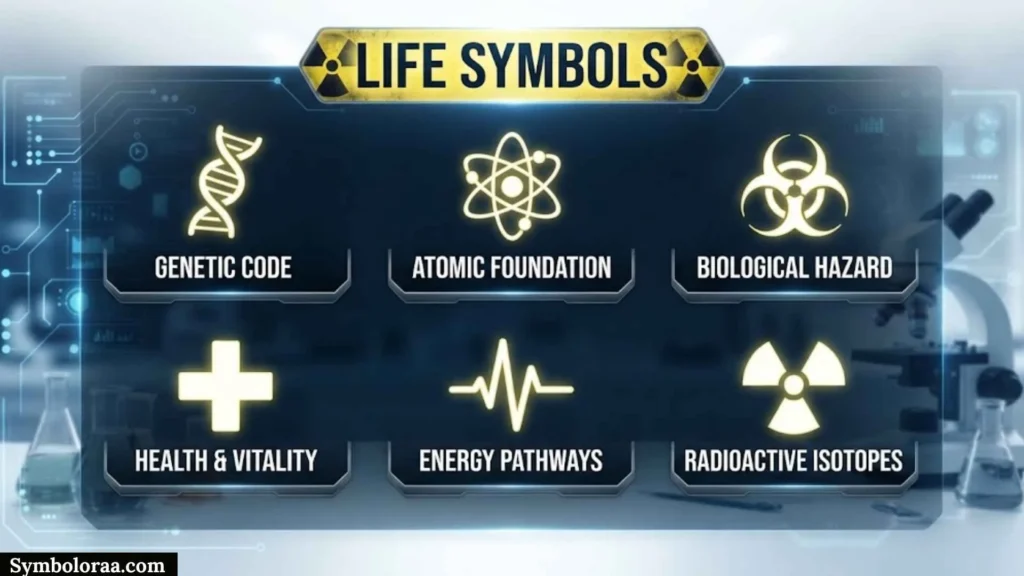
You do not need a special nuclear symbol font to write standard nuclear notation. Nuclear symbols are normally created using the chemical element symbol plus superscript and subscript numbers.
For example:
⁵⁶₂₆Fe
represents iron-56.
The important part is the position of the numbers:
- Mass number → upper left
- Atomic number → lower left
- Element symbol → center
Some websites and decorative fonts may contain atom or radiation icons, but decorative characters are not substitutes for standardized isotope notation.
When preparing chemistry assignments, equation editors or normal text formatting with superscript and subscript functions are usually more appropriate. Chemistry references commonly show nuclear notation in the form ᴬZX, with A as mass number and Z as atomic number.
Nuclear Symbols for Elements
Every chemical element has an official chemical symbol. Nuclear notation combines that symbol with the atomic number and mass number.
Here are some common examples:
| Element | Symbol | Atomic Number | Example Nuclear Symbol |
| Hydrogen | H | 1 | ¹₁H |
| Helium | He | 2 | ⁴₂He |
| Carbon | C | 6 | ¹²₆C |
| Nitrogen | N | 7 | ¹⁴₇N |
| Oxygen | O | 8 | ¹⁶₈O |
| Sodium | Na | 11 | ²³₁₁Na |
| Chlorine | Cl | 17 | ³⁵₁₇Cl |
| Iron | Fe | 26 | ⁵⁶₂₆Fe |
| Copper | Cu | 29 | ⁶³₂₉Cu |
| Silver | Ag | 47 | ¹⁰⁷₄₇Ag |
| Gold | Au | 79 | ¹⁹⁷₇₉Au |
| Uranium | U | 92 | ²³⁸₉₂U |
The atomic number is what defines the element. Changing the atomic number changes the element itself.
Periodic Table Nuclear Symbols
The periodic table is an important reference when writing nuclear symbols because it provides the chemical symbol and atomic number for each element.
For example, uranium appears as U and has an atomic number of 92. If the isotope is uranium-238, its nuclear notation is:
²³⁸₉₂U
It is useful to remember that the mass number of a specific isotope is not simply the same thing as the average atomic mass shown on a standard periodic table. The periodic table generally provides an element’s atomic number and a standard atomic-weight value, while nuclear notation identifies a particular isotope using an integer mass number.
For example:
U → atomic number 92
Uranium-235 → ²³⁵₉₂U
Uranium-238 → ²³⁸₉₂U
This distinction prevents a common mistake when students convert periodic-table information into isotope notation.
Different Nuclear Symbols
Different nuclear symbols can represent different elements or different isotopes of the same element.
Compare:
¹²₆C
¹³₆C
¹⁴₆C
All three are carbon because their atomic number is 6. However, their mass numbers differ, so they contain different numbers of neutrons.
Another comparison is:
¹⁴₆C
¹⁴₇N
These have the same mass number, 14, but different atomic numbers. Therefore, one is carbon and the other is nitrogen.
A useful rule is:
- Same atomic number + different mass number = isotopes
- Different atomic number = different elements
This rule is one of the easiest ways to compare nuclear symbols.
Different Nuclear Symbols Meaning
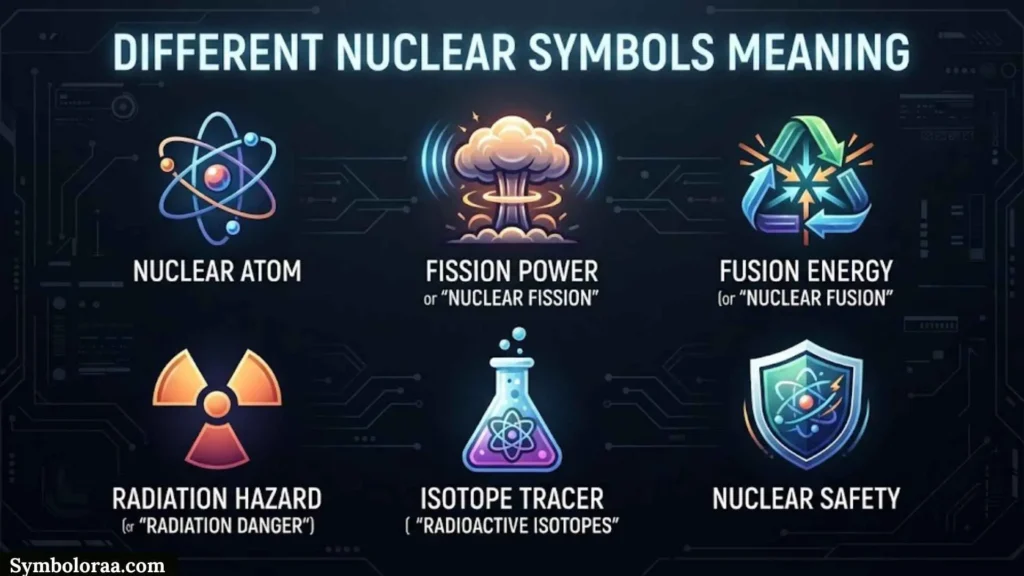
The meaning of a nuclear symbol depends on the position and value of each part.
For:
³⁷₁₇Cl
you can identify:
- Cl = chlorine
- 17 = atomic number
- 37 = mass number
- Protons = 17
- Neutrons = 20
The neutron calculation is:
37 − 17 = 20
The upper number is called the mass number, not the atomic mass. It is a whole number representing the total number of protons and neutrons in that nucleus.
The lower number is the atomic number, which equals the number of protons and identifies the element.
This distinction matters because students sometimes confuse mass number with the decimal atomic weight displayed on many periodic tables. Nuclear notation uses the mass number of a particular nuclide.
Difference Between Nuclear Symbols
The main difference between nuclear symbols is usually found in their atomic number, mass number, or element symbol.
For example:
¹²₆C and ¹⁴₆C
Both have atomic number 6, so both are carbon. Their mass numbers differ, making them different isotopes.
Now compare:
¹⁴₆C and ¹⁴₇N
The mass number is the same, but the atomic number is different. They are therefore different elements.
Nuclear notation should also be separated from radiation notation. A complete isotope symbol such as ²³⁵₉₂U identifies a nuclide, whereas α, β, and γ are commonly used for types of nuclear radiation or radiation particles.
Understanding this difference helps avoid treating every nuclear-related character as an isotope symbol.
How to Write Nuclear Symbols
Writing a nuclear symbol is straightforward when you know the element and its mass number.
Step 1: Identify the Element
Find the chemical symbol for the element.
For sodium:
Na
Step 2: Find the Atomic Number
Use the periodic table to find the atomic number.
Sodium has atomic number:
11
Step 3: Find the Mass Number
If you are writing sodium-23, the mass number is:
23
Step 4: Format the Symbol
Place the mass number at the upper left and atomic number at the lower left:
²³₁₁Na
The same method works for any isotope.
For chlorine-37:
³⁷₁₇Cl
For carbon-14:
¹⁴₆C
For uranium-238:
²³⁸₉₂U
The standard notation is commonly expressed as ᴬZX, where A is mass number and Z is atomic number.
Nuclear Symbols for Isotopes
Isotopes are atoms of the same element that have the same number of protons but different numbers of neutrons. Because their proton numbers remain the same, their atomic number also remains the same. Their different neutron counts produce different mass numbers.
For example, carbon has these common isotope examples:
¹²₆C — carbon-12
¹³₆C — carbon-13
¹⁴₆C — carbon-14
All have six protons.
Their neutron counts are:
- Carbon-12 → 6 neutrons
- Carbon-13 → 7 neutrons
- Carbon-14 → 8 neutrons
Hydrogen provides another useful example:
¹₁H — hydrogen-1
²₁H — hydrogen-2
³₁H — hydrogen-3
The last two are commonly called deuterium and tritium. The nuclear notation makes the difference between the isotopes immediately visible.
How to Write Nuclear Symbols for Isotopes
To write a nuclear symbol for an isotope, start with the isotope name and identify two numbers: its mass number and the element’s atomic number.
For example, suppose the isotope is oxygen-16.
- Oxygen has the symbol O.
- Oxygen’s atomic number is 8.
- Oxygen-16 has a mass number of 16.
- Place 16 at the upper left.
- Place 8 at the lower left.
The result is:
¹⁶₈O
For iron-56:
⁵⁶₂₆Fe
For carbon-14:
¹⁴₆C
The element symbol determines the atomic number, while the isotope name supplies the mass number. This is why you can convert between a name such as uranium-235 and the complete notation ²³⁵₉₂U.
Do Isotopes Have Different Nuclear Symbols
Yes. Different isotopes of an element have different nuclear symbols because their mass numbers are different.
For example:
¹²₆C
¹³₆C
¹⁴₆C
The lower number remains 6 because all carbon atoms have six protons. The upper number changes because the isotopes contain different numbers of neutrons.
However, the shorter isotope notation may show only the mass number and element symbol:
¹²C
¹³C
¹⁴C
This shorter format is common because the element symbol already identifies the atomic number. Complete nuclear notation is particularly useful when showing nuclear reactions or when the atomic number needs to be explicit.
Write Nuclear Symbols for Isotopes of Uranium
Uranium is a useful example for understanding isotope notation because uranium has an atomic number of 92.
Two commonly discussed uranium isotopes are:
²³⁵₉₂U — uranium-235
²³⁸₉₂U — uranium-238
Their proton and neutron counts are:
| Uranium isotope | Protons | Neutrons |
| Uranium-235 | 92 | 143 |
| Uranium-238 | 92 | 146 |
For uranium-235:
235 − 92 = 143 neutrons
For uranium-238:
238 − 92 = 146 neutrons
The atomic number stays 92 in both symbols because both nuclei belong to uranium. The mass number changes because the neutron counts are different. Chemistry references use the same notation when identifying uranium isotopes.
Nuclear Symbols Alpha Beta Gamma
The symbols α, β, and γ are strongly associated with nuclear radiation, but they are not simply alternative forms of an isotope’s basic nuclear symbol.
- α — alpha
- β — beta
- γ — gamma
An alpha particle is a helium nucleus containing two protons and two neutrons. It can therefore be represented in nuclear equations as:
⁴₂He
A beta-minus particle is an electron and may be represented as:
⁰₋₁e
Gamma radiation is electromagnetic radiation and is commonly represented in nuclear equations as:
⁰₀γ
These symbols appear in nuclear decay equations. For example, a nuclear equation may show a parent nuclide changing into another nuclide while emitting an alpha, beta, or gamma particle.
The important distinction is that ²³⁸₉₂U identifies a nuclide, while α, β, and γ identify forms of nuclear radiation or emissions.
How to Read Nuclear Symbols
Reading a nuclear symbol becomes easy when you follow the same order each time.
Take:
²³₁₁Na
First, identify Na as sodium.
Next, read the lower-left number:
11 = atomic number
Then read the upper-left number:
23 = mass number
Finally, calculate the neutrons if needed:
23 − 11 = 12
So ²³₁₁Na represents sodium-23 with:
- 11 protons
- 12 neutrons
- 23 total nucleons
Try another example:
⁵⁶₂₆Fe
This is iron-56.
- Atomic number = 26
- Mass number = 56
- Protons = 26
- Neutrons = 30
You can also read isotope notation in hyphen form. For example, ²⁴Mg is read as magnesium-24, and ²³⁸U is read as uranium-238.
Nuclear Symbols Worksheet
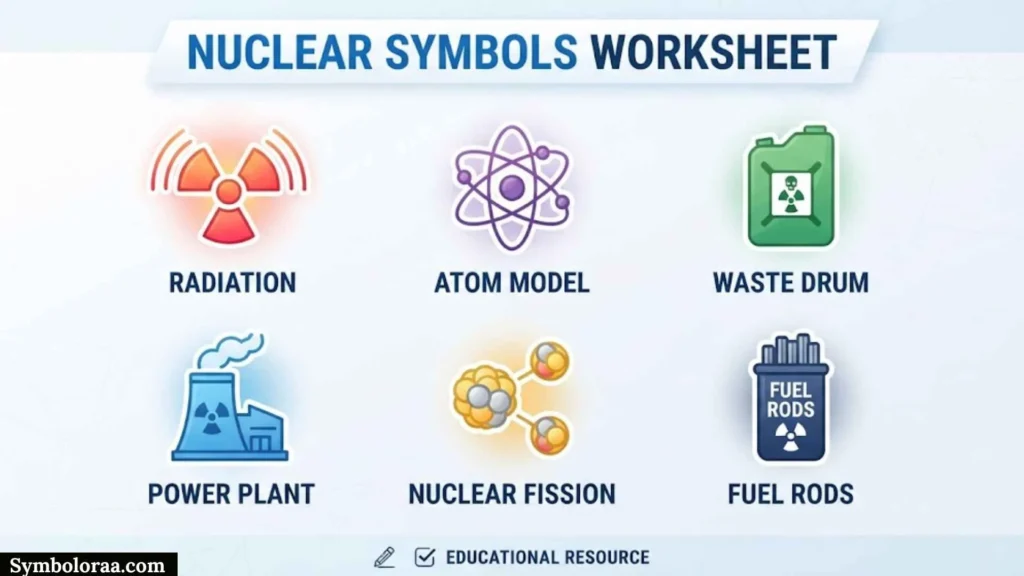
A nuclear symbols worksheet can help students practice identifying atomic numbers, mass numbers, protons, neutrons, elements, and isotopes.
Practice Question 1
Identify the element:
²³₁₁Na
Answer: Sodium
Practice Question 2
How many neutrons are in:
³⁵₁₇Cl
Answer:
35 − 17 = 18 neutrons
Practice Question 3
Write the nuclear symbol for carbon-14.
Answer:
¹⁴₆C
Practice Question 4
Identify this isotope:
²³⁸₉₂U
Answer: Uranium-238
Practice Question 5
How many protons are in:
⁵⁶₂₆Fe
Answer: 26 protons
Practice Question 6
Which pair represents isotopes?
A. ¹²₆C and ¹⁴₆C
B. ¹⁴₆C and ¹⁴₇N
Answer: A
Both symbols in A have the same atomic number and element but different mass numbers.
A useful worksheet formula to remember is:
Number of neutrons = mass number − atomic number
This single calculation solves many basic nuclear-symbol questions.
FAQ
What is a nuclear symbol?
A nuclear symbol identifies a nuclide using its element symbol, mass number, and atomic number.
How do you find neutrons from a nuclear symbol?
Subtract the atomic number from the mass number to find the number of neutrons.
Why do isotopes have different nuclear symbols?
Isotopes have different numbers of neutrons, which changes their mass numbers and therefore changes their isotope notation.
What is the nuclear symbol for uranium-235?
The complete nuclear symbol for uranium-235 is ²³⁵₉₂U.
What do α, β, and γ mean in nuclear chemistry?
They represent alpha, beta, and gamma radiation or emissions used in descriptions of nuclear decay and reactions.
Conclusion
Nuclear symbols provide a compact way to describe atoms and their nuclei. The basic pattern ᴬZX uses the mass number, atomic number, and element symbol to identify a specific nuclide. Once these three parts are understood, most isotope notation becomes much easier to read and write.
The same system can be used for common elements such as carbon, sodium, chlorine, iron, and uranium. It also helps explain why isotopes of the same element have the same atomic number but different mass numbers. Symbols such as ☢, ⚛, α, β, and γ are useful related characters, but they have different purposes from standard isotope notation.
For chemistry worksheets and study questions, remember the three core rules: atomic number equals protons, mass number equals protons plus neutrons, and neutrons equal mass number minus atomic number. With these rules, you can identify, compare, write, and read nuclear symbols with confidence.

I’m Jackson Miller, an American author inspired by mystery, adventure, and the unpredictable nature of life. I enjoy writing fast-moving stories filled with memorable characters, unexpected choices, and meaningful moments. Through my books, I want readers to experience new worlds while discovering something about courage, determination, and themselves.
Three Books:
The Edge of Tomorrow
Under a Broken Sky
The Road We Chose
 Madison Reed