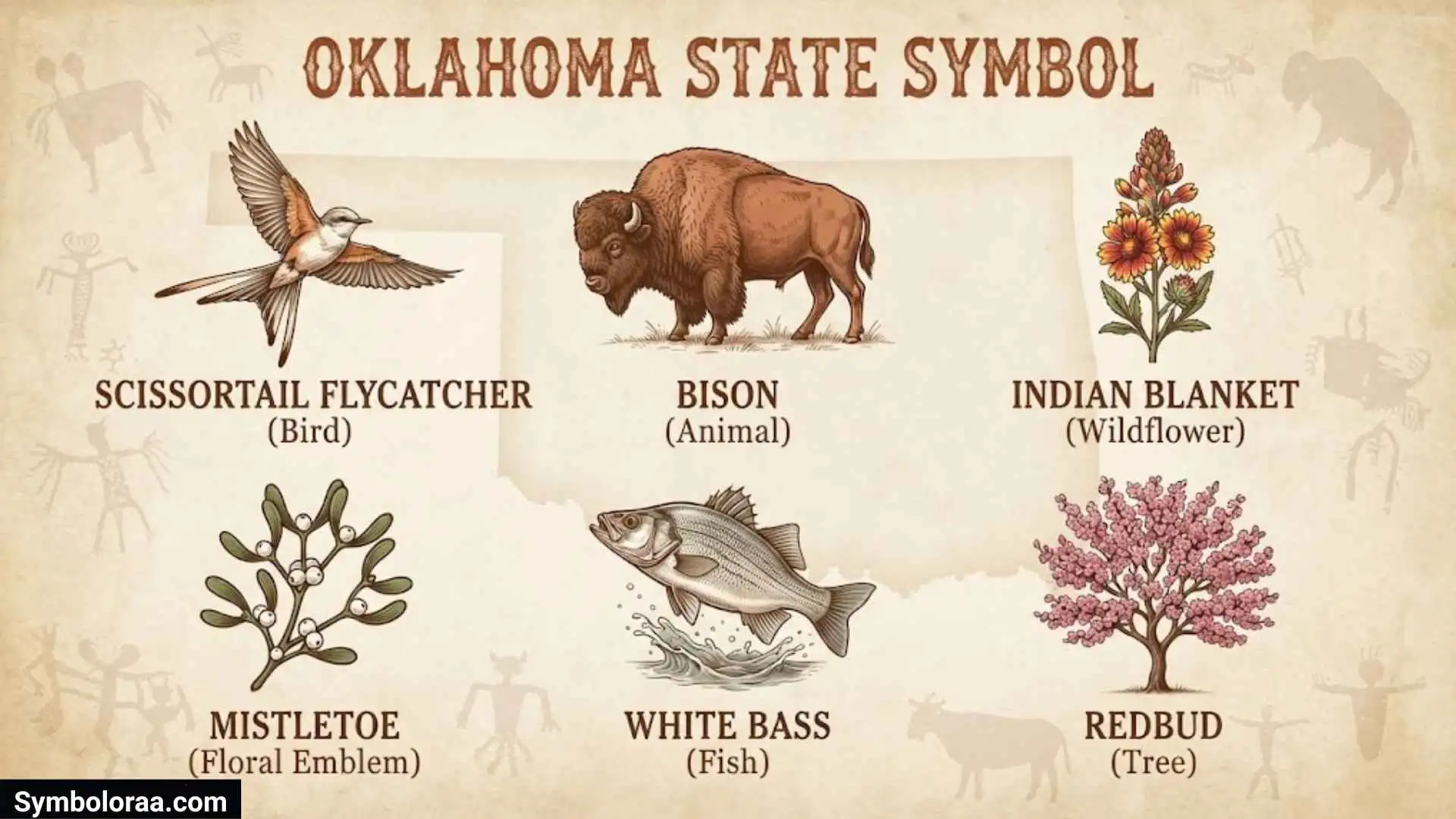
Oklahoma state symbols represent the state’s wildlife, plants, history, culture, and natural resources. From the scissor-tailed flycatcher to the Oklahoma rose, each official symbol tells something unique about the state and its identity. These emblems also help students understand Oklahoma’s connection to nature and its historical traditions.
If you are searching for Oklahoma state symbols and their meanings, this guide covers the most important official emblems, including the state bird, animal, flower, and tree. You will also learn about other state symbols, their differences from Kansas symbols, and how these emblems can be used in educational activities.
If you are preparing a school assignment, teaching children about American states, or researching official state emblems, this article provides useful facts in an easy-to-understand format. It also explains how to identify official designations and avoid confusing Oklahoma’s symbols with those of neighboring states.
Oklahoma State Symbols and Emblems
Oklahoma has many official state symbols that represent its natural environment, cultural heritage, and history. Some are familiar to residents, while others, such as the state rock and state crystal, are less widely known.
These symbols include animals, birds, flowers, trees, insects, rocks, colors, and official emblems. Each designation has its own significance, and some symbols were adopted many years apart.
Here is an overview of notable Oklahoma state symbols and what they represent.
| State Symbol | Official Symbol | Significance |
| State bird | Scissor-tailed flycatcher | Native wildlife and open landscapes |
| State animal | American bison | Grassland wildlife and cultural heritage |
| State flower | Oklahoma rose | Floral beauty and state pride |
| State tree | Eastern redbud | Springtime beauty and native vegetation |
| State wildflower | Indian blanket | Colorful prairie landscapes |
| State floral emblem | Mistletoe | Historical state tradition |
| State reptile | Collared lizard | Native reptile diversity |
| State raptor | Red-tailed hawk | Wildlife and the natural environment |
| State insect | Honeybee | Pollination and agriculture |
| State fruit | Strawberry | Agricultural heritage |
| State vegetable | Watermelon | Oklahoma’s agricultural identity |
| State rock | Rose rock | Distinctive geological formations |
| State crystal | Hourglass selenite | Unique mineral formations |
| State horse | American Quarter Horse | Equine heritage and ranching |
| State drink | Milk | Dairy farming |
| State colors | Green and white | Official state identity |
Oklahoma also has an official state flag and the Great Seal of Oklahoma. These emblems have different purposes: the flag serves as a recognizable representation of the state, while the seal is used in official government contexts.
The complete collection of symbols reflects Oklahoma’s diverse identity. Its animal symbols highlight wildlife, its plant symbols represent local vegetation, and its other emblems recognize geology, agriculture, and cultural traditions.
Ok State Bird
The official state bird of Oklahoma is the scissor-tailed flycatcher, scientifically known as Tyrannus forficatus. Oklahoma designated this distinctive bird as its state bird in 1951.
The scissor-tailed flycatcher is known for its long, forked tail, pale gray body, white underside, and dark wings. Its tail feathers create a shape that resembles an open pair of scissors, which explains the bird’s common name.
This bird is particularly associated with open grasslands, pastures, and areas with scattered trees. It often sits on fences or exposed branches before flying into the air to catch insects.
Why Is the Scissor-Tailed Flycatcher Oklahoma’s State Bird?
The scissor-tailed flycatcher represents Oklahoma’s native wildlife and open landscapes. Its unusual appearance also makes it one of the easiest state birds to recognize.
The bird feeds mainly on insects, including grasshoppers, beetles, and other flying insects. Its hunting behavior helps explain why it is frequently seen in open areas where prey is easier to spot.
Quick facts about the Oklahoma state bird:
- Common name: Scissor-tailed flycatcher
- Scientific name: Tyrannus forficatus
- Official designation: State bird
- Adoption year: 1951
- Distinctive feature: Long, forked tail
- Typical habitat: Open fields, grasslands, and pastures
The scissor-tailed flycatcher is also a useful subject for school projects about bird identification, migration, habitats, and food chains. Students can describe its appearance and explain how it catches insects to understand its role in the ecosystem.
OK State Animal
Oklahoma’s official state animal is the American bison, scientifically known as Bison bison. It was designated as the state animal in 1972.
The American bison is a large mammal with a muscular body, a prominent shoulder hump, short curved horns, and thick brown hair around its head and shoulders. Its powerful build makes it one of the most recognizable animals associated with North American grasslands.
Bison historically roamed large areas of the Great Plains, including parts of present-day Oklahoma. They also hold deep cultural and historical significance for many Indigenous peoples, for whom bison provided food, hides, and other essential resources.
What Does the American Bison Represent?
The American bison represents Oklahoma’s natural heritage and its connection to the Great Plains. Its history also highlights the importance of wildlife conservation and the relationship between people and the land.
Although people often use the word buffalo to describe this animal, the North American species is scientifically classified as a bison. True buffalo species, such as the African buffalo and water buffalo, belong to different groups.
Quick facts about the Oklahoma state animal:
- Common name: American bison
- Scientific name: Bison bison
- Official designation: State animal
- Adoption year: 1972
- Distinctive features: Shoulder hump, curved horns, and shaggy coat
- Natural habitat: Grasslands and other suitable open environments
The bison is an excellent example for educational activities about mammals, native wildlife, conservation, and Oklahoma’s historical landscape.
OK State Flower
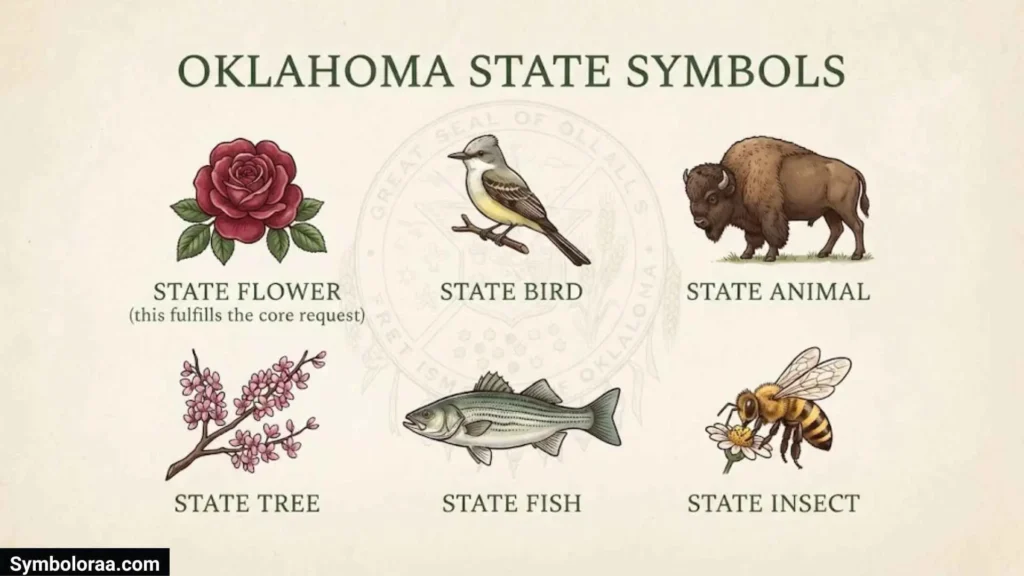
The official state flower of Oklahoma is the Oklahoma rose, a hybrid tea rose recognized in 2004.
The Oklahoma rose is known for its attractive, deep red blooms and noticeable fragrance. Its elegant petals and rich color make it a popular choice for gardens, floral arrangements, and decorative designs.
The variety was developed by rose breeders Herbert Swim and O. L. Weeks in 1964. Dottie Weissenberger later became a prominent advocate for recognizing the Oklahoma rose as the state’s official flower. Her campaign continued for decades before the designation was achieved.
What Does the Oklahoma Rose Symbolize?
Roses commonly represent love, beauty, respect, and appreciation, although their meanings can vary according to culture and context. As Oklahoma’s state flower, the Oklahoma rose represents the state’s floral identity and pride.
The Oklahoma rose is a cultivated hybrid rather than a wildflower native to the state’s prairies. This distinction is useful when comparing it with other official Oklahoma plant symbols.
Quick facts about the Oklahoma state flower:
- Common name: Oklahoma rose
- Flower type: Hybrid tea rose
- Recognized as the state flower: 2004
- Distinctive features: Deep red petals and strong fragrance
- Common uses: Gardens, floral arrangements, and educational artwork
The Oklahoma rose is suitable for school projects about plant varieties, gardening, and state emblems. Students can describe its color and fragrance while explaining why it was selected as an official symbol.
OK State Tree
Oklahoma’s official state tree is the eastern redbud, scientifically known as Cercis canadensis.
The eastern redbud is a small to medium-sized deciduous tree recognized for its pink or purplish flowers, which bloom in early spring. The flowers often appear on the branches before the leaves fully develop, creating a colorful display.
Its heart-shaped leaves provide another easy identification feature. After flowering, the tree develops green foliage and produces flat seed pods. Eastern redbuds can grow in suitable yards, parks, woodland edges, and natural landscapes.
Why Is the Eastern Redbud Oklahoma’s State Tree?
The eastern redbud represents Oklahoma’s natural beauty and seasonal plant life. Its spring flowers make it a familiar sight in many parts of the region.
The tree also supports local ecosystems. Its early flowers provide resources for pollinators, while its branches and foliage contribute to wildlife habitat.
Quick facts about the Oklahoma state tree:
- Common name: Eastern redbud
- Scientific name: Cercis canadensis
- Official designation: State tree
- Distinctive features: Pink spring flowers and heart-shaped leaves
- Typical height: Approximately 20 to 30 feet
- Type: Deciduous tree
The eastern redbud is a helpful example in lessons about trees, flowering plants, seasonal changes, and plant identification.
Kansas State Symbols
Kansas and Oklahoma are neighboring states with several similarities in geography, agriculture, and history. However, their official symbols differ, and learning about those differences helps students identify the correct bird, flower, and tree for each state.
Kansas is known as the Sunflower State because of its association with the sunflower. Oklahoma is commonly called the Sooner State and has its own distinct collection of state emblems.
Oklahoma and Kansas State Symbols Compared
| Symbol Category | Oklahoma | Kansas |
| State bird | Scissor-tailed flycatcher | Western meadowlark |
| State animal | American bison | American buffalo |
| State flower | Oklahoma rose | Wild native sunflower |
| State tree | Eastern redbud | Eastern cottonwood |
| State nickname | The Sooner State | The Sunflower State |
Kansas selected the western meadowlark as its state bird, the wild native sunflower as its state flower, and the eastern cottonwood as its state tree.
The American buffalo is Kansas’s official state animal. In North American usage, the term buffalo commonly refers to the American bison, the species also recognized as Oklahoma’s state animal.
Why Are These Differences Important?
Students sometimes mix up state symbols because neighboring states may share similar landscapes and wildlife. Comparing the official designations makes it easier to remember which symbol belongs to which state.
For example, the sunflower belongs to Kansas, while the Oklahoma rose represents Oklahoma. Similarly, the western meadowlark is Kansas’s state bird, whereas Oklahoma’s bird is the scissor-tailed flycatcher.
A comparison chart is especially useful for geography quizzes, classroom presentations, state reports, and educational worksheets.
Oklahoma State Symbols Coloring Pages
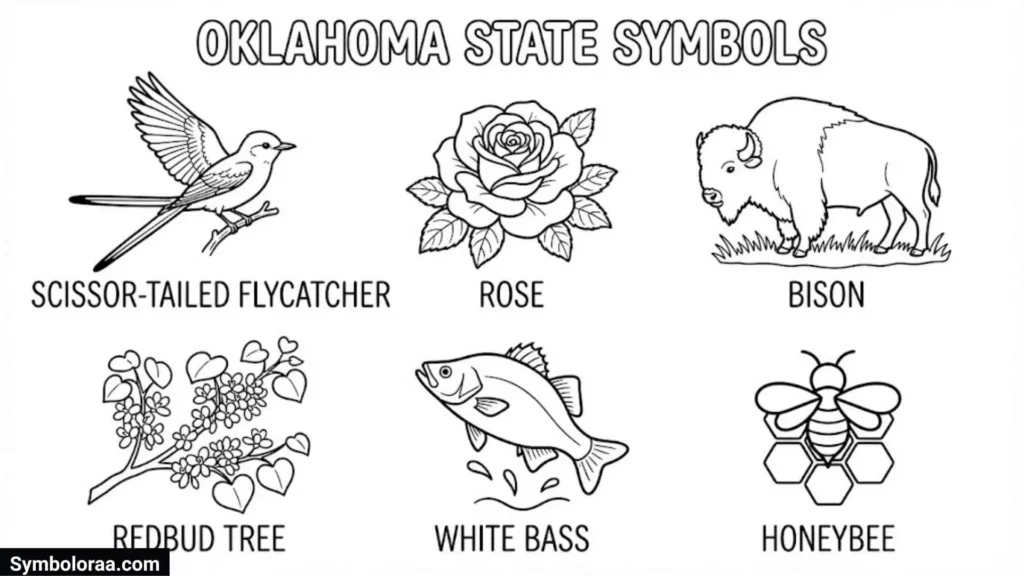
Oklahoma state symbols coloring pages offer a creative way to learn about the state’s official emblems. They combine art with basic information about animals, birds, flowers, trees, and other features of Oklahoma.
Teachers and parents can use coloring activities to help children recognize each symbol and remember its name. These activities are also suitable for classroom displays, state history lessons, and home learning.
Popular Oklahoma Symbol Coloring Ideas
Scissor-Tailed Flycatcher: Children can color the bird’s body, wings, and long forked tail while learning its name and habitat.
American Bison: A bison outline provides an opportunity to discuss mammals, grasslands, and wildlife conservation.
Oklahoma Rose: A rose coloring sheet can introduce flower parts, petal shapes, and cultivated plants.
Eastern Redbud: A redbud tree illustration can help children identify heart-shaped leaves and spring flowers.
Oklahoma State Flag: A flag worksheet can teach students about the official flag’s design and its historical meaning.
Great Seal of Oklahoma: A simplified educational outline can introduce the state seal and explain its role in official government use.
How to Make Coloring Activities Educational
Add a short fact or question beneath each drawing. For example, a bird worksheet might ask, “What makes the scissor-tailed flycatcher easy to recognize?” Children can answer by pointing to its long tail.
You can also create a matching activity by placing symbol names in one column and illustrations in another. Students then draw lines connecting the correct pairs.
When preparing educational materials, use accurate reference designs for the state flag and seal. This prevents children from learning incorrect details about official emblems.
Oklahoma State Symbols For Kids
Oklahoma state symbols provide children with an easy introduction to geography, natural science, history, and cultural heritage. Each symbol offers a memorable fact that connects classroom learning with the world around them.
For younger students, start with the four best-known categories: bird, animal, flower, and tree. Once children recognize these symbols, introduce other emblems such as the state insect, rock, fruit, and wildflower.
Fun Facts About Oklahoma State Symbols
| State Symbol | Fact for Kids |
| Scissor-tailed flycatcher | Its long tail looks like an open pair of scissors. |
| American bison | It has a large shoulder hump and a shaggy head. |
| Oklahoma rose | It is a fragrant hybrid tea rose. |
| Eastern redbud | It produces pink flowers in spring. |
| Indian blanket | Its colorful flowers often have red centers and yellow-tipped petals. |
| Rose rock | It is a distinctive mineral formation that resembles a rose. |
| Honeybee | It helps pollinate many flowering plants and crops. |
| Watermelon | Oklahoma officially recognizes it as the state vegetable. |
The watermelon designation is particularly interesting because watermelon is botanically a fruit. The official state designation reflects the terminology used in Oklahoma’s state symbols rather than the botanical classification.
Simple Learning Activities for Children
1. State Symbols Matching Game
Prepare cards with pictures and names of Oklahoma’s official symbols. Ask children to match each name with the correct picture.
2. Create a State Symbols Poster
Divide a large sheet into sections for the bird, animal, flower, tree, and other emblems. Add a drawing and one short fact to each section.
3. Play a Guessing Game
Describe one symbol without saying its name. For example, “I am Oklahoma’s state bird, and I have a long, forked tail.” Children can guess the scissor-tailed flycatcher.
4. Sort Plants and Animals
Give children a list of state symbols and ask them to place each one into the correct category. This activity builds basic classification skills.
5. Make a Mini State Symbols Book
Each page can feature one symbol, its name, a drawing, and a sentence explaining why it matters. Children can use the finished booklet to review what they have learned.
These activities encourage observation, improve vocabulary, and make state history more engaging for different age groups.
Oklahoma State Symbols Official
Official Oklahoma state symbols are designations that represent the state through law, legislative action, or formal recognition. They include natural features, cultural emblems, and other items associated with Oklahoma’s identity.
The state’s collection extends beyond its bird, animal, flower, and tree. Other designations recognize wildlife, minerals, agriculture, plants, and historical traditions.
A Selection of Official Oklahoma State Symbols
| Category | Official Symbol |
| State bird | Scissor-tailed flycatcher |
| State animal | American bison |
| State flower | Oklahoma rose |
| State tree | Eastern redbud |
| State wildflower | Indian blanket |
| State floral emblem | Mistletoe |
| State reptile | Collared lizard |
| State raptor | Red-tailed hawk |
| State insect | Honeybee |
| State fruit | Strawberry |
| State vegetable | Watermelon |
| State rock | Rose rock |
| State crystal | Hourglass selenite |
| State horse | American Quarter Horse |
| State drink | Milk |
| State colors | Green and white |
| State flag | Oklahoma state flag |
| State seal | Great Seal of Oklahoma |
Oklahoma also recognizes additional symbols connected to its agricultural products, natural resources, and history. Different symbols have different adoption dates and may be established through separate legislative actions.
How to Identify an Official State Symbol
When researching a symbol, check three things: its official designation, the date it was adopted, and the source that confirms the information.
A reliable historical reference can explain why a symbol was selected and how it became associated with the state. For legal confirmation, the relevant Oklahoma statute or legislative resolution is the strongest source when available.
It is also helpful to distinguish between an official designation and a popular association. An animal may be common in Oklahoma without being an official state animal, just as a flower may grow throughout the state without being its official state flower.
The Oklahoma state flag and Great Seal are also different emblems. The flag serves as a visible representation of the state, while the seal is associated with official government functions.
For school assignments, articles, and educational resources, verify unfamiliar designations before publishing them. This is especially important when several symbols have similar names or when an official category differs from everyday usage.
Frequently Asked Questions
What is the official state bird of Oklahoma?
The scissor-tailed flycatcher is Oklahoma’s official state bird. It was designated in 1951 and is recognized by its pale body, dark wings, and long, forked tail.
What is the state animal of Oklahoma?
The American bison is Oklahoma’s official state animal. It was designated in 1972 and represents the state’s wildlife and connection to the Great Plains.
What are the state flower and tree of Oklahoma?
Oklahoma’s official state flower is the Oklahoma rose, recognized in 2004. Its state tree is the eastern redbud, which is known for its pink spring blossoms and heart-shaped leaves.
How are Oklahoma state symbols different from Kansas state symbols?
Oklahoma’s state bird is the scissor-tailed flycatcher, and its state flower is the Oklahoma rose. Kansas has the western meadowlark as its state bird and the sunflower as its state flower.
Why do children learn about Oklahoma state symbols?
Children learn about state symbols to understand geography, wildlife, plants, history, and cultural identity. Coloring pages, matching games, and classroom posters help them remember each symbol and its significance.
Conclusion
Oklahoma state symbols reflect the state’s natural beauty, wildlife, agriculture, geology, and history. The scissor-tailed flycatcher, American bison, Oklahoma rose, and eastern redbud are among the best-known emblems, each representing a different aspect of Oklahoma’s identity.
The state also recognizes many other symbols, including the Indian blanket, honeybee, rose rock, and hourglass selenite. Comparing these emblems with Kansas symbols helps clarify the differences between neighboring states and makes the information easier to remember.
For students, teachers, and anyone researching American state emblems, these symbols provide a practical way to explore Oklahoma’s heritage. Use accurate names and official references when preparing reports, educational activities, or state-themed projects to ensure the information remains useful and reliable.

I’m Madison Reed, a contemporary American author who writes about love, family, friendship, and second chances. I’m fascinated by the choices that shape our lives and the moments that change us forever. My goal is to create honest, emotional stories with characters readers can connect with long after finishing each book.
Three Books:
When We Find Our Way
The Things We Never Said
Summer in September