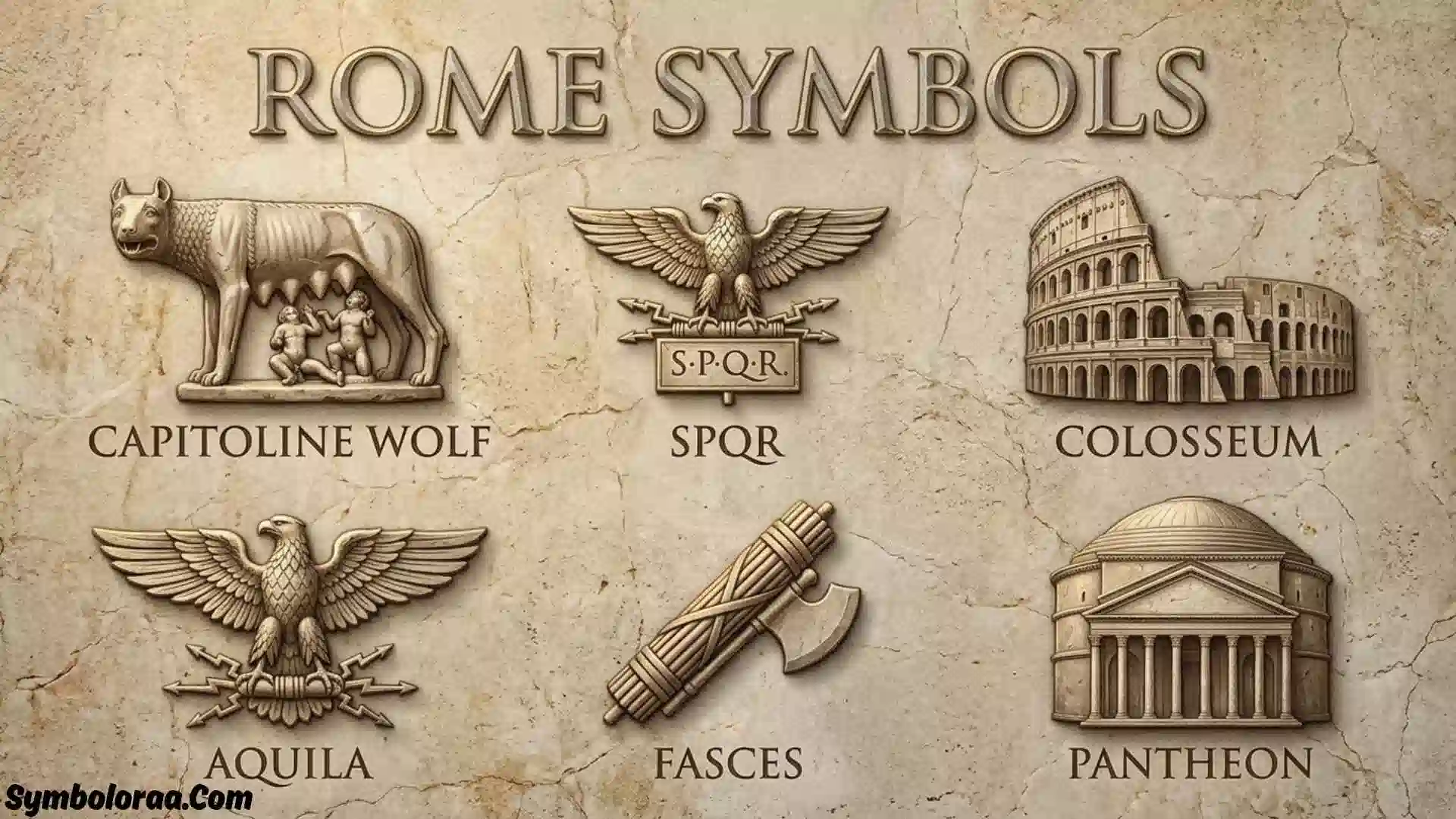
Rome symbols represent the power, beliefs, achievements, and identity of one of the most influential civilizations in human history. From the famous Roman eagle and SPQR inscription to the laurel wreath, fasces, and architectural designs, these symbols appear in museums, government buildings, books, movies, logos, coins, and modern artwork around the world.
Understanding Rome symbols helps explain how the Roman Empire communicated authority, religion, military strength, citizenship, and cultural values. These ancient signs were more than decorations; they carried deep messages about politics, society, mythology, and the Roman way of life.
Quick Meaning
Rome symbols are visual signs and objects that represent the values, power, religion, and identity of ancient Rome. Common examples include the Roman eagle symbolizing imperial authority, SPQR representing the Roman state, the laurel wreath representing victory, and the fasces representing government power and justice.
Symbol Overview Table
| Symbol Name | Primary Meaning | Category | Origin | Civilization or Culture | First Known Use | Common Usage | Modern Meaning | Related Symbols |
| Roman Eagle (Aquila) | Power, victory, empire | Military/Political | Ancient Rome | Roman Republic and Empire | Early Roman military period | Legions, standards, imperial imagery | Leadership and strength | Eagle, phoenix |
| SPQR | Roman state and authority | Political | Roman Republic | Rome | Around 1st century BCE inscriptions | Government, monuments, military | Civic identity and tradition | Roman fasces |
| Laurel Wreath | Victory, honor, achievement | Cultural | Ancient Mediterranean | Rome and Greece | Ancient Greek traditions adopted by Rome | Emperors, athletes, scholars | Success and excellence | Crown, olive branch |
| Fasces | Authority and justice | Political | Etruscan influence | Roman government | Early Roman Republic | Magistrates and officials | Law and leadership | Axe symbols |
| Roman Wolf (Lupa) | Origin myth and protection | Mythological | Roman mythology | Rome | Ancient foundation legends | Statues, art, literature | Heritage and identity | Twins Romulus and Remus |
| Roman Columns | Order and civilization | Architectural | Classical Rome | Roman architecture | Roman architectural era | Buildings and monuments | Stability and tradition | Greek columns |
| Roman Coin Symbols | Authority and propaganda | Economic | Roman Republic | Roman Empire | Ancient coinage period | Currency and portraits | Historical identity | Imperial symbols |
What Do Rome Symbols Mean?
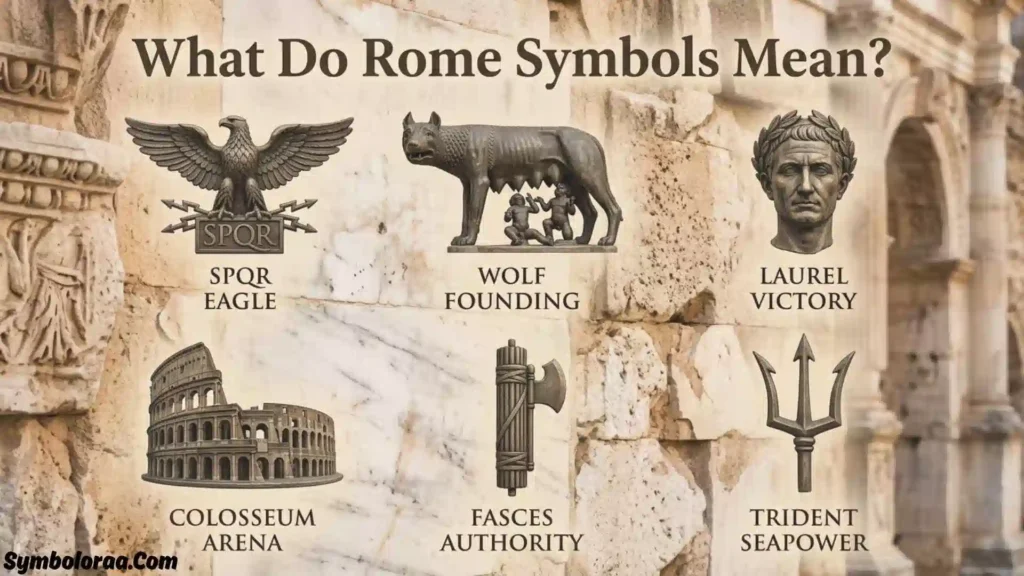
Rome symbols are visual representations of Roman ideas about power, religion, society, military success, and cultural identity. The Romans used symbols to communicate messages quickly across a vast empire where many different languages and cultures existed.
Unlike simple decorations, Roman symbols often carried political and emotional meanings. A Roman soldier carrying an eagle standard showed loyalty to the empire. An emperor wearing a laurel wreath suggested victory and divine favor. An inscription such as SPQR connected Roman citizens to the authority of the state.
Many Rome symbols continue to influence modern governments, military organizations, architecture, art, and popular culture because the Roman Empire shaped much of Western civilization.
History and Origin of Rome Symbols
The development of Rome symbols began during the early Roman Kingdom and expanded during the Roman Republic and Roman Empire. As Rome grew from a small city into a powerful Mediterranean empire, it needed recognizable signs to unite citizens and control distant territories.
Early Roman Symbolism
Early Roman symbols were connected to mythology, religion, and family traditions. The story of Romulus and Remus, the legendary founders of Rome, introduced the wolf as a powerful symbol of survival and divine protection.
Religious traditions also shaped Roman symbolism. Many symbols were linked to Roman gods, rituals, and beliefs about fate and authority.
Symbols During the Roman Republic
During the Roman Republic, symbols became closely connected with citizenship and government. The phrase SPQR, meaning “Senatus Populusque Romanus” or “The Senate and People of Rome,” represented the combined authority of the Roman Senate and citizens.
Political leaders used symbols to show legitimacy and public service rather than personal rule.
Symbols During the Roman Empire
Under the Roman Empire, symbols became strongly connected with emperors and military power. The eagle standard became one of the most important images of Roman armies. Losing an eagle standard in battle was considered a major disgrace.
Emperors also used symbols such as crowns, divine imagery, and coins to promote their authority throughout the empire.
Symbolism and Interpretation
Rome symbols have multiple layers of meaning. Their interpretation depends on historical context, cultural background, and modern usage.
Traditional Meanings
Traditional Roman symbolism often focused on:
- Power and authority
- Military victory
- Loyalty to Rome
- Divine protection
- Social order
- Citizenship
- Achievement and honor
These meanings helped create a shared identity among Roman citizens and soldiers.
Positive Symbolism
Many Rome symbols continue to represent positive concepts, including:
- Leadership
- Strength
- Courage
- Knowledge
- Justice
- Achievement
- Unity
For example, the laurel wreath remains a symbol of accomplishment because Romans associated it with victory and intellectual excellence.
Negative Symbolism
Some Roman symbols have also gained negative associations because of their connection with imperialism, conquest, and authoritarian power.
The fasces, for example, originally represented lawful authority in Rome, but later political movements adopted it as a symbol of power and nationalism. Modern interpretations may therefore vary depending on context.
Psychological Interpretation
Humans naturally use symbols to communicate complex ideas. Rome symbols demonstrate how societies create visual shortcuts for concepts like strength, belonging, and authority.
A symbol can influence emotions because people associate images with stories, historical events, and collective memories.
Cultural Significance of Rome Symbols
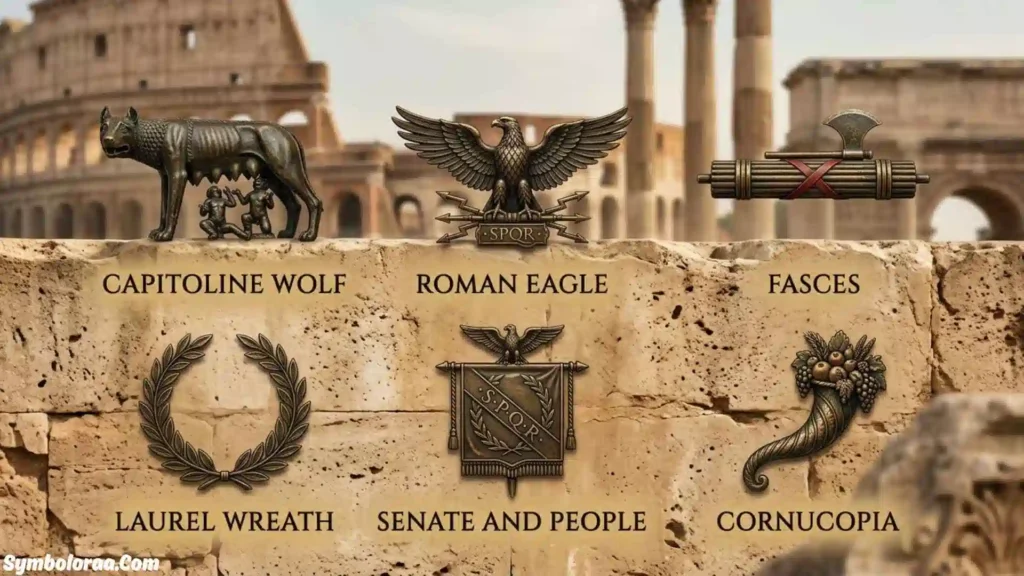
Rome symbols influenced cultures far beyond ancient Italy. The Roman Empire spread its language, laws, architecture, and artistic traditions across Europe, North Africa, and parts of Asia.
European Influence
Many European governments adopted Roman-inspired imagery to represent law, civilization, and political authority. Buildings with Roman columns, domes, and arches became associated with democracy, government, and public institutions.
American Influence
The United States and other modern nations borrowed several Roman ideas and symbols. Government buildings often use Roman architectural styles because they represent stability and historical continuity.
The eagle, fasces, and classical designs appear in various official contexts.
Modern Popular Culture
Rome symbols appear in:
- Historical movies
- Video games
- Fantasy artwork
- Books about ancient history
- Educational materials
- Jewelry designs
- Tattoos
They continue to attract attention because Roman history remains culturally influential.
Religious or Spiritual Meaning
Roman symbols were closely connected with ancient Roman religion. Many symbols represented relationships between humans, gods, and the natural world.
Roman Gods and Symbols
Different gods had associated symbols:
| Roman God | Symbol | Meaning |
| Jupiter | Eagle, thunderbolt | Supreme authority and power |
| Mars | Spear, shield | War and military strength |
| Venus | Dove, rose | Love and beauty |
| Mercury | Winged sandals, caduceus | Communication and trade |
| Neptune | Trident | Sea power |
These symbols helped worshippers identify divine figures in art and religious ceremonies.
Sacred Ceremonies
Romans used symbolic objects during religious rituals, public celebrations, and military ceremonies. Religious symbols helped connect political authority with divine approval.
Where Rome Symbols Are Used
Rome symbols continue to appear in many areas of modern life.
Architecture
Roman-inspired designs appear in:
- Government buildings
- Museums
- Universities
- Monuments
- Courts
Columns, arches, and domes often represent strength and permanence.
Jewelry and Tattoos
People choose Roman symbols for personal reasons, including:
- Interest in history
- Desire for strength
- Connection with victory
- Appreciation of classical art
Common tattoo choices include:
- Roman numerals
- Roman eagles
- Laurel wreaths
- SPQR designs
Literature and Media
Authors and filmmakers use Roman symbols to represent:
- Empires
- Leadership
- Conflict
- Ambition
- Civilization
Coins and Currency
Ancient Roman coins used symbols and images as political messages. Portraits of emperors and religious symbols helped communicate power throughout the empire.
Common Variations of Rome Symbols
Roman symbols changed over centuries and differed depending on location and purpose.
Roman Eagle Variations
The eagle appeared in different forms:
- Military eagle standards
- Imperial eagle designs
- Decorative architectural eagles
The meaning usually remained connected with authority and victory.
SPQR Variations
SPQR appeared on:
- Military objects
- Public buildings
- Coins
- Monuments
Today, it remains associated with the city of Rome.
Laurel Wreath Variations
The laurel wreath appeared as:
- A crown for leaders
- Decorative artwork
- Academic symbols
- Award imagery
Its meaning shifted from military victory to broader achievement.
Common Misconceptions About Rome Symbols
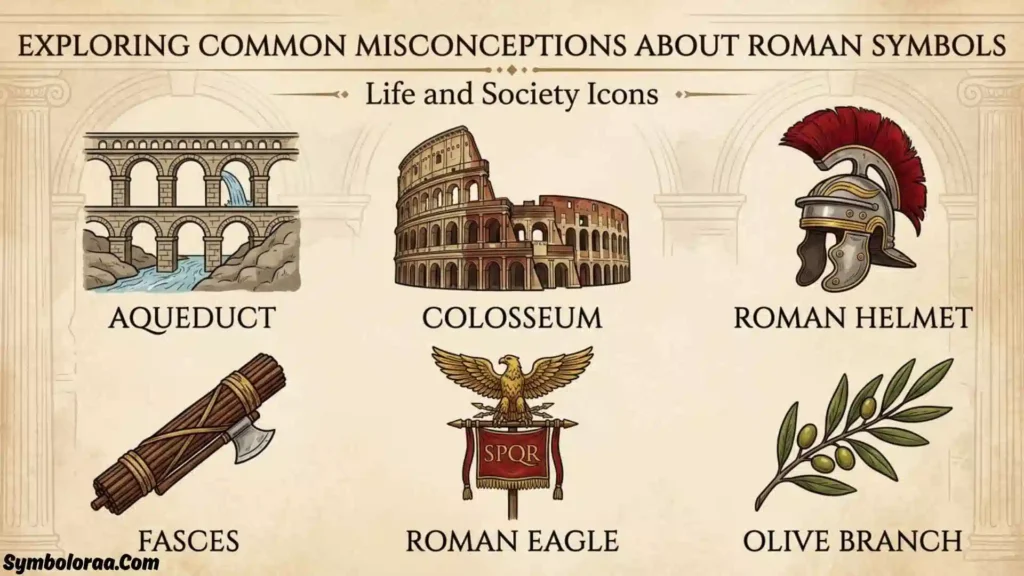
Myth 1: All Roman Symbols Were Religious
Not all Roman symbols were religious. Many represented politics, military organization, citizenship, or social values.
Myth 2: The Roman Eagle Was Only an Emperor Symbol
The eagle was strongly connected with Roman armies before and during the empire. It represented military identity as much as imperial power.
Myth 3: SPQR Means Only the Emperor’s Power
SPQR actually emphasized the authority of the Roman Senate and citizens, especially during the Republic.
Myth 4: Roman Symbols Have Only One Meaning
Symbols change over time. A symbol that represented one idea in ancient Rome may have different meanings today.
Interesting Facts About Rome Symbols
1. The Roman Eagle Was Extremely Important to Soldiers
Roman legions protected their eagle standards because losing one was considered a serious humiliation. The eagle represented the honor and identity of an entire military unit.
2. SPQR Is Still Visible in Rome Today
The abbreviation SPQR can still be seen on buildings, public signs, and monuments in modern Rome, connecting the present city with its ancient past.
3. Laurel Wreaths Inspired Modern Awards
The tradition of using laurel as a symbol of achievement influenced modern medals, academic ceremonies, and victory celebrations.
4. Roman Symbols Helped Control a Large Empire
Because many people in the empire spoke different languages, visual symbols helped communicate Roman authority across distant regions.
5. Roman Architecture Became a Symbol Itself
Columns, arches, and domes became associated with Roman ideas of order, engineering, and civilization.
6. Roman Numerals Are Ancient Roman Symbols
The numbers I, V, X, L, C, D, and M continue to be used today on clocks, books, and special events.
7. Roman Coins Were Communication Tools
Coins carried images of emperors, gods, and symbols to spread political messages throughout the empire.
8. Roman Symbols Influenced Modern Government Designs
Many modern institutions use Roman-inspired imagery to represent law, authority, and stability.
Related Symbols
| Symbol | Meaning | Connection to Rome Symbols |
| Greek Laurel Wreath | Victory and honor | Adopted and expanded by Romans |
| Olive Branch | Peace | Often compared with Roman victory symbols |
| Eagle Symbol | Power and freedom | Similar to the Roman eagle |
| Roman Numerals | Ancient numbering system | Directly from Roman culture |
| Greek Columns | Classical order | Influenced Roman architecture |
| Phoenix | Renewal and rebirth | Connected with imperial imagery |
Frequently Asked Questions
What is the most famous Rome symbol?
The Roman eagle is one of the most famous Rome symbols because it represented the strength, unity, and military power of the Roman legions. Another widely recognized symbol is SPQR, which represents the Roman state and its citizens.
What does SPQR mean in Roman symbols?
SPQR stands for “Senatus Populusque Romanus,” meaning “The Senate and People of Rome.” It represented the authority of the Roman Republic and later became a traditional symbol of the city of Rome.
What does the Roman eagle symbolize?
The Roman eagle symbolizes military power, victory, authority, and imperial strength. It was carried as a standard by Roman legions and represented the honor of each military unit.
Why are Roman symbols still used today?
Roman symbols remain popular because Roman civilization influenced modern law, government, architecture, language, and art. Many organizations use Roman imagery to represent strength, tradition, and authority.
What does the laurel wreath mean in Rome?
The laurel wreath represented victory, honor, and achievement. Roman emperors, generals, and respected individuals often wore laurel crowns as symbols of success.
Are Roman symbols religious?
Some Roman symbols were religious, especially those connected with gods and rituals. However, many others represented politics, military power, citizenship, and cultural identity.
What does the Roman wolf symbolize?
The Roman wolf represents the legendary founding story of Rome, in which Romulus and Remus were cared for by a she-wolf. It symbolizes origins, protection, and Roman identity.
Are Roman symbols used in tattoos?
Yes, Roman symbols are common tattoo designs. People often choose Roman numerals, eagles, laurel wreaths, and SPQR symbols because they represent history, strength, achievement, or personal meaning.
How did Rome symbols influence modern culture?
Rome symbols influenced architecture, government imagery, military designs, literature, art, and popular entertainment. Their meanings continue to shape how societies represent power and achievement.
Key Takeaways
- Rome symbols represented power, identity, religion, and cultural values.
- The Roman eagle was a major symbol of military strength and victory.
- SPQR represented the Roman Senate and citizens.
- Laurel wreaths symbolized achievement and honor.
- Roman symbols influenced modern architecture, government, and art.
- Many symbols changed meaning as they moved from ancient Rome into modern culture.
- Understanding Roman symbols provides insight into Roman history and civilization.
Conclusion
Rome symbols are powerful reminders of how ancient societies communicated ideas through images and objects. The Roman eagle, SPQR, laurel wreath, fasces, and other symbols carried messages about authority, victory, citizenship, religion, and cultural identity.
Although thousands of years have passed since the Roman Empire dominated the Mediterranean world, these symbols continue to influence architecture, politics, art, and popular culture. Exploring Rome symbols reveals not only the history of a great civilization but also the lasting power of human storytelling through visual language.

I’m Jackson Miller, an American author inspired by mystery, adventure, and the unpredictable nature of life. I enjoy writing fast-moving stories filled with memorable characters, unexpected choices, and meaningful moments. Through my books, I want readers to experience new worlds while discovering something about courage, determination, and themselves.
Three Books:
The Edge of Tomorrow
Under a Broken Sky
The Road We Chose
 Madison Reed