
If you have ever searched for a company’s stock price, opened a brokerage app, or read financial news, you have probably seen short combinations such as AAPL, MSFT, NVDA, or AMZN. These short identifiers are called ticker symbols, stock symbols, or ticker codes.
A ticker symbol gives investors and market systems a quick way to identify a publicly traded security. In the United States, publicly traded common stocks receive short abbreviations used to identify them in market data and trading systems.
But ticker symbols are more than random letters. They can identify stocks, ETFs, preferred securities, and other financial instruments, while additional characters or suffixes can sometimes provide information about a particular security or trading situation.
This guide explains what ticker symbols mean, how they are assigned, how to find the correct symbol, why symbols can change, and how ticker symbols differ from identifiers such as CUSIP numbers.
What Is a Ticker Symbol?
A ticker symbol is a short combination of letters used to identify a publicly traded security in financial markets.
For example:
| Company | Example ticker symbol | What it identifies |
| Apple | AAPL | Apple common stock |
| Microsoft | MSFT | Microsoft common stock |
| Amazon | AMZN | Amazon common stock |
| Nvidia | NVDA | Nvidia common stock |
| Nasdaq, Inc. | NDAQ | Nasdaq, Inc. common stock |
A ticker makes it easier for investors, brokers, exchanges, financial websites, and market-data systems to distinguish one security from another.
The SEC’s Investor.gov explains that U.S. publicly traded common stocks receive a short abbreviation known as a stock symbol or stock ticker symbol.
Why Ticker Symbols Matter
Company names can be long, similar, or easily confused. A short symbol provides a practical identifier for displaying quotes and other market information.
For example, a financial platform can display:
NVDA — Nvidia
instead of repeatedly displaying the company’s full legal or corporate name.
Ticker symbols are commonly used for:
- Stock quotes
- Brokerage orders
- Watchlists
- Market charts
- Financial news
- Earnings reports
- Stock screeners
- Trading platforms
- Investment research
- Market-data feeds
A stock quote can include information such as the current price, bid, offer, trading volume, and historical prices.
Ticker Symbol vs. Company Name
A ticker symbol is not the same thing as the company’s name.
For example:
Company name: Microsoft Corporation
Ticker symbol: MSFT
The company name describes the business, while the ticker symbol provides a compact market identifier.
This distinction becomes particularly important when companies have similar names or when a corporation owns multiple securities.
How Ticker Symbols Work in the Stock Market
Ticker symbols connect the security a person wants to trade with the market information displayed by exchanges, brokers, and data providers.
When an investor searches for a symbol in a brokerage platform, the system uses that identifier to locate the relevant security and display available market information.
How a Ticker Appears on a Trading Platform
A typical stock-search process looks like this:
- Enter the company name or ticker.
- Review the matching security.
- Check the exchange or trading venue.
- Confirm the security type.
- Review the quote and other market information.
- Make sure the symbol matches the intended investment before placing an order.
This last step matters because similar names or different security classes can sometimes appear in search results.
Nasdaq’s market-activity tools, for example, allow users to search stocks by symbol or company name and maintain symbols in a watchlist.
Who Assigns Ticker Symbols?
The answer depends on the type of security and where it trades.
A common misconception is that FINRA assigns every U.S. exchange-listed stock symbol. FINRA explains that it does not assign symbols for securities listed on a national securities exchange; firms should contact the relevant exchange for the symbol of a listed security.
OTC securities have different symbol-management processes. FINRA maintains resources for OTC equity symbols, including its Symbol Directory.
This is why it is useful to distinguish between exchange-listed securities and OTC securities when discussing ticker assignment.
Common Types of Ticker Symbols
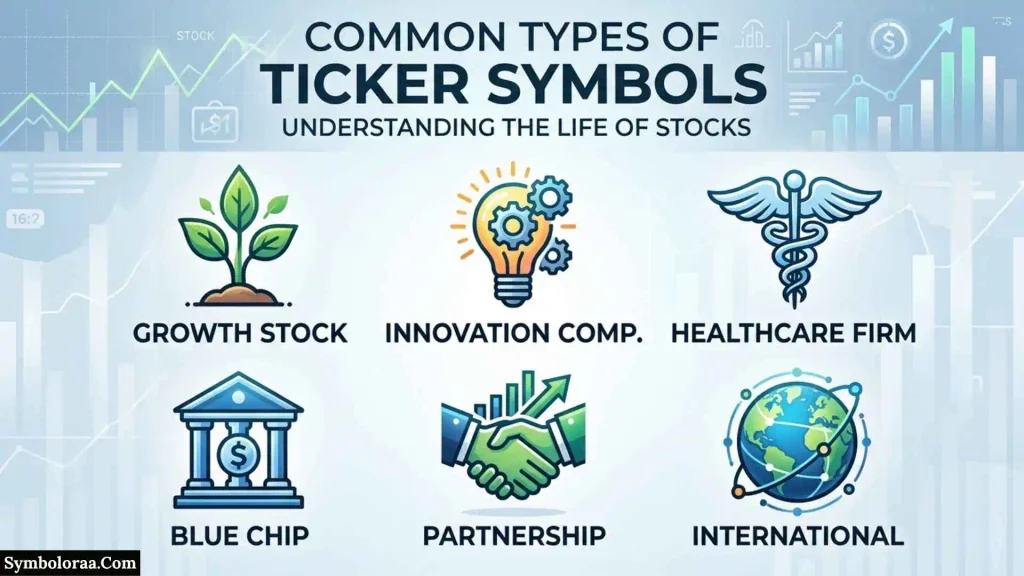
Not every ticker represents an ordinary common stock. Investors may encounter symbols associated with ETFs, preferred securities, ADRs, warrants, rights, and other instruments.
Common Stock Symbols
Common stock represents an ownership interest in a corporation. Investors may receive voting rights and, depending on the company, dividends.
Examples include:
- AAPL — Apple
- MSFT — Microsoft
- AMZN — Amazon
- NVDA — Nvidia
These symbols are generally what people mean when they casually refer to a company’s “stock ticker.”
ETF Ticker Symbols
Exchange-traded funds also use ticker symbols.
An ETF can hold a collection of securities or track an investment strategy, index, sector, commodity, or other underlying exposure.
This creates an important distinction:
Ticker symbol ≠ automatically individual company stock.
A ticker can represent a fund rather than ownership in a single operating company.
When researching an ETF, check:
- Fund name
- Ticker
- Expense ratio
- Investment objective
- Holdings
- Exchange
- Distribution policy
- Structure
The symbol alone does not tell you whether an investment is suitable for your goals.
Preferred Stock and Other Securities
Preferred stock can have symbols that distinguish it from a company’s common stock.
Other securities can also use symbols or symbol extensions, including:
- Preferred shares
- Warrants
- Rights
- Units
- ADRs
- Other specialized securities
FINRA’s OTC symbol resources show that additional characters can convey information about the type or status of certain OTC securities.
Ticker Symbols and Symbol Suffixes
Sometimes a ticker includes additional information beyond the basic symbol.
A suffix or additional character can help distinguish one security from another or communicate information about the security.
For OTC securities, FINRA documents fifth-character identifiers such as:
| Identifier | General meaning |
| A | Class A |
| B | Class B |
| D | New |
| J | Voting |
| K | Nonvoting |
| P | First preferred issue |
| Q | Bankruptcy-related |
| R | Rights |
| W | Warrants |
| Y | ADR |
These identifiers apply within FINRA’s OTC symbol framework and should not be assumed to have the same meaning across every market or platform.
Why Suffixes Can Be Important
Imagine an investor searches for a company and finds several securities with very similar symbols.
The investor should not assume that all of them represent the same investment.
A symbol extension can indicate a different:
- Share class
- Security type
- Voting status
- Preferred issue
- Warrant
- Right
- ADR
- Corporate action status
Practical rule: Always verify the full security description instead of relying only on the first few letters of a symbol.
Ticker Symbols vs. CUSIP Numbers
Ticker symbols are not the only identifiers used in financial markets.
A ticker is designed to be convenient and recognizable in market activity, while a CUSIP number is a more formal identifier used for securities identification.
Investor.gov explains that CUSIP numbers identify many financial instruments and consist of nine characters.
| Feature | Ticker symbol | CUSIP number |
| Typical format | Short letters | Nine alphanumeric characters |
| Main purpose | Market/security symbol | Security identification |
| Easy for investors to remember | Usually | Less so |
| Used in quotes and trading interfaces | Commonly | Less visible to everyday investors |
| Can change | Yes | Security-specific identification follows different rules |
| Example | AAPL | A CUSIP identifier for a particular security |
The two identifiers should not be treated as interchangeable.
Why the Difference Matters
Suppose a company changes its ticker after a corporate event. An investor who only remembers the old ticker may have difficulty finding the security.
A formal security identifier can provide a more precise reference.
For everyday investors, the ticker is usually the easiest starting point. For detailed operational, settlement, and securities-identification work, other identifiers can be more important.
How to Find a Company’s Ticker Symbol
Finding a ticker is usually simple, but the most reliable approach is to verify the result through an authoritative market or company source.
Method 1: Search an Exchange or Market Database
Start with the company name and confirm:
- Exact company name
- Ticker
- Exchange
- Security type
Nasdaq provides stock market activity tools that allow searches using company names and symbols.
Method 2: Check the Company’s Investor Relations Page
Public companies commonly provide information about their publicly traded securities through investor-relations resources.
This is especially useful when a company has:
- Multiple share classes
- Preferred securities
- Depositary receipts
- A recently changed ticker
- Multiple listed securities
Method 3: Verify Through Your Broker
If you intend to trade a security, searching directly through your brokerage platform can help confirm the tradable instrument.
Before submitting an order, check the security description rather than selecting the first result automatically.
A Simple Ticker Verification Checklist
Before using a ticker, ask:
- Is the company name correct?
- Is the ticker spelled correctly?
- Is this the intended share class?
- Is it common stock or another security?
- Which exchange or market lists it?
- Has the company recently changed its symbol?
- Does the security description match what I intend to buy?
This simple checklist can prevent avoidable mistakes.
Why Do Companies Change Ticker Symbols?
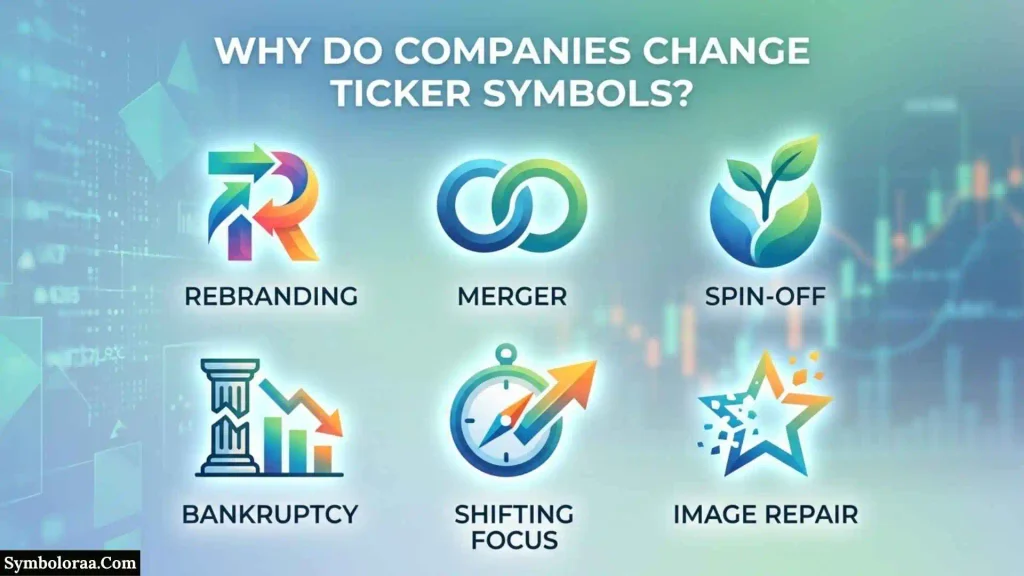
Ticker symbols are not necessarily permanent.
A company may change its symbol because of a corporate event, rebranding, merger, acquisition, restructuring, listing change, or another market-related reason.
Common Reasons for a Symbol Change
Examples include:
- Corporate rebranding
- Merger or acquisition
- Company name change
- Exchange transfer
- Corporate restructuring
- Spinoff
- Strategic repositioning
A ticker change does not automatically mean that the underlying investment has fundamentally changed in value or quality. The reason for the change must be examined separately.
What Investors Should Do After a Ticker Change
If you discover that a company has changed its symbol:
- Confirm the announcement.
- Check the effective date.
- Verify the new symbol.
- Confirm whether the security itself changed.
- Update watchlists and research notes.
- Check brokerage records if necessary.
Do not assume that a new ticker automatically represents a new company.
Ticker Symbols Around the World
Ticker conventions vary between markets.
A U.S. investor may be familiar with short alphabetic symbols, but international exchanges can use different formats, including combinations involving letters, numbers, exchange-specific identifiers, or market suffixes.
That means the same company may appear differently across financial platforms.
Why Exchange Information Matters
Consider a company that trades in more than one market.
A search result may show:
- Company name
- Local ticker
- Exchange
- Currency
- Depositary receipt
- Different share class
Therefore, the safest practice is to identify both the ticker and the exchange.
A symbol by itself may not provide enough context for international securities.
Common Mistakes People Make With Ticker Symbols
Understanding the symbol is only the first step. Investors can still make mistakes when interpreting it.
Mistake 1: Assuming Every Symbol Represents Common Stock
A ticker may identify an ETF, preferred security, ADR, warrant, or another instrument.
Always check the security type.
Mistake 2: Confusing Similar Symbols
Two companies can have similar names or symbols.
Never choose an investment solely because the ticker “looks right.”
Mistake 3: Ignoring the Exchange
International listings and multiple listings can create confusion.
Confirm the exchange and trading currency when relevant.
Mistake 4: Assuming a Ticker Is Permanent
Companies can change symbols.
If an old ticker no longer produces the expected result, look for corporate announcements or updated market information.
Mistake 5: Treating a Ticker as a Buy Signal
A ticker identifies an investment. It does not tell you whether the investment is good, cheap, expensive, risky, or appropriate for your portfolio.
A symbol such as NVDA or AAPL provides identification—not an investment recommendation.
How to Choose the Correct Symbol Before Trading
Use this quick decision guide when several symbols appear in a search.
Do you know the company?
↓
Yes → Confirm the exact company name.
↓
Does the symbol match the intended security?
→ Yes → Check the exchange and security type.
→ No → Continue searching.
↓
Are multiple share classes listed?
→ Yes → Compare voting rights and security descriptions.
→ No → Continue.
↓
Is it an ETF, preferred share, ADR, warrant, or another security?
→ Yes → Read the full instrument description before trading.
→ No → Confirm the common-stock listing.
↓
Does the information match your intended investment?
→ Yes → You have identified the correct instrument.
→ No → Do not place the order until the discrepancy is resolved.
This decision process is especially useful for beginners because a familiar company name does not guarantee that the first search result is the security they intend to purchase.
Ticker Symbols in Financial News and Research
Financial news uses ticker symbols because they make headlines, charts, and market updates easier to scan.
You may see statements such as:
AAPL rises after earnings
or:
MSFT added to an investor’s watchlist
The symbol provides a compact reference, but readers should still verify the context.
A headline might refer to:
- Common stock
- A specific share class
- Options activity
- An ETF
- A market index
- A company announcement
Understanding the surrounding terminology is just as important as recognizing the ticker.
How Ticker Symbols Improve Market Data

Ticker symbols make it easier for financial systems to organize and display information.
A market-data platform may connect a symbol with:
- Price
- Trading volume
- Bid
- Ask
- Market capitalization
- Historical data
- Corporate actions
- News
- Earnings information
FINRA’s technical documentation also uses security symbols as fields within trade-reporting systems, showing that symbols are part of the structured information used in market infrastructure.
This is one reason accuracy matters. A wrong symbol can lead a user to completely different market information.
Key Takeaways About Ticker Symbols
The most important points are:
- A ticker symbol is a short identifier for a publicly traded security.
- Stock symbols and ticker symbols are commonly used interchangeably.
- A ticker does not necessarily represent common stock.
- ETFs, preferred securities, warrants, rights, and other instruments can have symbols.
- Exchange-listed and OTC securities can follow different symbol conventions.
- FINRA does not assign symbols for securities listed on national securities exchanges.
- OTC symbols can contain additional characters that identify certain security characteristics.
- A ticker symbol is different from a CUSIP number.
- Companies can change ticker symbols.
- Always verify the company, security type, exchange, and complete symbol before trading.
Frequently Asked Questions About Ticker Symbols
What is an example of a ticker symbol?
Examples include AAPL for Apple, MSFT for Microsoft, AMZN for Amazon, and NVDA for Nvidia. These are examples of commonly used U.S. stock symbols.
Is a ticker symbol the same as a stock symbol?
Yes. The terms ticker symbol, stock symbol, and ticker are commonly used to refer to the short market identifier for a stock. Investor.gov specifically describes a stock symbol as a stock ticker symbol.
Can two companies have the same ticker symbol?
The answer depends on the market and security context. A symbol generally needs to identify a particular listed or traded security within its relevant market structure, but similar symbols can create confusion across exchanges or different securities. Always verify the exchange and full security description.
Can a company change its ticker symbol?
Yes. A company can change its ticker because of events such as a rebranding, merger, acquisition, restructuring, or listing change. Investors should verify the official announcement and effective date.
What is the difference between a ticker symbol and a CUSIP?
A ticker is a short market symbol commonly used in quotes and trading interfaces. A CUSIP is a nine-character identifier used to identify many securities more formally.
Do ETFs have ticker symbols?
Yes. ETFs trade using ticker symbols, just like many individual stocks. However, an ETF ticker represents a fund rather than necessarily representing ownership in one operating company.
What does a ticker suffix mean?
A suffix or additional character can provide information about a particular security or its status. The exact meaning depends on the market and symbol system. FINRA’s OTC framework, for example, uses specific fifth-character identifiers for certain security characteristics.
Where can I find a company’s ticker symbol?
You can check an exchange’s market-data tools, the company’s investor-relations website, or your brokerage platform. For OTC securities, FINRA’s Symbol Directory is another useful reference.
Does a ticker symbol tell me whether a stock is a good investment?
No. A ticker is an identifier, not an investment rating. Investors should evaluate financial statements, valuation, business fundamentals, risks, objectives, and other relevant information separately.
Conclusion
Ticker symbols are the compact language of the stock market. They allow investors and financial systems to identify securities quickly, but a ticker alone does not tell the complete story.
To identify an investment correctly, look beyond the letters. Confirm the company, security type, share class, exchange, and current symbol. This becomes especially important when dealing with ETFs, preferred securities, international listings, OTC securities, or companies that have recently changed their symbols.
For beginners, the best habit is simple: use the ticker as a starting point, then verify the full security description before making an investment decision.

I’m Madison Reed, a contemporary American author who writes about love, family, friendship, and second chances. I’m fascinated by the choices that shape our lives and the moments that change us forever. My goal is to create honest, emotional stories with characters readers can connect with long after finishing each book.
Three Books:
When We Find Our Way
The Things We Never Said
Summer in September
 Ethan Brooks
 Jackson Miller