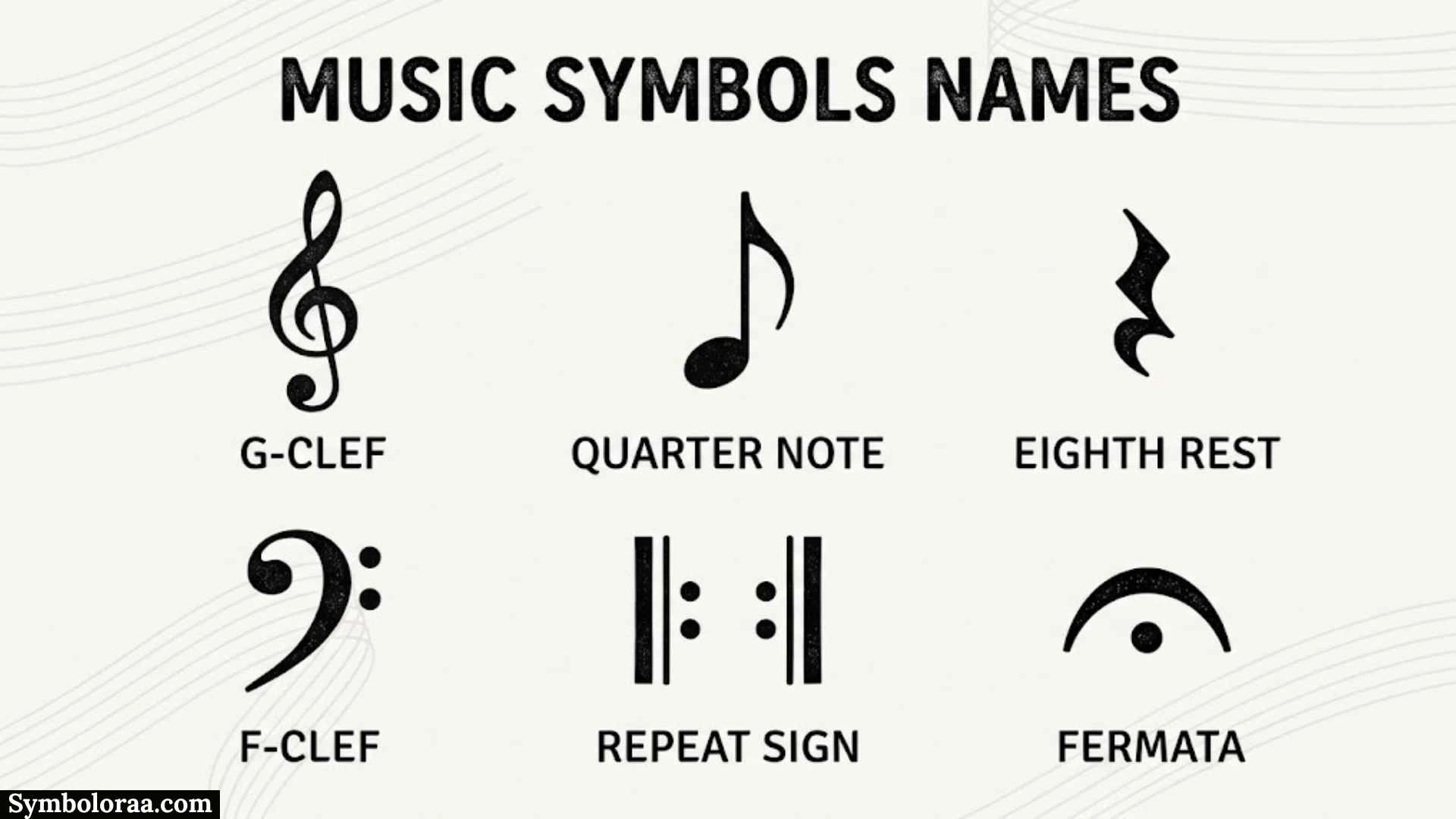
If you are searching for music symbols names, you are probably trying to identify the marks, signs, and notation used on sheet music. These symbols tell a musician much more than which notes to play. They can show pitch, rhythm, silence, volume, speed, articulation, expression, repetition, and musical structure.
A beginner may see a staff filled with notes, rests, sharps, flats, dynamic markings, clefs, and other signs and wonder what each symbol means. The good news is that musical notation becomes much easier when the symbols are grouped by their job.
This guide explains the most common music symbols and their names, what each one means, where it appears in written music, and how to recognize it when reading a score. It also covers common mistakes, instrument-specific symbols, chord notation, professional uses, and a simple method for identifying unfamiliar symbols.
Quick Answer: What Are the Main Music Symbols?
The main music symbols include staff lines, clefs, notes, rests, accidentals, key signatures, time signatures, bar lines, dynamics, articulation marks, ties, slurs, tempo markings, repeat signs, and navigation symbols.
Here is a quick reference:
| Music Symbol | Name | Main Purpose |
| 𝄞 | Treble clef | Identifies pitch positions for higher registers |
| 𝄢 | Bass clef | Identifies pitch positions for lower registers |
| ♯ | Sharp | Raises a note by a semitone |
| ♭ | Flat | Lowers a note by a semitone |
| ♮ | Natural | Cancels a previous sharp or flat |
| 𝄴 | Whole note | Shows a long note value |
| 𝄰 | Half note | Shows a two-beat note in common time |
| ♩ | Quarter note | Shows a one-beat note in common time |
| ♪ | Eighth note | Shows a shorter rhythmic value |
| 𝄽 | Quarter rest | Shows a period of silence |
| 𝄼 | Eighth rest | Shows a shorter period of silence |
| 4/4 | Common time | Shows the meter |
| p | Piano | Play softly |
| f | Forte | Play loudly |
| < | Crescendo | Gradually become louder |
| > | Decrescendo | Gradually become softer |
| • | Staccato | Play notes short and detached |
| — | Tenuto | Sustain the note fully |
| 𝄐 | Fermata | Hold a note or rest longer than its written value |
| 𝄆 𝄇 | Repeat signs | Repeat a musical section |
| 𝄌 | Coda | Indicates a separate concluding section |
The exact appearance of some symbols can vary by notation font, software, historical period, or musical tradition. Modern digital notation systems also use standardized symbol mappings so notation software can represent musical glyphs consistently.
What Do Music Symbols Mean?
Music symbols are visual instructions used to communicate musical information in written form. Instead of explaining every performance detail with words, a composer or arranger can use established notation to show how music should be organized and performed.
For example, a written passage may tell a performer:
- Which pitch to play through the clef and note position.
- How long to play it through the note value.
- When to remain silent through rests.
- Which pitches are altered through accidentals.
- How loudly to perform through dynamics.
- How quickly to perform through tempo markings.
- How notes should sound through articulation marks.
- When to repeat a section through repeat and navigation symbols.
This is why learning symbol names is more useful than memorizing isolated shapes. Each symbol belongs to a larger system.
How to Identify an Unfamiliar Music Symbol
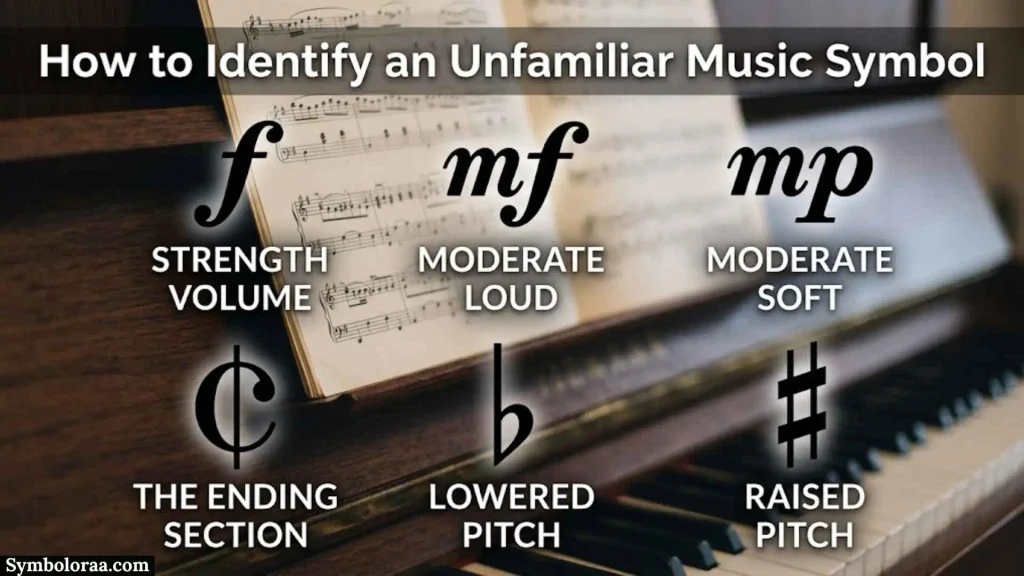
When you see a symbol you do not recognize, do not try to memorize its shape immediately. First ask what part of the music it appears to control.
If It Changes Pitch
Look for symbols near notes, especially:
- Sharp
- Flat
- Natural
- Double sharp
- Double flat
- Key signature
These symbols affect pitch.
If It Changes Rhythm
Look for:
- Note values
- Rests
- Dots
- Ties
- Time signatures
- Tuplets
These symbols help organize musical time and duration.
If It Changes Volume
Look for:
- p
- pp
- mp
- mf
- f
- ff
- Crescendo
- Decrescendo
These are dynamic markings.
If It Changes How a Note Is Performed
Look for:
- Staccato
- Tenuto
- Accent
- Marcato
- Fermata
- Slur
These markings provide articulation or expressive instructions.
If It Tells You Where to Go
Look for:
- Repeat signs
- First and second endings
- D.C.
- D.S.
- Coda
- Fine
These symbols control navigation through a score.
This approach creates a simple mental framework:
Pitch → Rhythm → Volume → Articulation → Tempo → Navigation
Once you know which category a symbol belongs to, identifying its purpose becomes much easier.
Staff, Clefs, and Basic Music Symbols
The staff is the foundation of traditional Western staff notation. A modern staff contains five horizontal lines and four spaces, and notes are placed on or between these lines to represent pitch. Clefs establish how those positions should be interpreted.
Staff Symbol and Name
The staff consists of five horizontal lines separated by four spaces.
Notes are placed on the lines or in the spaces. Their exact pitch depends on the clef.
A staff without a clef does not provide the same pitch reference that a performer needs for ordinary staff notation.
The staff is therefore the basic visual framework on which many other music symbols are placed.
Treble Clef
Symbol: 𝄞
Name: Treble clef or G clef
The treble clef is commonly used for higher-pitched instruments and voices.
It identifies the position of G above middle C and provides the pitch reference for the remaining lines and spaces.
Common instruments and parts that may use treble clef include:
- Violin
- Flute
- Trumpet
- Guitar
- Right-hand piano music
- Many higher vocal parts
Bass Clef
Symbol: 𝄢
Name: Bass clef or F clef
The bass clef is commonly used for lower musical registers.
It identifies the position of F below middle C and establishes the pitch relationships on the staff.
It is frequently used for:
- Cello
- Double bass
- Bassoon
- Trombone
- Tuba
- Left-hand piano music
- Lower vocal parts
Library of Congress music cataloging documentation also distinguishes G, F, and C clefs when describing notated musical sources.
Grand Staff
The grand staff combines two staves, normally a treble staff and a bass staff, connected for instruments such as piano.
The treble staff generally represents the higher register while the bass staff represents the lower register.
Middle C sits between the two staves and can be represented with a ledger line.
Ledger Lines
Ledger lines are short horizontal lines placed above or below the staff.
They extend the musical range beyond the five regular staff lines.
For example, a very high note may require ledger lines above the treble staff, while a very low note may require ledger lines below the bass staff.
Music Note Symbols and Their Names
Notes communicate both pitch and duration. Their position on the staff helps identify pitch, while their visual form indicates rhythmic value.
Whole Note
Symbol: 𝅝
A whole note is an open notehead without a stem.
In common 4/4 meter, it normally lasts for four quarter-note beats.
Its actual duration depends on the meter and musical context, so it is better to think of it as a defined rhythmic value rather than always saying it lasts four seconds or four beats.
Half Note
Symbol: 𝅗𝅥
A half note has an open notehead with a stem.
In 4/4 meter, it normally occupies two quarter-note beats.
Two half notes can therefore fill a standard 4/4 measure when no other rhythmic values are present.
Quarter Note
Symbol: ♩
A quarter note has a filled notehead and a stem.
In 4/4 meter, it normally represents one quarter-note beat.
Four quarter notes can fill one 4/4 measure.
Eighth Note
Symbol: ♪
An eighth note has a filled notehead, a stem, and one flag when written individually.
When several eighth notes occur together, their flags are commonly connected by beams.
Two eighth notes have the same total duration as one quarter note.
Sixteenth Note
Symbol: 𝅘𝅥𝅯
A sixteenth note has two flags when written individually.
Four sixteenth notes have the same total duration as one quarter note.
Sixteenth notes are common in faster rhythmic passages and can be grouped with beams.
Thirty-Second Note
A thirty-second note has three flags when written individually.
Its duration is half that of a sixteenth note.
These smaller values allow composers to represent increasingly fast rhythmic patterns.
Dotted Note
A dot placed after a note increases the note’s duration by half of its original value.
For example:
- Quarter note = 1 beat in 4/4
- Dotted quarter note = 1.5 beats
- Half note = 2 beats
- Dotted half note = 3 beats
The dot is therefore a rhythmic modifier rather than a separate note value.
Music Rest Symbols and Their Names
Rests are symbols of silence. They indicate that no note should be sounded for the specified duration.
Whole Rest
A whole rest represents a duration equal to a whole note in the relevant context.
It is traditionally written as a small rectangle hanging below a staff line.
Half Rest
A half rest represents the duration of a half note.
It is traditionally written as a small rectangle sitting above a staff line.
Quarter Rest
A quarter rest represents the duration of a quarter note.
Its shape is more complex than the whole and half rests and is one of the most recognizable silence symbols in written music.
Eighth Rest
An eighth rest represents the duration of an eighth note.
It contains a single flag-like element.
Sixteenth Rest
A sixteenth rest represents the duration of a sixteenth note and contains additional flag elements.
The important principle is simple: note values describe sound, while rests describe silence.
Accidentals: Sharp, Flat, and Natural Symbols
Accidentals change the pitch of individual notes.
Sharp Symbol
Symbol: ♯
The sharp sign raises a note by one semitone in the standard twelve-tone equal-tempered framework.
For example:
C → C♯
The musical sharp sign is not exactly the same glyph as the ordinary keyboard number sign #.
Flat Symbol
Symbol: ♭
A flat lowers a note by one semitone.
For example:
B → B♭
Natural Symbol
Symbol: ♮
A natural sign cancels a previously indicated sharp or flat and returns the note to its natural pitch within the relevant notation context.
For example:
F♯ → F♮
Double Sharp
Symbol: 𝄪
A double sharp raises a pitch by two semitones.
For example:
F𝄪 sounds enharmonically equivalent to G in common twelve-tone equal temperament, although the written spelling serves a different harmonic purpose.
Double Flat
Symbol: 𝄫
A double flat lowers a pitch by two semitones.
Accidentals are normally placed immediately before the note they affect. Music notation references also distinguish accidentals from key signatures when documenting written music.
Key Signature Symbols and Their Purpose
A key signature is the collection of sharps or flats written near the beginning of a staff, after the clef.
It establishes the pitch alterations that normally apply throughout a passage until the key changes or other notation overrides them.
Common key signatures include:
| Key Signature Example | Common Association |
| No sharps or flats | C major / A minor |
| One sharp | G major / E minor |
| One flat | F major / D minor |
| Two sharps | D major / B minor |
| Two flats | B♭ major / G minor |
| Three sharps | A major / F♯ minor |
| Three flats | E♭ major / C minor |
A key signature should not be confused with an accidental placed directly before an individual note.
Key Signature vs Accidental
The distinction is important:
Key signature: establishes recurring pitch alterations for a section of music.
Accidental: changes a specific written note according to the rules of the notation.
This difference is one of the most common beginner stumbling blocks.
Time Signature Symbols and Musical Meter
A time signature appears near the beginning of a piece, normally after the clef and key signature.
It describes the organization of beats into measures.
4/4 Time
4/4 is commonly called common time.
The top number indicates four beats or beat units in each measure, while the bottom number identifies the note value used as the basic unit.
Four quarter-note units can therefore fill a 4/4 measure.
3/4 Time
3/4 contains three quarter-note units per measure.
It is strongly associated with triple meter and is commonly heard in waltz-like music.
2/4 Time
2/4 contains two quarter-note units per measure.
It is frequently encountered in marches and other music with a clear two-beat organization.
6/8 Time
6/8 contains six eighth-note units in each measure.
However, the six units are often grouped into two larger beats, each commonly represented by a dotted quarter note.
This distinction matters because a time signature describes meter and organization, not simply a mechanical count of notes.
Common Time Symbol
Symbol: C
The letter-like C is traditionally used to represent common time, equivalent to 4/4.
Cut Time Symbol
Symbol: ₵ or a C-like symbol with a vertical stroke
Cut time is traditionally associated with 2/2 and is also called alla breve.
It often gives music a strong two-beat feel with the half note functioning as the beat unit.
Bar Lines and Measure Symbols
Bar lines divide music into measures and help performers see the rhythmic structure of a piece.
Bar Line
A single vertical line separates one measure from another.
It does not normally represent a sound itself. Instead, it organizes the written music.
Double Bar Line
Two vertical lines indicate an important structural boundary.
A double bar may mark the end of a section, a major change, or the conclusion of a piece depending on the context.
Final Bar Line
A final bar line commonly consists of a thin line followed by a thicker line.
It indicates the end of the composition or movement.
Repeat Sign
Symbol: 𝄆 … 𝄇
Repeat signs tell the performer to return and play a specified section again.
This allows composers to avoid writing the same passage repeatedly.
Dynamic Music Symbols and Their Names
Dynamics tell performers how loudly or softly music should be played.
Pianissimo
Symbol: pp
Play very softly.
Piano
Symbol: p
Play softly.
Mezzo Piano
Symbol: mp
Play moderately softly.
Mezzo Forte
Symbol: mf
Play moderately loudly.
Forte
Symbol: f
Play loudly.
Fortissimo
Symbol: ff
Play very loudly.
Crescendo
Symbol: <
Gradually become louder.
A crescendo may appear as a hairpin or may be written as the word cresc.
Decrescendo
Symbol: >
Gradually become softer.
It may also be written as decresc. or dim., depending on the notation.
Dynamics describe loudness or intensity. They should not be confused with articulation marks, which describe how individual notes are shaped or attacked.
Articulation Symbols and Their Names
Articulation marks tell performers how individual notes should be approached or connected.
Staccato
Symbol: •
A dot above or below a note usually indicates staccato.
The note is performed in a short, detached manner.
Accent
Symbol: >
An accent mark indicates that a note should receive additional emphasis.
The exact performance effect depends on the instrument and musical context.
Tenuto
Symbol: —
A horizontal line indicates tenuto.
The performer generally sustains the note for its full written value, often with a sense of emphasis or weight.
Marcato
Symbol: ^
Marcato indicates a strongly marked or emphasized note.
It is generally more forceful than ordinary articulation.
Fermata
Symbol: 𝄐
A fermata indicates that a note, chord, or rest should be held longer than its written value.
The exact length is normally determined by the performer, conductor, or musical context.
A fermata is an expressive marking, not a dynamic marking.
Tie and Slur Symbols
Ties and slurs can look similar, but they perform different jobs.
Tie
A tie connects two notes of the same pitch.
Its purpose is to combine their durations.
For example, if a note cannot conveniently be represented as one available value across a bar line, a tie can connect two notes and make them sound as one continuous pitch.
Slur
A slur connects notes that may have different pitches.
It generally indicates that the notes should be performed smoothly and connected in the appropriate musical style.
Tie vs Slur
| Feature | Tie | Slur |
| Connects | Same pitch | Usually different pitches |
| Main purpose | Combines duration | Indicates smooth phrasing or articulation |
| Creates one sustained pitch? | Yes | No |
| Can cross a bar line? | Yes | Yes |
A quick test is useful:
Same pitch + combined duration = tie
Different pitches + smooth connection = slur
Tempo Symbols and Terms
Tempo markings tell performers how fast or slow the music should be performed.
Largo
Very slow and broad.
Adagio
Slow and expressive.
Andante
A moderate walking pace.
Moderato
Moderate speed.
Allegro
Fast and lively.
Presto
Very fast.
These Italian terms are traditional tempo instructions, but modern scores may also provide precise metronome markings.
Metronome Marking
A metronome marking gives a numerical tempo reference, such as:
♩ = 120
This means the quarter note is assigned a tempo of 120 beats per minute.
Tempo terminology and numerical markings work together to communicate the intended speed more clearly.
Common Music Symbols for Repetition and Navigation
Long compositions often use navigation symbols to make scores easier to read.
D.C. — Da Capo
D.C. means Da Capo, or “from the beginning.”
The performer returns to the beginning of the piece or specified section.
D.S. — Dal Segno
D.S. means Dal Segno, or “from the sign.”
The performer returns to the symbol called the segno.
Coda
Symbol: 𝄌
A coda indicates a concluding section that may be reached through a navigation instruction such as D.S. al Coda.
Fine
Fine means “end.”
It identifies the point where the music finishes after a navigation instruction.
First and Second Endings
These are also called volta brackets.
They allow a repeated section to have a different ending the first time and subsequent times.
For example:
- Play the repeated section.
- Take the first ending.
- Repeat the section.
- Skip the first ending.
- Take the second ending.
Music Symbols Used for Piano and Pedal
Piano scores contain symbols that provide information specific to pedal use and keyboard technique.
Sustain Pedal
The sustain pedal may be indicated with Ped. followed by a release mark or line.
It tells the pianist when to engage and release the sustain pedal.
Una Corda
Una corda means “one string” and is associated with the soft pedal on a piano.
Tre Corde
Tre corde means “three strings.”
It indicates a return from the soft-pedal position to normal playing on a grand piano.
Pedal notation can vary in appearance between publishers and notation software, so performers should also consider the surrounding score and performance tradition.
Music Symbols Used for Chords and Harmony
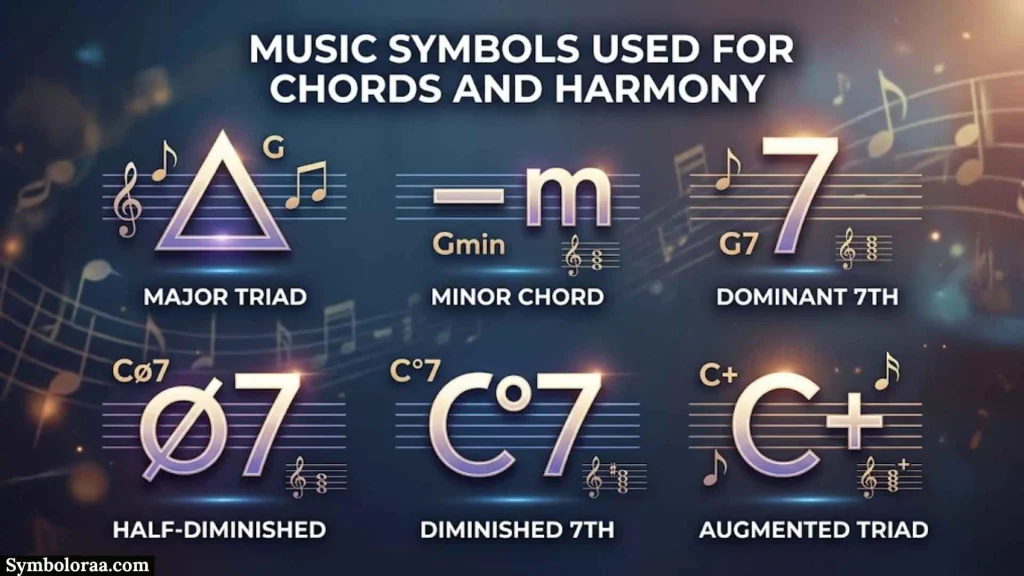
Chord symbols are common in lead sheets, popular music, jazz, worship charts, fake books, and many contemporary arrangements.
Major Chord
Example: C
A plain letter such as C commonly represents a C major chord.
Minor Chord
Example: Cm
The m indicates minor.
Dominant Seventh Chord
Example: C7
The number 7 commonly indicates a dominant seventh chord.
Major Seventh Chord
Example: Cmaj7
This identifies a major seventh chord.
Diminished Chord
Example: Cdim
This indicates a diminished chord.
Augmented Chord
Example: Caug
This indicates an augmented chord.
Suspended Chord
Example: Csus4
This indicates a suspended fourth chord.
Chord symbols are different from the symbols used to represent individual notes on a staff. A performer may need both systems when reading a modern lead sheet.
Music Symbols for Guitar and String Instruments
Some notation symbols are specific to particular instruments.
Guitar Tablature
Guitar tablature, or TAB, uses lines representing guitar strings rather than relying entirely on traditional staff notation.
Numbers indicate fret positions.
TAB is especially useful for guitarists because it directly shows where notes can be played on the instrument.
Hammer-On
A hammer-on is commonly represented with a curved marking connecting two notes and may be accompanied by the letter H in simplified guitar notation.
The player sounds the first note and produces the second primarily with the fretting hand.
Pull-Off
A pull-off is commonly marked with a curved connection and may be represented by P in simplified guitar notation.
The player moves from a higher fretted note to a lower note without picking the second note in the usual way.
Slide
A slide is often shown using a diagonal line between notes.
It indicates that the player should move between pitches while maintaining the connection characteristic of a slide.
Bend
Guitar notation may use an upward curved arrow or other marking to indicate a bend.
The exact notation varies by tablature system and publisher.
Music Symbols by Category
Grouping symbols by function is one of the fastest ways to learn them.
| Category | Common Symbols | What They Control |
| Pitch | Clefs, sharps, flats, naturals | Note identity and pitch |
| Rhythm | Notes, dots, tuplets | Note duration |
| Silence | Rests | Duration of silence |
| Meter | Time signatures | Beat organization |
| Structure | Bar lines | Measure divisions |
| Dynamics | p, f, cresc., dim. | Loudness |
| Articulation | Staccato, accent, tenuto | Note attack and shape |
| Expression | Fermata, phrasing marks | Performance character |
| Tempo | Largo, Andante, Allegro | Speed |
| Navigation | D.C., D.S., Coda, Fine | Score movement |
| Harmony | C, Cm, C7, Cmaj7 | Chords |
| Instrumental | TAB, pedal marks, bends | Instrument-specific technique |
This classification is more useful than memorizing a long list because it tells you why each symbol exists.
How to Read Music Symbols in a Sheet Music Example
Suppose you open a piece of sheet music and see a treble clef, three sharps, a 4/4 time signature, several notes, and a dynamic marking.
Do not try to read everything at once.
Step 1: Identify the Clef
Start with the clef.
Ask:
Which pitch system am I using?
A treble clef and bass clef place different pitch names on the staff.
Step 2: Check the Key Signature
Next, look immediately after the clef.
Sharps or flats in this area form the key signature.
This tells you which pitch alterations are normally expected.
Step 3: Check the Time Signature
Look for the meter marking, such as:
4/4
This establishes the rhythmic organization of the measures.
Step 4: Identify the Tempo
Look above the staff for a term such as:
Andante
or a numerical marking such as:
♩ = 100
This tells you how quickly the music should move.
Step 5: Read the Notes and Rests
Now identify the actual notes and rests.
Look at both:
- Their position on the staff.
- Their rhythmic shape.
A note’s position and duration are separate pieces of information.
Step 6: Look for Accidentals
Check whether any individual notes have:
- ♯
- ♭
- ♮
- 𝄪
- 𝄫
These may temporarily alter the pitch indicated by the key signature.
Step 7: Check Dynamics and Articulation
Look for:
- p
- f
- cresc.
- dim.
- staccato dots
- accents
- tenuto marks
- fermatas
These markings tell you how the music should be performed rather than simply which notes to play.
Step 8: Follow Navigation Symbols
Finally, check for:
- Repeat signs
- First and second endings
- D.C.
- D.S.
- Coda
- Fine
These tell you how the musical form should be followed.
This eight-step process prevents beginners from treating sheet music as one large collection of confusing symbols.
Common Music Symbol Mistakes to Avoid
Understanding common mistakes can make learning notation much faster.
Confusing Sharp With the Number Sign
The musical sharp ♯ and keyboard # are visually related but are not identical glyphs.
In plain text, people often use # when the proper music symbol is unavailable.
Confusing a Tie With a Slur
A tie connects notes of the same pitch to combine their duration.
A slur normally connects notes of different pitches to indicate smooth phrasing or connected performance.
Treating Every Dot as Staccato
A dot after a note can mean something completely different from a dot above or below a note.
- Dot after note: extends duration by half.
- Dot above/below note: commonly indicates staccato.
Position matters.
Confusing Dynamics With Articulation
A forte marking tells you about loudness.
A staccato marking tells you about note separation.
They answer different performance questions.
Assuming Every Time Signature Is Just a Note Count
Time signatures describe meter and rhythmic organization.
For example, 6/8 contains six eighth-note units but is commonly felt in two larger beats.
Confusing Key Signatures With Individual Accidentals
A key signature establishes recurring pitch alterations.
An accidental modifies a particular written note according to the notation rules.
Memorizing Symbols Without Learning Their Function
A better method is to learn:
Symbol → Name → Function → Example → Category
For example:
♯ → Sharp → Raises pitch → C♯ → Pitch
This creates a stronger mental connection than memorizing the symbol alone.
How to Memorize Music Symbols Faster
You do not need to learn every symbol in one sitting.
Start With the Most Important Groups
Learn these first:
- Treble clef
- Bass clef
- Whole, half, quarter, and eighth notes
- Whole, half, quarter, and eighth rests
- Sharp
- Flat
- Natural
- Time signatures
- p and f
- Staccato
- Tie
- Slur
- Repeat sign
These cover many of the symbols beginners encounter regularly.
Use Symbol Families
Learn related symbols together.
For example:
Sharp → Flat → Natural → Double Sharp → Double Flat
Or:
p → mp → mf → f → ff
Families make patterns easier to remember.
Practice Recognition Before Recall
First look at a symbol and ask:
What is this?
Then ask:
What does it do?
Finally ask:
Where would I find it in a score?
This is more useful than simply copying definitions.
Read Real Music
Use simple sheet music and identify five symbols at a time.
For example:
- Find the clef.
- Find the key signature.
- Find the time signature.
- Find one dynamic marking.
- Find one articulation marking.
With repeated exposure, recognition becomes much faster.
Why Music Symbols Matter to Musicians
Musical notation is more than a collection of decorative marks. It provides a system for communicating musical information between composers, arrangers, performers, teachers, students, conductors, editors, and publishers.
A score can contain information about several musical parts at the same time.
The Library of Congress describes a full score as notated music representing the sounds of an ensemble’s parts so they can be read together.
That makes symbols valuable in several professional situations.
For Composers
Composers use notation to record musical ideas and communicate them to performers.
For Arrangers
Arrangers use symbols to organize parts, rhythms, dynamics, articulations, and performance instructions.
For Performers
Musicians use notation to interpret pitch, rhythm, expression, structure, and technique.
For Music Teachers
Teachers use notation to explain musical concepts and assess students’ reading skills.
For Music Publishers
Publishers need consistent notation so printed and digital scores can be understood by performers.
For Music Software
Modern notation software depends on digital representations of musical symbols.
The Standard Music Font Layout, or SMuFL, provides a standardized mapping of musical glyphs for modern music fonts and notation software.
Digital music encoding systems also allow notation to be represented as structured data. The Music Encoding Initiative, for example, can represent standard notation as well as forms such as tablature and historical notation.
How Music Notation Has Developed Over Time
Modern staff notation did not appear fully formed.
Different musical cultures have developed their own ways of representing sound, rhythm, pitch, and performance. Western staff notation developed over centuries, with earlier systems using different approaches to represent musical information.
Historical sources also show that scholars, librarians, performers, and transcribers have had to convert older or culturally specific musical traditions into written notation.
For example, the Library of Congress documents efforts to preserve and transcribe Coptic liturgical music using notation during the twentieth century.
This history explains an important point:
There is no single universal visual language for every musical tradition.
The symbols discussed in this article are primarily associated with modern Western staff notation and related contemporary systems. Other traditions may use different notation methods, symbols, or performance conventions.
Modern Music Notation and Digital Standards
Music notation today exists both on paper and in digital systems.
Notation software must represent thousands of possible musical elements, including notes, clefs, dynamics, articulations, ornaments, and other symbols.
The Library of Congress notes that SMuFL was created to provide standardized glyph mappings for musical symbols used by music notation software and font designers.
Digital encoding is also important for:
- Music archives
- Digital sheet music
- Music education
- Music research
- Searchable scores
- Music publishing
- Automated score rendering
- Preservation of historical notation
This means that learning music symbols is useful not only for reading printed sheet music but also for understanding how modern digital music documents are structured.
A Simple Decision Tree for Identifying Music Symbols
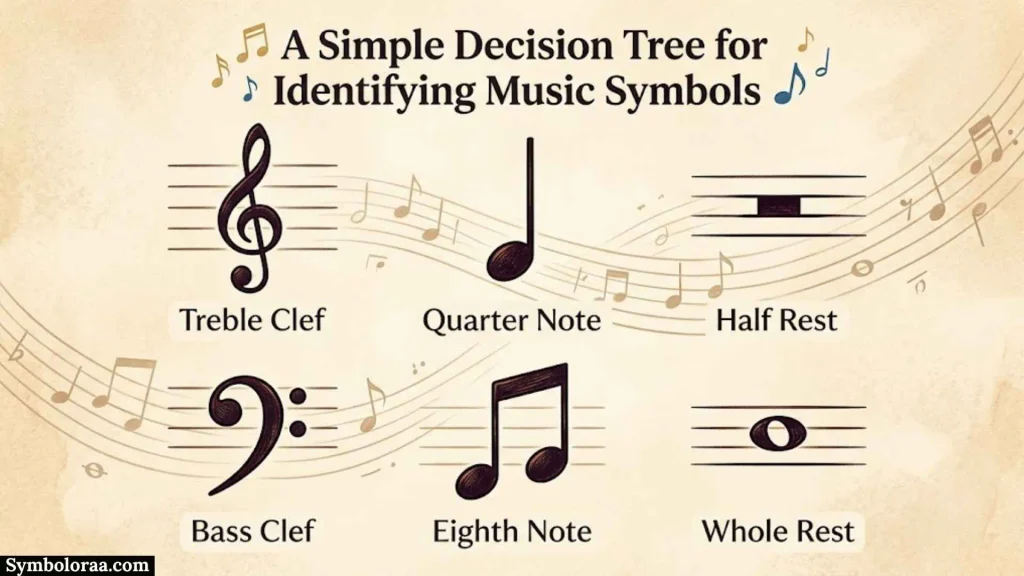
When you encounter an unfamiliar symbol, use this quick decision process.
Does it appear near the beginning of the staff?
→ Check whether it is a clef, key signature, or time signature.
Does it appear directly beside a note?
→ Check for an accidental or articulation mark.
Does it appear after a note?
→ Check whether it is a dot that changes duration.
Does it sit above or below several notes?
→ Check for a slur, phrase marking, or articulation.
Does it appear between two sections?
→ Check for a bar line, double bar line, or repeat sign.
Does it contain letters such as p, f, or cresc.?
→ It is probably a dynamic or expressive marking.
Does it contain Italian tempo terminology?
→ It is probably a tempo instruction.
Does it tell you to return somewhere in the score?
→ It is probably a navigation symbol such as D.C. or D.S.
This decision tree gives beginners a practical way to identify unfamiliar notation without memorizing an enormous symbol list.
Frequently Asked Questions
What Are the Most Common Music Symbols?
The most common music symbols include clefs, notes, rests, sharps, flats, naturals, key signatures, time signatures, bar lines, dynamics, articulation marks, ties, slurs, tempo markings, and repeat signs.
These symbols cover the main information needed to read and perform traditionally notated music.
What Is the Symbol for a Musical Note?
There is no single symbol for every musical note. Common note values include the whole note, half note, quarter note, eighth note, and sixteenth note.
The note’s shape communicates duration, while its position on the staff helps identify pitch.
What Are the Five Main Music Symbols?
There is no universal rule that limits music notation to five symbols. However, beginners often start with five important categories:
- Clefs
- Notes
- Rests
- Accidentals
- Time signatures
These provide a useful foundation for learning written music.
What Does the Music Symbol ♯ Mean?
The symbol ♯ is a sharp. It raises the affected pitch by one semitone in standard chromatic notation.
It should not be confused with the ordinary keyboard number sign #.
What Does ♭ Mean in Music?
The symbol ♭ is a flat. It lowers the affected pitch by one semitone in standard chromatic notation.
What Does ♮ Mean in Music?
The symbol ♮ is a natural sign. It cancels a previously indicated sharp or flat for the relevant note according to the notation context.
What Does a Dot Mean in Music?
A dot can have different meanings depending on where it appears.
A dot after a note increases its duration by half.
A dot above or below a note commonly indicates staccato.
Therefore, the dot’s position matters.
What Is the Difference Between a Tie and a Slur?
A tie connects two notes of the same pitch to combine their durations.
A slur generally connects notes of different pitches and indicates smooth or connected performance.
What Does C Mean in Music?
The letter-like C can represent common time, meaning 4/4.
In chord notation, however, C commonly represents a C major chord.
The meaning therefore depends on where the symbol appears.
What Does F Mean in Music?
A lowercase f in a dynamic marking means forte, or loud.
An uppercase F in another context may refer to the pitch F, an instrument, a clef-related term, or another notation convention.
Context is essential.
What Are Music Symbols Called?
They are generally called musical symbols, music notation symbols, musical notation marks, notation signs, or music symbols.
Different categories have more specific names, such as clefs, accidentals, dynamics, articulations, rests, and navigation symbols.
How Many Music Symbols Are There?
There is no single fixed number.
The total depends on what notation system, instrument, historical period, and level of detail you include. Modern notation systems contain a very large range of glyphs for standard notation, ornaments, articulations, dynamics, techniques, and other musical information. Digital standards such as SMuFL provide extensive mappings for musical glyphs used in notation fonts.
Are Music Symbols the Same in Every Country?
Not necessarily.
Many musicians worldwide use modern Western notation, but musical cultures can use different notation systems and conventions.
Historical notation, tablature, graphic notation, and culturally specific systems may use different symbols and structures.
Are Chord Symbols the Same as Sheet Music Symbols?
Not exactly.
Chord symbols such as C, Cm, C7, and Cmaj7 communicate harmonic information.
Traditional staff notation communicates pitch and rhythm visually through notes, clefs, accidentals, and other markings.
A lead sheet may use both systems together.
Key Takeaways
- Music symbols communicate pitch, rhythm, silence, dynamics, tempo, articulation, expression, and structure.
- The staff provides the basic framework for traditional Western notation.
- Treble and bass clefs establish pitch references.
- Notes communicate pitch and duration.
- Rests communicate silence and duration.
- Sharps, flats, and naturals modify pitch.
- Key signatures establish recurring pitch alterations.
- Time signatures organize musical metres.
- Dynamics describe loudness and changes in intensity.
- Articulation marks describe how notes should be performed.
- Ties and slurs look similar but serve different purposes.
- Tempo markings communicate speed.
- Repeat and navigation symbols control the order in which sections are performed.
- Chord symbols and tablature provide additional information in modern music.
- The fastest way to learn unfamiliar symbols is to identify what musical function they control.
Conclusion
Learning music symbols names becomes much easier when the symbols are understood as parts of a system rather than as a random collection of shapes.
Start with the foundation: staff, clefs, notes, rests, accidentals, key signatures, and time signatures. Then move to performance markings such as dynamics, articulation, tempo, ties, slurs, and fermatas. Once those are familiar, navigation symbols, chord notation, guitar tablature, piano markings, and more specialized notation become easier to understand.

I’m Jackson Miller, an American author inspired by mystery, adventure, and the unpredictable nature of life. I enjoy writing fast-moving stories filled with memorable characters, unexpected choices, and meaningful moments. Through my books, I want readers to experience new worlds while discovering something about courage, determination, and themselves.
Three Books:
The Edge of Tomorrow
Under a Broken Sky
The Road We Chose
 Ethan Brooks