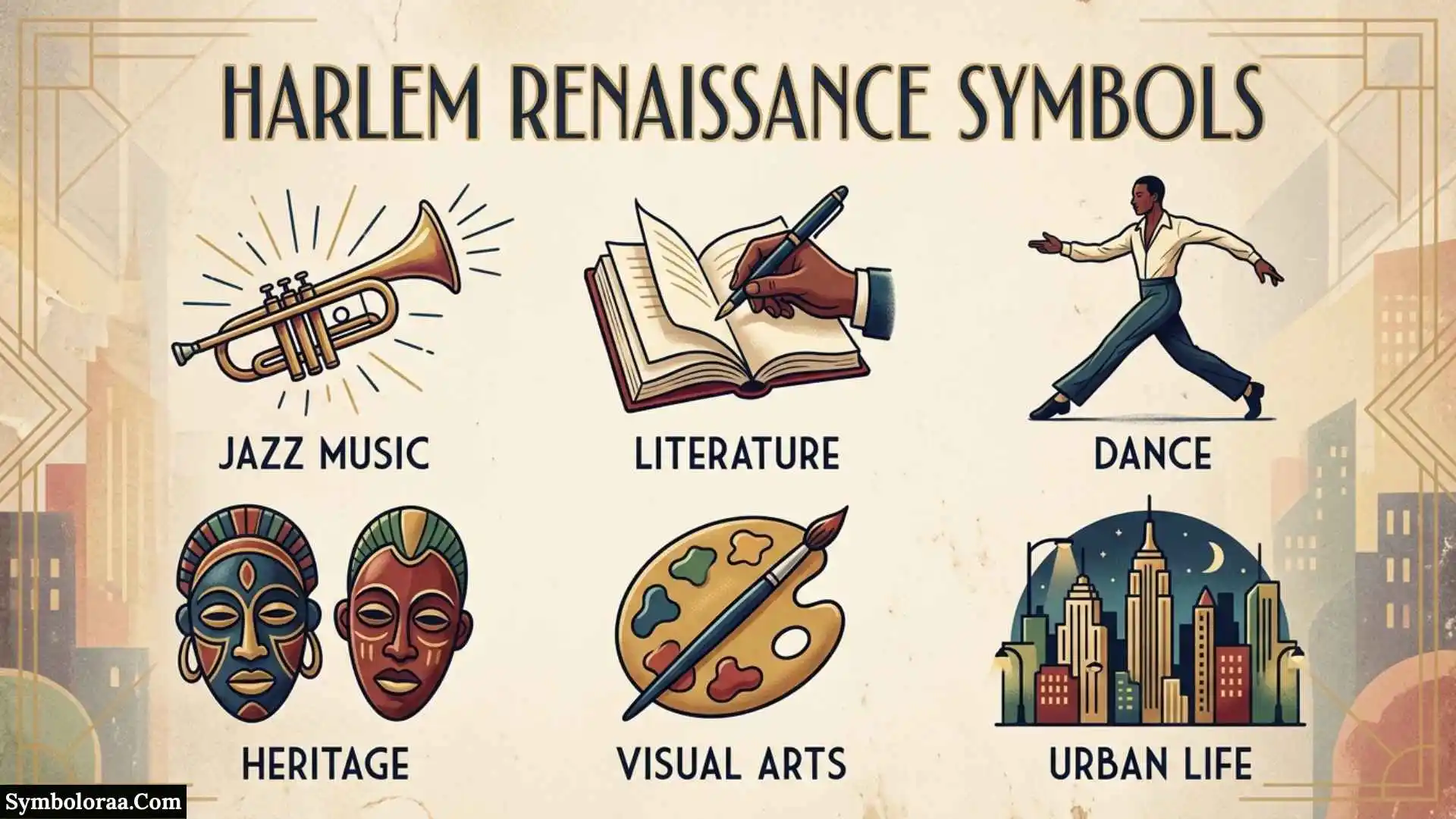
The most important Harlem Renaissance symbols include African heritage, jazz and musical expression, light and the North Star, migration and movement, Black beauty, books and newspapers, fashion, dance, masks and identity, and African and Egyptian-inspired visual forms. These symbols helped artists and writers explore racial pride, freedom, identity, heritage, creativity, resistance, and the experience of Black life in modern America.
The Harlem Renaissance, also called the New Negro Renaissance, was a major period of African American cultural and artistic expression that developed from the early 20th century and reached its height during the 1920s and early 1930s. It was not limited to literature. It included poetry, fiction, visual art, photography, jazz, theater, dance, fashion, and intellectual life. The National Gallery of Art describes the period as a cultural and artistic rebirth among African Americans between about 1918 and the mid-1930s.
Understanding its symbols requires more than memorizing a list. A symbol can change meaning depending on the artwork, poem, historical setting, or artist using it. For example, a star may suggest hope or freedom in one work, while African imagery may communicate ancestry and cultural pride in another.
This guide explains the major Harlem Renaissance symbols, what they can represent, where they appear, and how to analyze them accurately.
Quick Answer: What Are Harlem Renaissance Symbols?
Harlem Renaissance symbols are recurring objects, images, artistic forms, and cultural references used by Black writers and artists to express ideas about identity, heritage, freedom, racial pride, migration, modernity, creativity, and social change.
Common examples include:
| Symbol or Motif | Common Meaning or Association | Where It Appears |
| African heritage | Ancestry, cultural identity, racial pride | Visual art, literature |
| Jazz | Creativity, freedom, modern Black culture | Music, poetry, literature |
| Light | Hope, knowledge, freedom, spiritual direction | Visual art and poetry |
| North Star | Guidance, liberation, freedom | African American cultural imagery |
| Harlem/city | New identity, opportunity, modern life | Literature, photography, music |
| Books and newspapers | Education, self-definition, intellectual power | Harlem’s literary culture |
| Fashion | Self-presentation, dignity, modern identity | Photography, nightlife, social life |
| Dance | Freedom, movement, cultural expression | Performing arts |
| Migration/trains | Movement, escape, opportunity, transformation | Literature and visual culture |
| Masks/profile figures | Identity, ancestry, artistic connection to Africa | Visual art |
| Geometric forms | Modernity, rhythm, movement, abstraction | Visual art |
| Egyptian/African-inspired forms | Ancestral connection and cultural heritage | Especially visual art |
Important: these are not universal dictionary definitions. A symbol’s meaning depends on its context.
What the Harlem Renaissance Was and Why Its Symbols Matter
The Great Migration Created New Cultural Communities
The Harlem Renaissance cannot be understood without the Great Migration.
During the early 20th century, large numbers of African Americans moved from the South to cities in the North and Midwest. New York’s Harlem became one of the most important centers of Black cultural life. The migration brought together workers, intellectuals, writers, musicians, artists, and entrepreneurs.
The Smithsonian’s National Museum of African American History and Culture explains that the Great Migration helped create communities where African Americans could work toward new forms of social, economic, and cultural self-determination. Harlem became a major center for publishing, newspapers, music companies, theaters, nightclubs, and cabarets.
This history gives several Harlem Renaissance symbols their deeper meaning.
A train, for example, can represent physical migration, but it can also suggest movement toward a different future. A city can represent opportunity and modernity, while a home or Southern landscape may represent memory, ancestry, hardship, or belonging.
The New Negro Represented Self-Definition
One of the most important concepts connected with the Harlem Renaissance was the New Negro.
Alain Locke’s 1925 anthology The New Negro became one of the defining intellectual works associated with the movement. It promoted recognition of African heritage and encouraged greater pride in Black cultural identity.
The idea was larger than a particular physical object.
The New Negro represented a changing approach to identity: African Americans increasingly insisted on defining themselves rather than accepting racist stereotypes imposed by others.
This is why symbols of self-representation, education, fashion, artistic achievement, beauty, African heritage, and intellectual independence became so important.
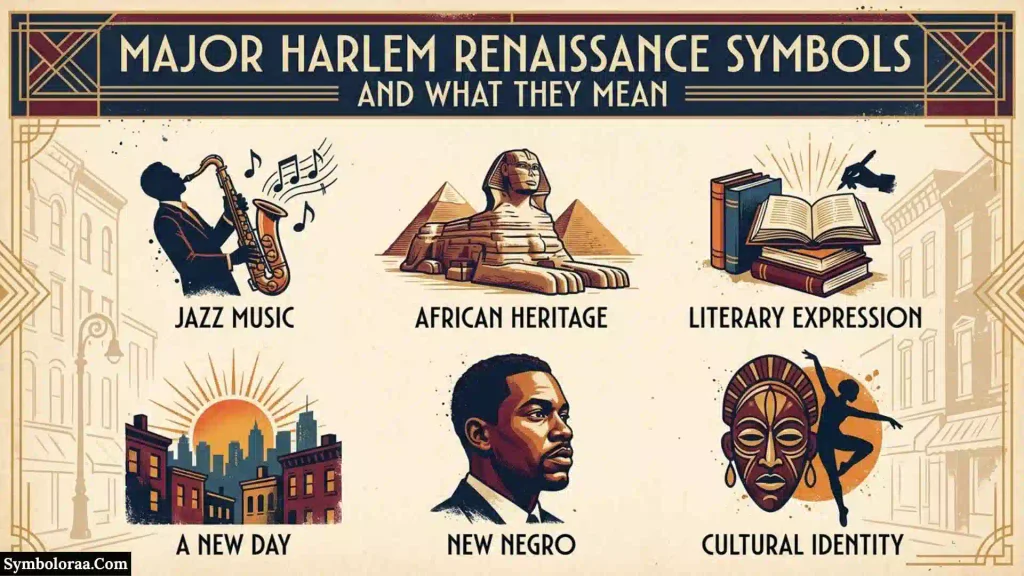
Major Harlem Renaissance Symbols and What They Mean
African Heritage and Ancestral Imagery
African heritage is one of the strongest symbolic threads in Harlem Renaissance visual culture.
Artists looked toward African art and history as sources of inspiration. This did not mean that every artist used African imagery in the same way or that African cultures had one single visual language. Rather, artists selectively incorporated African-inspired forms to create connections with ancestry and Black identity.
The National Gallery of Art notes that Aaron Douglas and other artists looked toward African art, including stylized forms associated with masks and sculpture from places such as Benin, Congo, and Senegal. They also drew inspiration from ancient Egyptian art.
Common symbolic associations include:
- ancestry
- cultural memory
- racial pride
- African identity
- resistance to racist stereotypes
- reconnection with a history often distorted or ignored
The important point is that African imagery should be interpreted in context, not as a universal symbol with one fixed meaning.
Jazz and Musical Instruments
Jazz is both a musical form and an important cultural symbol associated with the Harlem Renaissance.
Jazz represented creativity, experimentation, rhythm, individuality, performance, and the emergence of modern Black cultural expression.
Instruments such as trumpets, saxophones, pianos, and drums can therefore carry symbolic meaning when they appear in Harlem Renaissance-related art or literature.
But jazz should not be reduced to simply meaning “freedom.”
Its significance was more complex. Jazz was part of a living cultural environment that included musicians, clubs, dancers, audiences, recording industries, and nightlife.
The Smithsonian identifies jazz and swing as important components of the Harlem Renaissance alongside literature, painting, sculpture, opera, and dance.
Harlem and the Urban City
Harlem itself became a powerful cultural symbol.
It represented a place where Black creativity, business, entertainment, publishing, and intellectual life could develop together.
During the height of the movement, Harlem contained newspapers, publishing houses, music businesses, theaters, nightclubs, and cabarets.
In literature and photography, an urban street can therefore suggest:
- modern life
- opportunity
- community
- cultural exchange
- nightlife
- ambition
- social change
However, Harlem was not a perfect symbol of freedom or prosperity. The community also experienced poverty, racism, economic inequality, and discrimination.
That tension makes urban imagery more interesting. The same city can represent both possibility and struggle.
Light, Sun, Stars, and Radiating Forms
Light often carries associations with hope, knowledge, spiritual direction, or liberation.
The symbolism becomes especially clear in Aaron Douglas’s Into Bondage.
The National Gallery of Art explains that the painting contains a central figure looking toward a star, with a beam of light reaching across the composition. The work addresses the forced transportation and enslavement of Africans while also presenting the star as a possible sign of hope and freedom.
Douglas also frequently used concentric circles. In Into Bondage, these circles are connected with sound, particularly African and African American song.
This creates an important lesson:
A visual form can carry more than one meaning.
Circles may create rhythm visually, while also connecting the scene to music and cultural memory.
Black Beauty and Self-Representation
The Harlem Renaissance helped challenge racist representations of Black people.
Portraits, photographs, poetry, fashion, and visual art presented Black people as complex individuals rather than stereotypes.
Black beauty therefore became connected with:
- dignity
- individuality
- confidence
- self-definition
- cultural pride
- resistance to degrading stereotypes
This is especially important when studying portrait photography and fashion during the period.
A well-dressed subject in a formal portrait is not merely showing clothing. The image can also communicate how the subject wants to be seen by the world.
Books, Newspapers, and Publishing
Books and newspapers can symbolize knowledge, voice, education, intellectual authority, and self-definition.
This symbolism was especially meaningful because Harlem became a major center for Black publishing and journalism.
Writing allowed African American authors to describe Black life from their own perspectives. Poetry and fiction could explore racism, love, family, migration, work, dreams, music, religion, and everyday experiences.
The Smithsonian describes the Harlem Renaissance as a period in which African American writers and artists developed new forms of expression while asserting Black identity and cultural independence.
A book in a Harlem Renaissance image can therefore be interpreted as more than an object. It may represent the power to tell one’s own story.
Fashion and Social Presentation
Fashion is another important but sometimes overlooked aspect of Harlem Renaissance symbolism.
Clothing, hairstyles, formal portraits, evening wear, and social presentation could communicate modern identity and personal dignity.
Photography from the period helped preserve images of Black professionals, artists, performers, families, and social groups.
Fashion can therefore symbolize:
- confidence
- modernity
- respectability
- individuality
- social mobility
- self-presentation
It is important not to assume that every fashionable portrait is making a political statement. The safest interpretation is to examine the setting, subject, pose, clothing, audience, and surrounding cultural context.
Dance and Movement
Dance was closely connected with the musical culture of the Harlem Renaissance.
Movement can symbolize energy, freedom, social interaction, creativity, and modernity. In a literary passage, a dancer may also represent emotional release or resistance to social restrictions.
Dance should therefore be analyzed through its relationship to music, performance, bodies, public spaces, and community life.
Religion and Spirituality
Religion remained an important part of African American cultural expression.
Spirituals, religious imagery, biblical references, prayer, heaven, light, and spiritual journeys could connect present struggles with historical memory and hope.
The Harlem Renaissance did not have one single religious viewpoint. Writers and artists approached religion differently, ranging from traditional Christian belief to more secular or modern perspectives.
Therefore, religious imagery should be interpreted according to the individual work rather than assigned one universal meaning.
Folk Culture, Blues, and Oral Tradition
The Harlem Renaissance was not only about elite or formal culture.
Artists and writers also drew attention to folk traditions, everyday speech, blues, spirituals, rural memories, and Black Southern culture.
This created an important tension between folk culture and modern urban life.
A blues reference may evoke:
- sorrow
- endurance
- emotional honesty
- everyday experience
- cultural memory
- resilience
The Smithsonian’s documentation of the period includes spirituals, folk melodies, and road songs alongside jazz, literature, theater, and visual art.
Migration, Trains, Roads, and Journeys
Migration is both a historical reality and a powerful literary motif.
The journey from the South to Northern cities changed families, communities, employment, cultural networks, and artistic life.
A train or road can therefore symbolize:
departure → transition → uncertainty → opportunity → transformation
But migration was not always a simple journey toward success. Many migrants encountered racism, segregation, housing discrimination, low wages, and difficult working conditions.
This complexity makes migration imagery especially valuable for literary analysis.
Egyptian and Ancient African Imagery
Ancient Egyptian imagery became influential in some Harlem Renaissance visual art.
This interest existed within a broader search for connections to African history and cultural heritage. The 1922 discovery of King Tutankhamun’s tomb also contributed to the public fascination with ancient Egypt during the era.
Aaron Douglas incorporated Egyptian-inspired forms with modern artistic styles.
In Into Bondage, for example, the figure’s profile reflects the visual language associated with Egyptian wall paintings.
The key interpretation is not simply “Egypt means Africa.”
Instead, ask:
Why did this artist choose this historical visual language at this particular moment?
The answer may involve ancestry, cultural pride, historical continuity, modern Black identity, or artistic experimentation.
Masks and Identity
Masks can create a particularly rich symbolism.
They may raise questions about:
- identity
- visibility
- hidden identity
- ancestry
- performance
- cultural memory
- how society sees an individual
African-inspired masks were important references for some Harlem Renaissance artists. The National Gallery of Art notes that artists connected stylized African masks and sculpture with African heritage.
However, a mask should not automatically be interpreted as “hiding one’s identity.” The surrounding artwork must determine whether the mask represents concealment, ancestry, transformation, artistic form, or something else.
Geometric Shapes and Modernism
Circles, triangles, silhouettes, diagonal lines, overlapping forms, and simplified figures are important visual features in Harlem Renaissance art.
Aaron Douglas combined African and Egyptian-inspired imagery with modern artistic approaches, including Cubism, Precisionism, and Art Deco.
Geometric forms can create:
- rhythm
- movement
- visual order
- modernity
- abstraction
- emphasis
- repetition
This is one reason Douglas’s work remains so useful for understanding Harlem Renaissance symbolism: his style connects African heritage with modern visual language rather than treating tradition and modernity as opposites.
Harlem Renaissance Symbols in Literature
Langston Hughes
Langston Hughes frequently explored Black identity, racial consciousness, everyday life, music, work, dreams, and American identity.
His poetry is particularly useful for studying how ordinary experiences can become symbolic.
Rivers, dreams, music, roads, darkness, light, and the American landscape can carry meanings that extend beyond their literal descriptions.
Hughes’s work also demonstrates why symbolism should not be separated from history. His poems often connect individual experience with the larger history of African Americans.
The Smithsonian identifies Hughes as one of the major literary figures associated with the Harlem/New Negro Renaissance and emphasizes the movement’s interest in African heritage, racial pride, artistic freedom, and racial uplift.
Zora Neale Hurston
Zora Neale Hurston brought attention to Black Southern life, folklore, speech, community, gender, identity, and cultural traditions.
Her work demonstrates that Harlem Renaissance symbolism was not limited to urban Harlem.
Folk speech, music, storytelling, nature, community spaces, and everyday objects can become important carriers of cultural meaning.
Hurston’s presence in the movement also helps correct the misconception that the Harlem Renaissance consisted only of male writers or only of urban jazz culture.
Countee Cullen and Claude McKay
Countee Cullen and Claude McKay explored race, identity, beauty, discrimination, history, and belonging through poetry.
Their work shows that Harlem Renaissance literature could combine traditional poetic forms with modern concerns about race and society.
Symbols such as beauty, nature, night, death, dreams, homeland, and historical memory can therefore take on racial and political significance depending on the poem.
The best approach is to identify the image first, then examine how the poet develops it through language and historical context.
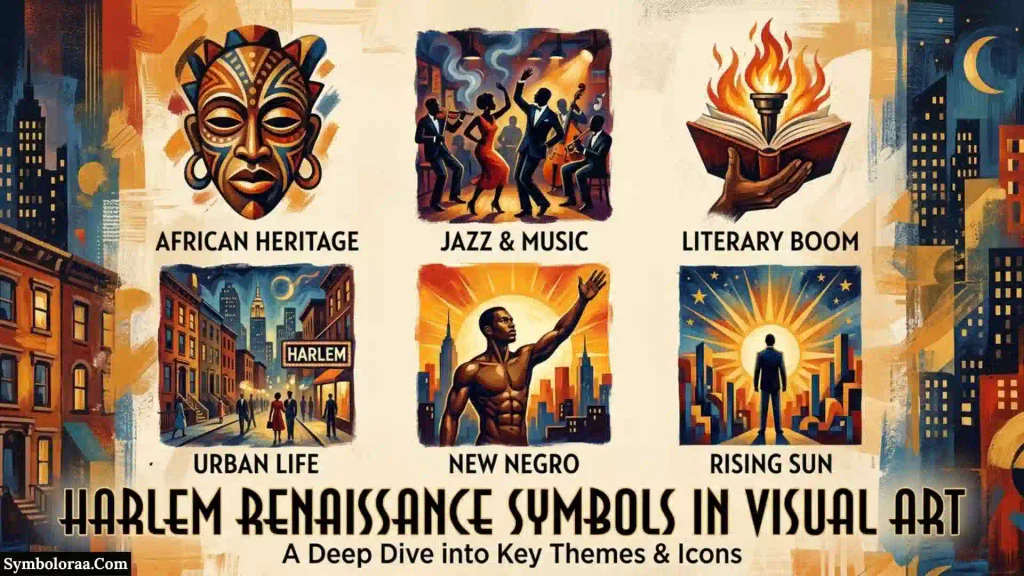
Harlem Renaissance Symbols in Visual Art
Aaron Douglas
Aaron Douglas is one of the most important artists for understanding Harlem Renaissance symbolism.
He developed a distinctive visual language using silhouettes, geometric forms, radiating circles, strong contrasts, African-inspired references, Egyptian imagery, and modernist design.
The National Gallery of Art describes his approach as a combination of African art, Egyptian visual traditions, Cubism, Precisionism, and Art Deco.
His work is especially valuable because the symbols often work together.
In Into Bondage:
- shackles refer directly to enslavement
- ships suggest forced transportation
- the bowed figures communicate suffering
- the star can suggest hope and freedom
- light creates a visual connection between oppression and hope
- concentric circles connect the composition with music and sound
- African-inspired forms connect the scene to cultural heritage
The painting therefore cannot be reduced to one symbol.
It creates a network of symbols.
James VanDerZee
James VanDerZee’s photography provides another way to understand Harlem Renaissance symbolism.
Portraits and photographs can communicate identity through clothing, posture, setting, facial expression, objects, and social relationships.
Unlike a painting in which an artist may intentionally create an obvious symbolic form, photography can communicate meaning through what is selected and how people are presented.
A formal portrait may therefore symbolize dignity and self-representation without containing an obvious symbolic object.
Symbol vs. Motif vs. Theme: What Is the Difference?
These terms are related but should not be treated as identical.
| Term | Meaning | Example |
| Symbol | An object, image, action, or form that carries meaning beyond its literal function | A star representing hope in a particular artwork |
| Motif | A recurring image, form, idea, or pattern | Repeated circles in Aaron Douglas’s visual language |
| Theme | A broader idea explored by a work | Identity, freedom, racial pride |
| Historical reference | An image or event connected to real history | Slave ships representing the transatlantic slave trade |
| Subject | What the work is directly about or depicts | African American migration |
This distinction improves academic accuracy.
For example, freedom is usually better described as a theme or idea than as a physical symbol. A North Star, however, can function as a symbol of freedom or guidance in a particular context.
How to Interpret a Harlem Renaissance Symbol
Step 1: Identify the Literal Object
Start with what you can actually see or read.
Is it:
- a star?
- a train?
- a musical instrument?
- a book?
- a mask?
- a river?
- a city?
- clothing?
- a circle?
- a religious image?
Do not interpret it too quickly.
Step 2: Ask What It Does in the Work
Next ask:
Why did the artist or writer include it?
Look at repetition, position, contrast, language, color, movement, and relationships with other objects.
Step 3: Connect It to Historical Context
Ask what was happening during the Harlem Renaissance.
Consider:
- Great Migration
- segregation
- racial discrimination
- Black cultural self-expression
- African American political activism
- modern urban life
- African heritage
- changing ideas of identity
Historical context prevents shallow interpretation.
Step 4: Find Evidence
Do not write:
“The star means freedom.”
Instead write something more precise:
“In this artwork, the star can be interpreted as a sign of hope and freedom because the central figure directs his attention toward it while the surrounding scene depicts enslavement.”
That approach connects symbol + evidence + context.
Step 5: Consider More Than One Meaning
Strong analysis recognizes ambiguity.
A train may mean migration, but it may also represent separation, uncertainty, opportunity, or transformation.
A mask may suggest African heritage, identity, performance, or concealment.
The correct interpretation depends on the work.
The Symbol → Meaning → Context → Evidence Framework
For essays and academic assignments, use this simple framework:
Symbol: What is the object or image?
↓
Meaning: What idea might it represent?
↓
Context: How does Harlem Renaissance history influence that meaning?
↓
Evidence: What specific detail from the poem, artwork, photograph, or historical source supports your interpretation?
Example
Symbol: North Star
Possible meaning: Hope, direction, liberation
Historical context: The North Star had longstanding associations with freedom and escape from slavery.
Evidence: In Aaron Douglas’s Into Bondage, a central figure looks toward a star while a beam of light extends from it. The National Gallery of Art interprets this imagery in relation to hope and freedom.
This is much stronger than simply listing “North Star = freedom.”
Common Misconceptions About Harlem Renaissance Symbols
The Harlem Renaissance Was Only About Harlem
The movement’s cultural influence extended beyond Harlem.
The Smithsonian notes that this cultural explosion also developed in other cities shaped by the Great Migration, including Chicago, Cleveland, Los Angeles, Washington, D.C., and others.
Every African-Inspired Image Has the Same Meaning
This is incorrect.
Artists drew inspiration from different African artistic traditions and combined them with modern Western art movements.
The meaning depends on the artist, source, medium, and historical context.
Jazz Always Means Freedom
Jazz can represent creativity and cultural expression, but it can also simply depict entertainment, nightlife, community, performance, or modern urban culture.
Do not assign a political meaning without evidence.
Every Circle Is a Symbol of Unity
Circles can have many functions.
In Aaron Douglas’s work, concentric circles can be connected to sound and African American music.
Their meaning should therefore be established from the specific artwork.
The Harlem Renaissance Was Only a Literary Movement
Literature was important, but the movement also included music, theater, dance, painting, sculpture, photography, and intellectual life.
Real Examples of Harlem Renaissance Symbolism
Example 1: Aaron Douglas’s Into Bondage
This is one of the clearest examples of multiple symbols working together.
The painting addresses the forced enslavement and transportation of Africans. Shackles, ships, bowed figures, water, light, and the star all contribute to the historical and emotional meaning.
Instead of identifying only one symbol, analyze the entire visual system.
Example 2: The New Negro
Alain Locke’s The New Negro is important because the phrase itself became associated with a new approach to Black identity and cultural self-definition.
The book can therefore be discussed not only as a literary publication but also as an important intellectual expression of the Harlem Renaissance.
Example 3: Harlem Nightlife
Nightclubs and cabarets represented entertainment and musical performance, but they also formed part of a larger cultural economy.
Harlem’s nightlife brought together musicians, dancers, audiences, writers, photographers, and visitors.
Therefore, nightlife imagery can represent modernity, community, creativity, business, and cultural exchange.
A Practical Decision Tree for Identifying a Symbol
Use these questions when analyzing a Harlem Renaissance poem, painting, photograph, or story:
Is the object repeated or strongly emphasized?
- Yes → It may function as a motif or symbol.
- No → Continue examining its context.
Does it carry a meaning beyond its literal function?
- Yes → It may be a symbol.
- No → It may simply be part of the setting.
Does its meaning connect to the work’s historical context?
- Yes → Explain that connection.
- No → Avoid forcing a historical interpretation.
Does the artist’s use of the image support your interpretation?
- Yes → Use the specific evidence.
- No → Consider another interpretation.
This approach helps prevent overinterpretation.
Best Practices for Writing About Harlem Renaissance Symbols
Use Specific Evidence
Instead of writing:
“African imagery represents pride.”
Write:
“Douglas incorporated African-inspired visual forms into a modernist style, creating a visual connection between African heritage and contemporary Black identity.”
The second statement is more precise because it explains how the symbolism operates.
Avoid Treating Symbols as Fixed Definitions
Do not create a simplistic dictionary such as:
- jazz = freedom
- train = escape
- star = hope
- mask = identity
These can be useful starting points, but they are not universal rules.
Connect Symbols to Historical Context
A strong paragraph should normally connect three things:
artistic detail + symbolic meaning + historical context
This is what turns a basic list into meaningful analysis.
Name Specific Artists and Works
Specific examples increase the usefulness of an article and make academic research easier.
Useful examples include:
- Aaron Douglas’s Into Bondage
- Aaron Douglas’s The New Negro illustrations
- Alain Locke’s The New Negro
- Langston Hughes’s poetry
- Zora Neale Hurston’s writing
- James VanDerZee’s photography
Do Not Invent Statistics
There is no need to add artificial statistics simply to make an article appear authoritative.
For this topic, historical documentation and specific primary or museum examples are more useful than unsupported numbers.
Why Harlem Renaissance Symbols Still Matter
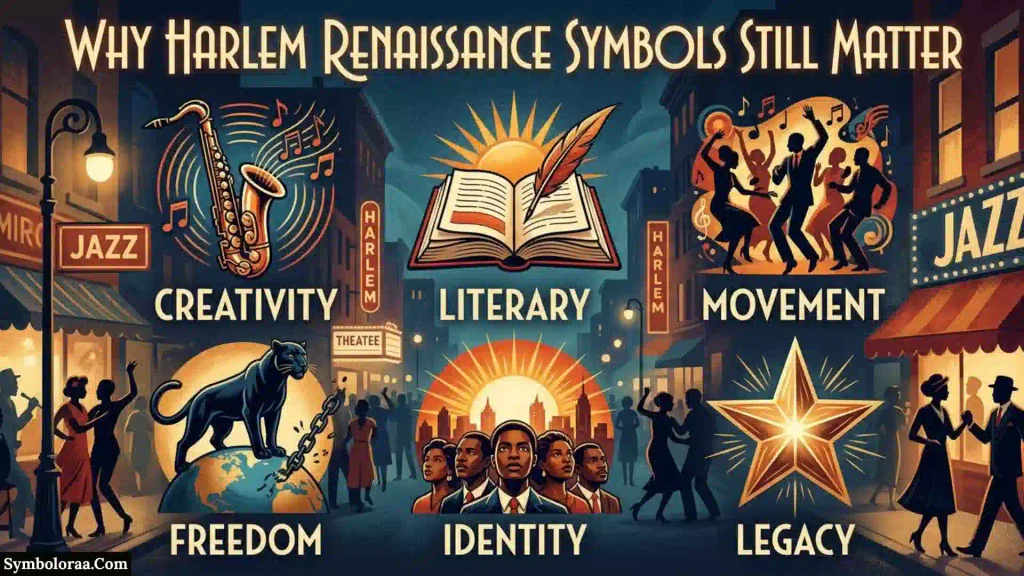
Harlem Renaissance symbols continue to matter because the movement changed how Black identity and Black culture could be represented in American art and literature.
The Smithsonian describes the movement’s legacy in terms of self-determination, pride, social consciousness, and political activism. It also connects the cultural achievements of the Harlem Renaissance with later generations of African American artists and intellectuals.
Its influence can still be seen in:
- African American literature
- Black visual art
- jazz and popular music
- photography
- fashion
- poetry
- film
- graphic design
- political art
- discussions of identity and representation
The movement’s symbols remain relevant because questions about who gets represented, who controls cultural narratives, and how history shapes identity did not end in the 1930s.
Frequently Asked Questions
What are the main symbols of the Harlem Renaissance?
Major symbols and motifs include African heritage, jazz, musical instruments, Harlem’s urban environment, light, stars, migration, trains, books, newspapers, fashion, dance, religious imagery, masks, and geometric visual forms. Their meanings depend on context.
What did African symbols represent during the Harlem Renaissance?
African-inspired imagery often helped artists establish connections with African heritage, ancestry, cultural pride, and Black identity. However, different artists used different African artistic sources, so there is no single meaning for every African symbol.
What does jazz symbolize in the Harlem Renaissance?
Jazz can symbolize creativity, cultural expression, experimentation, modernity, performance, and community. It should not automatically be interpreted as a symbol of freedom unless the specific work supports that reading.
What does the North Star symbolize?
The North Star can symbolize guidance, hope, liberation, and freedom in African American cultural contexts. Aaron Douglas uses a star in Into Bondage, where it is associated with hope in a scene depicting enslavement.
Why is Aaron Douglas important to Harlem Renaissance symbolism?
Douglas developed a distinctive visual style that combined African and Egyptian-inspired imagery with modern artistic approaches such as Cubism and Art Deco. His use of silhouettes, geometric forms, radiating circles, and historical imagery made him one of the defining visual artists of the movement.
What does the train symbolize in Harlem Renaissance literature?
A train can symbolize migration, movement, escape, opportunity, separation, or transformation. The exact meaning depends on the literary context.
What does Harlem symbolize in the Harlem Renaissance?
Harlem can symbolize Black cultural community, modernity, creativity, intellectual life, entertainment, opportunity, and self-expression. It can also represent the social and economic challenges that accompanied urban life.
How can I identify symbolism in a Harlem Renaissance artwork?
First identify an emphasized object or visual form. Then ask what it may represent, connect it to the historical context, and support your interpretation with evidence from the artwork. Avoid assigning a fixed meaning without examining context.
Is racial pride a symbol or a theme?
Racial pride is generally better described as a theme or central idea. A specific object, image, artistic form, or recurring motif may symbolize racial pride within an individual work.
Why is the distinction between symbol and theme important?
It prevents inaccurate analysis. Saying “freedom is a symbol” is less precise than identifying the specific image that represents freedom and then explaining that freedom is the broader theme.
Key Takeaways
- Harlem Renaissance symbols do not have one universal dictionary of meanings.
- African heritage was an important source of cultural and artistic inspiration.
- Jazz represented a major form of Black creativity and modern cultural expression.
- Harlem became a symbol of Black cultural and intellectual life.
- Light and stars can represent hope, guidance, or liberation in particular works.
- Migration imagery reflects the historical importance of the Great Migration.
- Books and newspapers can symbolize voice, knowledge, and self-definition.
- Fashion and photography can communicate dignity, individuality, and self-representation.
- Masks and African-inspired forms can connect visual art with ancestry and identity.
- Aaron Douglas is especially important for understanding Harlem Renaissance visual symbolism.
- Themes such as freedom, racial pride, identity, and resistance should not automatically be labeled as physical symbols.
- The strongest interpretation follows the symbol → meaning → historical context → evidence method.
Conclusion
Harlem Renaissance symbols are best understood as part of a larger cultural conversation about identity, ancestry, freedom, migration, creativity, dignity, and self-definition.
African-inspired imagery connected artists with heritage. Jazz and dance expressed new forms of cultural creativity. Harlem represented a major center of Black urban life. Books and newspapers gave writers new ways to control cultural narratives. Photography and fashion offered powerful forms of self-representation. Stars, light, trains, masks, circles, and other recurring images could carry deeper meanings when placed within their historical and artistic contexts.
The most important lesson is that symbolism should never be reduced to a fixed list of definitions. A strong interpretation asks what an image means in this particular work, by this particular artist or writer, during this particular historical period.
That approach makes Harlem Renaissance symbolism easier to understand and produces stronger literary, historical, and art analysis.

I’m Madison Reed, a contemporary American author who writes about love, family, friendship, and second chances. I’m fascinated by the choices that shape our lives and the moments that change us forever. My goal is to create honest, emotional stories with characters readers can connect with long after finishing each book.
Three Books:
When We Find Our Way
The Things We Never Said
Summer in September
 Ethan Brooks
 Jackson Miller