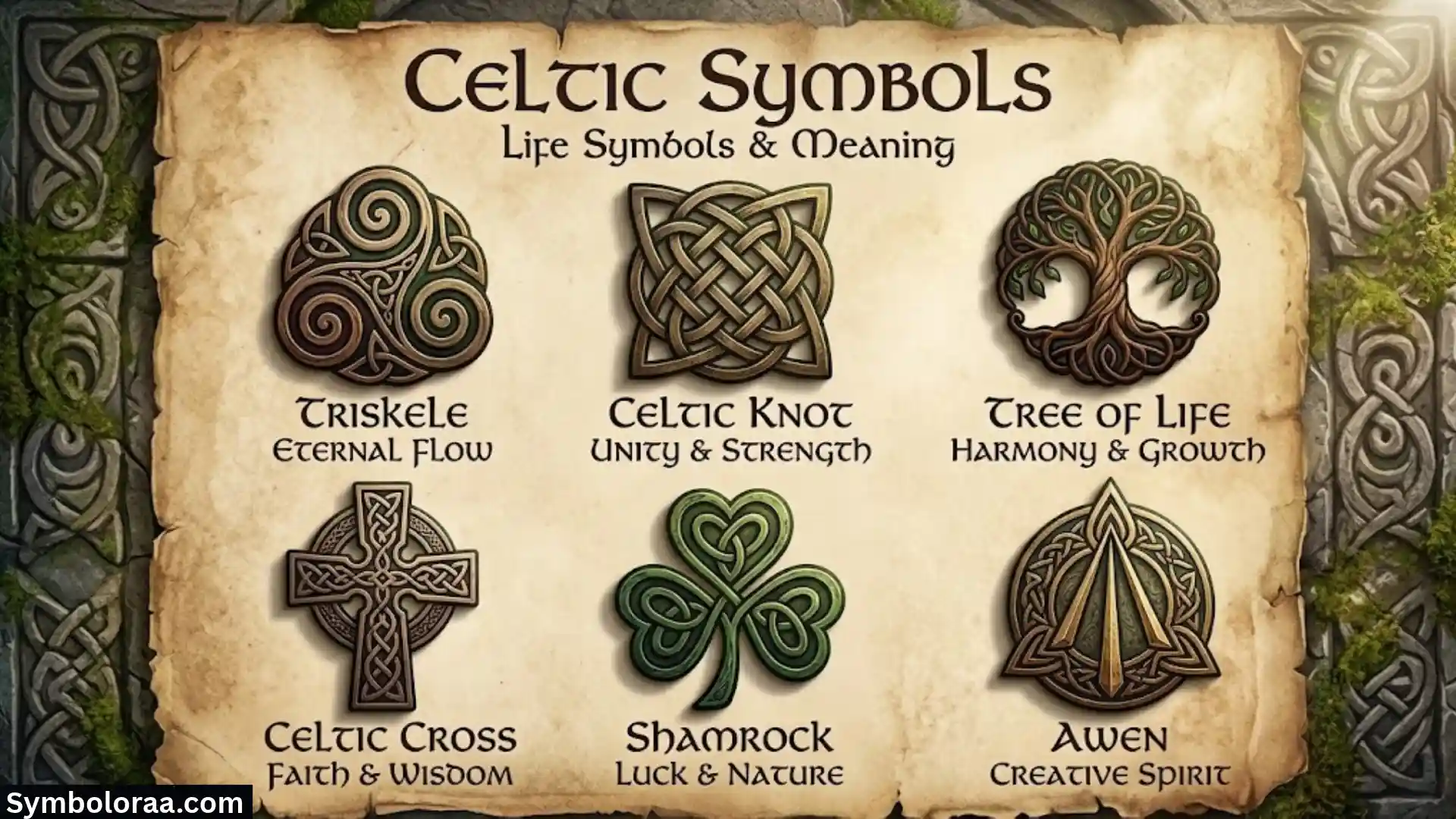
Celtic symbols have fascinated people for centuries. Their intricate knots, spirals, crosses, and animal motifs appear in jewelry, tattoos, artwork, architecture, and cultural celebrations. Each design carries its own visual appeal, and many have connections to spirituality, nature, love, family, or eternity.
But there’s more to Celtic symbolism than beautiful patterns. Some designs come from ancient archaeological sites, while others developed through medieval Christian art or modern Celtic-inspired traditions. Understanding these differences helps you appreciate what each symbol represents and where its meaning comes from.
If you’re researching your heritage, choosing a tattoo, or simply curious about Celtic symbols and their meanings, this guide explores 44 popular designs, their historical backgrounds, and their modern interpretations.
What Are Celtic Symbols?
Celtic symbols are designs associated with the cultures, artistic traditions, languages, and historical communities commonly described as Celtic. These communities developed across parts of central and western Europe and later became especially associated with Ireland, Scotland, Wales, Cornwall, Brittany, and the Isle of Man.
Celtic art is known for its elaborate interlacing patterns, spirals, geometric forms, and stylized animals. Artists used these designs in metalwork, stone carving, illuminated manuscripts, weapons, jewelry, and religious objects.
Many people associate Celtic symbols with concepts such as:
- Eternity and continuity: Patterns that have no obvious beginning or end.
- Love and loyalty: Designs used today to express romantic commitment and lasting relationships.
- Family and connection: Interwoven lines that suggest relationships and shared identity.
- Protection and strength: Knots and animal motifs interpreted as symbols of resilience.
- Nature and renewal: Spirals, trees, animals, and seasonal imagery.
- Faith and spirituality: Crosses and other motifs found in Christian and pre-Christian contexts.
However, not every design has a confirmed ancient meaning. Some interpretations come from historical evidence, while others developed through folklore, modern spirituality, jewelry marketing, and popular culture.
Understanding that distinction makes Celtic symbolism more meaningful rather than less interesting.
The History and Origins of Celtic Symbols
Celtic symbols developed over many centuries. Their history includes prehistoric monuments, Iron Age art, Roman-era encounters, medieval Christianity, and modern cultural revival.
1. Prehistoric Spirals and Stone Carvings
Some designs commonly associated with Celtic art appeared long before historical Celtic-speaking societies.
Newgrange, a prehistoric passage tomb in Ireland, dates to approximately 3200 BCE. Its stones feature spirals, curved lines, and other geometric carvings. These designs belong to Neolithic art, so they predate the historical Celtic cultures often associated with them.
The famous triple spiral is one of the best-known examples. People today sometimes interpret it as a symbol of life, death, rebirth, or the relationship between different realms. However, its original meaning remains uncertain.
2. Iron Age Celtic Art
During the Iron Age, communities across parts of Europe developed distinctive artistic styles. Archaeologists associate some of these objects with what is broadly called Celtic art.
Artists decorated weapons, vessels, ornaments, and other objects with curves, spirals, symmetrical patterns, and stylized animal forms. Designs varied by region and period rather than following one universal Celtic system.
This period helped establish many of the visual traditions that later generations connected with Celtic identity.
3. Medieval Insular Art
From roughly the early medieval period onward, Ireland and parts of Britain became important centers of intricate manuscript illustration and metalwork.
Artists created elaborate interlacing patterns in illuminated manuscripts, stone crosses, brooches, and religious objects. The Book of Kells is a famous example of this artistic tradition.
Celtic knotwork became particularly recognizable through these designs. Its complex lines filled decorative panels, framed religious imagery, and transformed ordinary surfaces into detailed works of art.
4. Christianity and Celtic Crosses
Christianity influenced many forms of medieval art in Ireland and Britain. Crosses appeared alongside intricate interlace, spirals, and other decorative elements.
The Celtic Cross is now one of the most recognizable symbols associated with Celtic heritage. Historic examples include monumental stone crosses decorated with biblical scenes and elaborate patterns.
Although modern interpretations sometimes connect the cross with ancient sun worship, the historical evidence does not support treating every Celtic Cross as a pre-Christian solar symbol.
5. The Celtic Revival and Modern Symbolism
Interest in Celtic language, literature, folklore, and art grew during the nineteenth and twentieth centuries. Artists, writers, scholars, and cultural movements helped renew public interest in Celtic heritage.
During this revival, older motifs gained new interpretations. Modern jewelry and tattoo designs also popularized symbols such as the Tree of Life, the Dara Knot, and various named love knots.
Today, Celtic-inspired designs appear in fashion, personal art, memorial jewelry, family gifts, and spiritual practices. Their meanings often combine historical references with modern personal beliefs.
44 Popular Celtic Symbols and Their Meanings
The following symbols include historic motifs, cultural emblems, religious designs, legendary animals, and modern Celtic-inspired patterns. Their origins and historical evidence differ, so each symbol should be understood in its proper context.
Celtic Knot Symbols

Celtic knots are among the most recognizable elements of Celtic-inspired design. Their interwoven lines create complex patterns that can suggest continuity, unity, and connection.
Many modern meanings reflect the appearance of the designs rather than a documented explanation from ancient artists.
1. Triquetra
The Triquetra, also called the Trinity Knot, consists of three interconnected arcs that form a three-pointed shape.
In modern symbolism, it can represent unity, eternity, and the relationship between three connected elements. Some people associate it with mind, body, and spirit. Others use it to express family bonds or spiritual balance.
The Triquetra also appears in Christian contexts, where it can represent the Father, Son, and Holy Spirit. However, its use across different periods and cultures means that its meaning depends on context.
Common modern meanings: Unity, eternity, spiritual connection, and the number three.
2. Triskele
The Triskele, or triple spiral, features three curved arms radiating from a central point. Some versions use three spirals, while others have three bent or flowing limbs.
Triple-spiral designs appear in prehistoric art, including the carvings at Newgrange in Ireland. Their original meaning remains unknown, although modern interpretations often connect them with movement, growth, transformation, and the cycles of life.
Some people also associate the three arms with past, present, and future.
Common modern meanings: Transformation, movement, growth, and life’s recurring cycles.
3. Celtic Knotwork
Celtic knotwork uses interlaced lines that weave over and under one another. The designs range from simple loops to elaborate patterns covering entire objects.
Historic knotwork appears in medieval manuscripts, stone crosses, metalwork, and other decorative art. Its complex construction demonstrates the skill and patience of the artists who created it.
Today, people often interpret continuous knotwork as a symbol of interconnectedness, enduring relationships, or the continuity of life.
Common modern meanings: Connection, continuity, unity, and eternity.
4. Celtic Cross
The Celtic Cross combines a Christian cross with a ring or circle surrounding the intersection of its arms. Many historic examples also feature intricate carvings and interlacing patterns.
Monumental high crosses became important parts of medieval religious and artistic life in Ireland and Britain. They often displayed biblical scenes and served as prominent landmarks.
Today, the Celtic Cross can represent Christian faith, Irish heritage, remembrance, or cultural identity. Its meaning depends on how and where it is used.
Common meanings: Christian faith, heritage, remembrance, and spiritual devotion.
5. Tree of Life
The Celtic Tree of Life is a popular design featuring a tree whose branches and roots form a connected composition.
Trees have held cultural and spiritual importance in many societies. In some early Irish traditions, sacred trees were associated with places, communities, authority, and the natural world.
However, the familiar symmetrical design showing branches and roots intertwined in a circular pattern is widely used in modern Celtic-inspired art. It should not automatically be treated as one standardized ancient Celtic symbol.
Common modern meanings: Growth, family, balance, strength, and the connection between life and nature.
6. Dara Knot
The Dara Knot is a modern Celtic-inspired knot design commonly associated with the oak tree.
Its name is linked to the Irish word doire, meaning an oak grove. Oak trees have long carried associations with strength and endurance in various European traditions.
The specific knot design marketed as the Dara Knot does not have a clearly established ancient history. Its contemporary meaning comes largely from its association with the oak.
Common modern meanings: Strength, resilience, wisdom, and stability.
7. Celtic Love Knot
A Celtic Love Knot usually features interwoven lines arranged into a heart, loop, or symmetrical pattern.
These designs are popular in wedding jewelry, anniversary gifts, and romantic tattoos. Their continuous lines offer a visual metaphor for two people whose lives remain connected.
However, the phrase describes a broad category of modern designs rather than one universally documented ancient symbol.
Common modern meanings: Romantic love, commitment, loyalty, and lasting affection.
8. Heart Knot
The Heart Knot combines a heart shape with interwoven lines inspired by Celtic knotwork.
Its appearance makes it a natural choice for gifts between romantic partners, family members, or close friends. The heart communicates affection, while the interlacing suggests a bond that remains connected.
The exact design varies widely, and its meaning generally reflects modern decorative symbolism.
Common modern meanings: Love, devotion, emotional connection, and commitment.
9. Serch Bythol
Serch Bythol is a Welsh phrase often translated as “everlasting love.” In modern Celtic-inspired jewelry, it is associated with a design formed from two connected triquetras or three-pointed knot motifs.
The design is commonly used to represent two people joined by an enduring relationship. Some interpretations emphasize the connection between body, mind, and spirit.
Although the phrase is Welsh, the popular symbol should not automatically be assumed to be an ancient, standardized Celtic emblem.
Common modern meanings: Eternal love, partnership, unity, and spiritual connection.
10. Motherhood Knot
The Motherhood Knot is a modern design associated with motherhood, family relationships, and the bond between a parent and child.
Different versions use interwoven loops, hearts, or connected shapes. Some incorporate a heart within a knot, while others feature multiple connected forms.
There is no single historically established ancient design that represents all Celtic motherhood symbolism. Modern versions are meaningful because of the personal connections people assign to them.
Common modern meanings: Maternal love, family, care, and an enduring parent-child bond.
11. Sailor’s Knot
The Sailor’s Knot is a modern category of Celtic-inspired design often associated with loyalty and relationships that survive distance.
Its interwoven appearance makes it a popular choice for couples, family members, and people who share a strong connection despite being apart.
Traditional sailors’ knots have practical maritime purposes, but the symbolic interpretations attached to Celtic-style sailor’s knots vary. The specific design should not automatically be considered an ancient Celtic emblem.
Common modern meanings: Loyalty, friendship, enduring relationships, and connection across distance.
12. Eternity Knot
An Eternity Knot is a general name for a design with continuous lines and no obvious endpoint.
The term can refer to several different patterns, including endless interlacing and designs influenced by knot traditions from multiple cultures. Not every eternity knot is specifically Celtic.
In contemporary jewelry and tattoos, the uninterrupted line represents a bond that continues without a clear beginning or end.
Common modern meanings: Eternity, lasting love, continuity, and commitment.
13. Quaternary Knot
A Quaternary Knot is a modern descriptive term for a four-part Celtic-inspired design.
The number four can encourage interpretations involving the four seasons, four directions, four elements, or four stages of life. These associations depend on the individual design and the beliefs of the person using it.
There is no universal historical meaning that applies to every pattern described by this name.
Common modern meanings: Balance, completeness, stability, and the number four.
14. Shield Knot
A Shield Knot generally describes a symmetrical interlaced design enclosed within a circular, square, or shield-like boundary.
Modern interpretations connect the motif with protection, courage, and resilience. Its enclosed shape can suggest a barrier that surrounds or guards something important.
Although interlaced designs have historical roots in Celtic art, the modern category called the Shield Knot includes many different patterns.
Common modern meanings: Protection, strength, courage, and security.
Ancient and Geometric Celtic-Inspired Symbols

Some symbols associated with Celtic heritage rely on geometric forms, repeated lines, or distinctive shapes rather than elaborate interlacing.
15. Awen
The Awen is a symbol associated with inspiration in modern Druidic and Welsh cultural contexts. A common version features three rays extending upward from three points, sometimes enclosed by circles.
The Welsh word awen refers to inspiration or poetic inspiration. The symbol has become associated with creativity, wisdom, spiritual awareness, and artistic expression.
Its current form is especially connected with modern Druidic traditions rather than a universally documented ancient Celtic symbol.
Common modern meanings: Inspiration, creativity, wisdom, and spiritual awareness.
16. Ogham
Ogham is an early medieval writing system associated primarily with inscriptions in Ireland and parts of western Britain.
Its characters consist of lines or notches arranged along a central stem line. Many surviving examples appear on standing stones, often recording personal names or short inscriptions.
Ogham is sometimes called the Celtic tree alphabet because later traditions associated certain letters with trees. However, it is fundamentally a writing system, not simply a collection of mystical symbols.
Common associations: Language, ancestry, inscriptions, and Irish heritage.
17. St. Brigid’s Cross
St. Brigid’s Cross is traditionally made by weaving rushes or similar plant material into a four-armed cross.
In Ireland, it is associated with St. Brigid and the observance of her feast day on February 1. People traditionally placed these crosses in homes and other buildings as a sign of faith and protection.
The practice also connects with the seasonal transition around Imbolc, a festival associated with the beginning of spring in the traditional Irish calendar. Christian and seasonal customs have influenced how the symbol is understood.
Common meanings: Protection, faith, renewal, and Irish cultural identity.
18. Shamrock
The Shamrock is a three-leafed plant strongly associated with Ireland. It has become one of the country’s best-known cultural emblems.
Tradition connects St. Patrick with the shamrock as a way of explaining the Christian Trinity. However, the details of this story come from later tradition rather than strong contemporary evidence from Patrick’s lifetime.
The shamrock also appears in Irish national identity, celebrations, clothing, and decorative designs.
Common meanings: Ireland, Irish heritage, good fortune, and the Christian Trinity.
19. Spiral Symbol
The Celtic Spiral appears in several forms, from single spirals to more complex arrangements of curved lines.
Spirals feature in prehistoric European art, including ancient monuments in Ireland. Their original meanings are often uncertain, but their repeated appearance shows that curved geometric designs held artistic importance across different periods.
Modern interpretations connect spirals with growth, movement, energy, and personal development.
Common modern meanings: Growth, transformation, movement, and life’s cycles.
20. Double Spiral
A Double Spiral features two spirals that may turn in opposite directions or connect through a central line.
Modern interpretations often use the paired forms to represent balance, opposing forces, or the relationship between complementary aspects of life. Some people connect the design with expansion and contraction or the cycles of nature.
These meanings are interpretations rather than confirmed explanations for every ancient double-spiral carving.
Common modern meanings: Balance, duality, renewal, and interconnected forces.
21. Triple Spiral of Newgrange
The Triple Spiral of Newgrange is one of the most famous prehistoric motifs associated with Ireland.
Newgrange was built during the Neolithic period, around 3200 BCE. Its carved stones feature several types of geometric designs, including spirals and curved patterns.
The triple spiral is often interpreted today as representing birth, life, and death or the past, present, and future. These interpretations can be meaningful, but archaeologists cannot confidently identify the original meaning intended by the monument’s builders.
It is especially important to distinguish this prehistoric design from symbols created by later Celtic-speaking communities.
Common modern meanings: Transformation, cycles, continuity, and renewal.
22. Solar Cross
The Solar Cross usually consists of a cross enclosed within a circle. Similar geometric forms have appeared in different historical and cultural settings.
Modern Celtic-inspired interpretations sometimes associate the design with the sun, seasonal cycles, or the relationship between the four directions.
However, the shape is not exclusive to Celtic culture. Its meaning depends on the period, community, and context in which it appears.
Common modern meanings: Balance, cycles, direction, and solar symbolism.
23. Five-Fold Symbol
The Five-Fold Symbol commonly features four outer circles or shapes arranged around a central point.
Modern interpretations associate it with the four directions surrounding a central source of balance. Some versions connect the design with the four elements and a fifth unifying principle.
These explanations vary, and the familiar contemporary design should not be treated as a universally established ancient Celtic emblem.
Common modern meanings: Balance, harmony, unity, and interconnectedness.
24. Labyrinth
A Labyrinth is a winding path arranged within a defined shape. Unlike a maze, a traditional labyrinth usually has one continuous route leading toward the center and back out.
Labyrinths appear in several cultures and historical periods. Their use is not exclusive to Celtic communities, although Celtic-inspired artwork sometimes incorporates labyrinth-like patterns.
Today, people may walk a labyrinth as a reflective practice or use it to symbolize a journey toward understanding.
Common modern meanings: Reflection, personal growth, patience, and the journey through life.
25. Wheel of Balance
The Wheel of Balance is a modern descriptive name for circular designs divided into sections or arranged around a central point.
Depending on the version, its sections may represent different aspects of life, the seasons, or opposing forces that require balance.
Because the name covers varied designs, it does not identify one universally recognized ancient Celtic symbol.
Common modern meanings: Harmony, stability, balance, and the cycles of life.
26. Celtic Compass
A Celtic Compass generally refers to a modern design combining compass imagery with Celtic knotwork or geometric patterns.
The compass traditionally helps people find direction. In symbolic use, it can represent guidance, purpose, and confidence when facing uncertainty.
The Celtic-inspired decoration adds a visual connection to Celtic art, but the combined design is not necessarily an ancient Celtic emblem.
Common modern meanings: Guidance, direction, exploration, and finding your path.
27. Warrior’s Knot
The Warrior’s Knot is a modern label for Celtic-inspired designs associated with courage, discipline, and resilience.
Some versions use interlaced lines, angular patterns, or shield-like shapes. Their appearance encourages associations with endurance and strength under pressure.
Although historic Celtic societies included warriors and military traditions, the modern designs marketed under this name do not share one confirmed ancient origin.
Common modern meanings: Courage, determination, strength, and perseverance.
28. Celtic Arrow
A Celtic Arrow combines an arrow shape with interlacing or decorative elements inspired by Celtic art.
Arrows can represent movement, direction, protection, or progress in many cultures. In contemporary tattoos, they may express the desire to move forward or remain focused on a goal.
The Celtic styling adds a decorative heritage-inspired element rather than proving that the design existed as a traditional ancient Celtic symbol.
Common modern meanings: Direction, ambition, progress, and determination.
Celtic Animals and Nature Symbols
Animals and plants appear throughout European folklore, mythology, decorative art, and modern Celtic-inspired designs. Their meanings often depend on the particular story or tradition involved.
29. Celtic Harp
The Harp is one of the strongest cultural emblems associated with Ireland.
Harps have a long history in Irish music and courtly traditions. Historical harpists held important roles in musical and poetic culture, and the instrument became closely associated with Irish identity.
The harp also appears in national symbolism, including Ireland’s official state emblem. Unlike many modern knot designs, it has a well-established cultural connection.
Common meanings: Irish identity, music, poetry, creativity, and cultural heritage.
30. Green Man
The Green Man is a decorative face surrounded by, or formed from, leaves and plant growth.
Leafy faces appear in medieval European architecture, including churches and other buildings. Their exact meanings vary, and scholars have debated whether particular examples represent nature, renewal, decorative fantasy, or other ideas.
Modern interpretations often connect the Green Man with the natural world, seasonal renewal, and humanity’s relationship with the environment. However, it should not automatically be treated as a single ancient Celtic deity.
Common modern meanings: Nature, renewal, fertility, and the cycle of growth.
31. Serpent
The Serpent appears in myths, religious imagery, and folklore across many cultures. Its meanings can include danger, wisdom, healing, transformation, or renewal.
Serpents are not exclusive to Celtic tradition, and their symbolism differs considerably between societies. Modern Celtic-inspired artwork may use serpent forms to suggest the cycles of life or the power of nature.
Claims that a particular serpent design represents one universal Celtic belief should be treated carefully.
Common modern meanings: Transformation, renewal, wisdom, and natural power.
32. Horse
Horses played important roles in transportation, warfare, farming, and social life across many ancient European communities.
In Celtic-related mythology, certain horse figures have important cultural and religious associations. The Gaulish goddess Epona, for example, was closely connected with horses and protection.
Modern Celtic-inspired horse imagery may represent freedom, strength, movement, or loyalty. The exact interpretation depends on whether the design refers to a specific historical or mythological figure.
Common meanings: Strength, freedom, mobility, and companionship.
33. Boar
The Boar appears in ancient European art and mythology. Its strength, tusks, and aggressive behavior made it a powerful animal in many historical settings.
In some Celtic-related traditions, boars are associated with hunting, feasting, martial strength, and prestige. Boar imagery also appears on objects from the ancient European world.
Modern interpretations often emphasize courage, determination, and fearlessness, although not every design carries the same historical associations.
Common meanings: Courage, strength, protection, and determination.
34. Raven
The Raven is an intelligent bird associated with many stories and cultural traditions.
In Irish and Welsh mythology, birds can appear in tales involving battle, prophecy, transformation, and the supernatural. The exact role depends on the particular figure or story.
Modern Celtic-inspired raven designs often symbolize intelligence, mystery, observation, or transformation. These meanings draw on a mixture of folklore and broader bird symbolism.
Common modern meanings: Wisdom, mystery, transformation, and insight.
35. Wolf
The Wolf is a powerful animal in European folklore, although its symbolic role varies across cultures and historical periods.
Modern Celtic-inspired wolf imagery often emphasizes loyalty to a group, independence, courage, and survival. Some people choose wolf designs to represent family bonds or a strong sense of belonging.
However, the popular idea of a single, universal ancient Celtic wolf symbol is not supported by one consistent historical tradition.
Common modern meanings: Loyalty, independence, resilience, and instinct.
36. Stag
The Stag, or male deer, appears in European mythology and decorative art. Its antlers make it a distinctive symbol of the natural world and the changing seasons.
The horned figure Cernunnos appears in ancient Gaulish religious imagery, although the precise nature of this figure and the beliefs surrounding him remain subjects of scholarly discussion.
Modern Celtic-inspired stag designs often represent nature, dignity, renewal, and strength.
Common modern meanings: Nature, renewal, dignity, and vitality.
37. Bear
The Bear appears in folklore and mythology across several European cultures.
Modern Celtic-inspired designs often associate bears with physical strength, courage, protection, and endurance. Their ability to survive harsh conditions also makes them a natural symbol of resilience.
Bear symbolism is broader than Celtic culture, so a bear motif should not automatically be described as a uniquely Celtic emblem.
Common modern meanings: Strength, protection, resilience, and courage.
38. Bull
The Bull has appeared in ancient European art and mythology, including traditions associated with Celtic-speaking communities.
In Irish mythology, the story of the Táin Bó Cúailnge, often translated as the Cattle Raid of Cooley, centers on a conflict involving prized bulls. Cattle also held economic and social importance in early Irish society.
Modern bull designs often symbolize power, fertility, determination, and material wealth.
Common meanings: Strength, prosperity, determination, and vitality.
39. Salmon of Knowledge
The Salmon of Knowledge is a legendary fish from Irish mythology, most famously connected with the hero Fionn mac Cumhaill.
In the story, a salmon gains wisdom by consuming hazelnuts that fall into a sacred pool. Fionn acquires knowledge after tasting the fish, linking the salmon with the transfer of wisdom and inspiration.
Unlike many modern knot designs, this symbol has a clear place in Irish legendary tradition.
Common meanings: Wisdom, knowledge, inspiration, and learning.
40. Cat Sìth
The Cat Sìth is a supernatural cat from Scottish folklore, commonly described as a large black cat with a white spot on its chest.
Stories about the creature vary. In some traditions, it is feared as a mysterious presence, while other tales connect it with supernatural activity and household customs.
The Cat Sìth is a figure of folklore rather than a universal Celtic religious symbol. Modern artwork may use it to express mystery, independence, or an interest in Scottish legends.
Common meanings in modern art: Mystery, independence, folklore, and the supernatural.
41. Hawk
The Hawk is a bird of prey associated in modern symbolism with sharp vision, focus, and freedom.
Birds appear in Celtic-related mythology and medieval literature, sometimes serving as messengers or appearing in stories of transformation. However, the meaning of a hawk depends on the specific tale or cultural context.
Modern Celtic-inspired hawk designs often emphasize observation, courage, and the ability to see opportunities clearly.
Common modern meanings: Focus, awareness, freedom, and vision.
42. Swan
The Swan holds an important place in Irish and other Celtic-related legends. Swans often appear in stories involving transformation, enchantment, love, and separation.
One well-known Irish legend, The Children of Lir, tells of children transformed into swans. The story has become an enduring part of Irish cultural memory.
Modern swan imagery may represent grace, devotion, beauty, and spiritual transformation.
Common meanings: Love, grace, transformation, and loyalty.
43. Dragon
The Dragon appears in Welsh and broader European mythology, often representing power, conflict, protection, or royal authority.
The red dragon is especially associated with Wales and appears on the Welsh national flag. Its modern cultural significance is well established, even though dragon traditions differ across historical periods.
Celtic-inspired dragon designs often combine the creature with interlacing patterns, creating a dramatic symbol of strength and mythical power.
Common meanings: Power, courage, protection, and Welsh identity.
44. Celtic Knot of Interconnection
The Celtic Knot of Interconnection is a broad modern description for designs in which multiple lines weave together to create one continuous pattern.
Unlike a specific named historic motif, this category can include many different forms of knotwork. People often choose these patterns to express the idea that relationships, experiences, and personal histories remain connected.
The design’s meaning usually comes from its continuous structure and the intentions of the person using it.
Common modern meanings: Unity, connection, continuity, and shared experiences.
Celtic Symbols and Their Meanings at a Glance
The table below summarizes the most common modern interpretations of the symbols discussed above. These meanings can help you compare designs, but they do not replace historical context.
| Celtic symbol | Common meaning | Historical context |
| Triquetra | Unity and eternity | Used in multiple artistic and religious contexts |
| Triskele | Movement and transformation | Triple-form motifs appear in ancient art |
| Celtic knotwork | Connection and continuity | Well represented in medieval Insular art |
| Celtic Cross | Faith and heritage | Strongly associated with medieval Christianity |
| Tree of Life | Growth and family | Popular modern Celtic-inspired design |
| Dara Knot | Strength and resilience | Modern named knot design |
| Celtic Love Knot | Romantic commitment | Broad modern design category |
| Heart Knot | Love and devotion | Modern decorative motif |
| Serch Bythol | Everlasting love | Modern symbol associated with Welsh wording |
| Motherhood Knot | Parent-child connection | Modern design category |
| Sailor’s Knot | Loyalty and connection | Modern symbolic interpretation |
| Eternity Knot | Continuity | General name for multiple patterns |
| Quaternary Knot | Balance and completeness | Modern descriptive category |
| Shield Knot | Protection and strength | Modern label for several interlaced patterns |
| Awen | Inspiration and creativity | Associated with Welsh and modern Druidic contexts |
| Ogham | Language and ancestry | Early medieval writing system |
| St. Brigid’s Cross | Protection and renewal | Irish Christian and seasonal tradition |
| Shamrock | Irish identity and faith | Established Irish cultural emblem |
| Spiral | Growth and movement | Appears in prehistoric art |
| Double Spiral | Balance and cycles | Ancient forms have uncertain original meanings |
| Triple Spiral of Newgrange | Transformation and cycles | Neolithic carving with unknown original meaning |
| Solar Cross | Direction and solar imagery | Geometric form used across cultures |
| Five-Fold Symbol | Balance and harmony | Modern interpretations vary |
| Labyrinth | Reflection and personal growth | Found in several cultural traditions |
| Wheel of Balance | Harmony | Modern descriptive category |
| Celtic Compass | Guidance and direction | Modern Celtic-inspired design |
| Warrior’s Knot | Courage and resilience | Modern design category |
| Celtic Arrow | Progress and direction | Modern decorative motif |
| Celtic Harp | Irish heritage and music | Established Irish cultural emblem |
| Green Man | Nature and renewal | Medieval European decorative motif |
| Serpent | Transformation and wisdom | Meaning varies across cultures |
| Horse | Strength and freedom | Horses appear in ancient European traditions |
| Boar | Courage and power | Appears in ancient European art |
| Raven | Mystery and insight | Associated with various myths and stories |
| Wolf | Loyalty and resilience | Broad European symbolism |
| Stag | Nature and renewal | Connected with European animal imagery |
| Bear | Strength and protection | Broad European symbolism |
| Bull | Power and prosperity | Important in some Irish legendary traditions |
| Salmon of Knowledge | Wisdom and learning | Figure from Irish mythology |
| Cat Sìth | Mystery and folklore | Scottish legendary creature |
| Hawk | Focus and vision | Modern interpretation varies |
| Swan | Grace and transformation | Appears in Irish legendary stories |
| Dragon | Power and Welsh identity | Strong association with Welsh national symbolism |
| Knot of Interconnection | Unity and shared experience | Broad modern knotwork category |
Celtic Symbols by Meaning
Choosing a Celtic symbol becomes easier when you begin with the idea you want to express. Some designs have clear cultural or historical associations, while others are popular mainly because of their modern interpretations.
Celtic Symbols for Love and Relationships
If you want a design that expresses affection, loyalty, or a lasting partnership, consider these options:
- Celtic Love Knot: Often used to represent romantic commitment.
- Heart Knot: Combines a heart shape with interwoven lines.
- Serch Bythol: Commonly associated with enduring love.
- Triquetra: Can represent unity and the connection between three elements.
- Swan: Connects with love and transformation in Irish legendary stories.
For wedding jewelry, matching tattoos, or anniversary gifts, knot designs can offer a personal way to represent a relationship. Choose a design that reflects your own story rather than relying solely on a popular label.
Celtic Symbols for Family and Friendship
Family-related designs often use connected lines or forms to represent relationships that endure through time.
- Tree of Life: Commonly associated with family, growth, and roots.
- Celtic Knotwork: Represents interconnectedness and continuity.
- Motherhood Knot: Used to symbolize the bond between a parent and child.
- Sailor’s Knot: Often chosen to represent loyalty across distance.
- Triquetra: Can express unity among family members.
Keep in mind that many of these interpretations are modern. If historical authenticity matters to you, research the specific motif rather than assuming every family-themed design has ancient Celtic origins.
Celtic Symbols for Strength and Protection
Symbols associated with strength often feature animals, enclosed patterns, or forms that suggest resilience.
- Shield Knot: Commonly interpreted as a sign of protection.
- Dara Knot: Associated with the strength of the oak tree.
- Warrior’s Knot: A modern design representing courage and perseverance.
- Boar: Connected with strength and martial imagery in some historical contexts.
- Bear: Often symbolizes endurance and protection.
- St. Brigid’s Cross: Traditionally placed in Irish homes as a sign of protection.
If you’re choosing a tattoo, jewelry piece, or personal emblem, consider which type of strength matters most to you. Physical courage, emotional resilience, family protection, and spiritual faith are different ideas.
Celtic Symbols for Wisdom and Knowledge
Several symbols and legendary figures connect with knowledge, inspiration, or insight.
- Salmon of Knowledge: A figure from Irish mythology associated with wisdom.
- Awen: Represents inspiration and creative insight in modern contexts.
- Ogham: Connects with early medieval writing and Irish heritage.
- Raven: Often interpreted as a symbol of intelligence or mystery.
- Hawk: Commonly associated with focus and awareness.
The Salmon of Knowledge is particularly useful if you want a design rooted in a recognizable Irish legend. Ogham is a good option if your interest centers on language, inscriptions, or cultural history.
Celtic Symbols for Nature and Renewal
Nature appears throughout Celtic-related art, mythology, and seasonal traditions.
- Tree of Life: Represents growth, roots, and the natural world.
- Green Man: Commonly interpreted as a symbol of renewal.
- Stag: Associated with nature, dignity, and vitality.
- Spiral: Often used to represent growth and movement.
- Triskele: Commonly connected with cycles and transformation.
- Swan: Associated with transformation in Irish mythology.
These symbols suit people who feel connected to forests, wildlife, changing seasons, or the natural environment. Their meanings can also reflect personal growth and new beginnings.
Celtic Symbols for Faith and Spirituality
Spiritual symbolism in Celtic art includes both Christian and modern spiritual interpretations.
- Celtic Cross: Strongly associated with Christian faith and cultural heritage.
- St. Brigid’s Cross: Connects with Irish Christian tradition and seasonal customs.
- Triquetra: Used in some Christian contexts to represent the Trinity.
- Awen: Associated with inspiration and modern Druidic spirituality.
- Triple Spiral: Often used today to represent cycles and transformation, although its original meaning is unknown.
Before choosing a spiritual symbol, consider its historical background and how different communities understand it. A design can hold personal meaning without having the same meaning for everyone.
Irish, Scottish, and Welsh Symbols

Celtic culture is not one single tradition. Ireland, Scotland, and Wales have distinct languages, histories, legends, and cultural emblems.
Irish Symbols
Irish symbolism includes Christian emblems, legendary figures, traditional music, and motifs connected with the natural world.
Some well-known examples include:
- Shamrock: A widely recognized emblem of Ireland.
- Celtic Harp: Associated with Irish music and national identity.
- St. Brigid’s Cross: A traditional woven cross connected with Irish customs.
- Salmon of Knowledge: A legendary figure associated with wisdom.
- Celtic Cross: A prominent feature of medieval Irish Christian art.
Irish knotwork and manuscript art are also important parts of the country’s artistic heritage.
Scottish Symbols
Scottish cultural traditions include distinctive animals, folklore, music, and regional emblems.
Examples include:
- Cat Sìth: A supernatural creature from Scottish folklore.
- Swan: Appears in broader Celtic-related legends and artistic traditions.
- Stag: Often used in modern Scottish-inspired designs to represent nature and strength.
- Celtic knotwork: Appears in decorative art and modern heritage designs.
- Harp: Has a history in the wider musical traditions of the British Isles, including Scotland.
Not every symbol commonly sold as Scottish or Celtic has a specific Scottish origin. Check the context when historical accuracy matters.
Welsh Symbols
Welsh symbols reflect the country’s language, national identity, mythology, and artistic traditions.
Examples include:
- Red Dragon: A prominent symbol of Wales and its national identity.
- Awen: Associated with poetic inspiration and modern Druidic traditions.
- Serch Bythol: A Welsh phrase connected with everlasting love in modern symbolic use.
- Celtic knotwork: Often used in contemporary Welsh-inspired art and jewelry.
The Welsh language and its poetic traditions are also central to understanding the cultural background of these symbols.
Ancient Celtic Symbols vs. Modern Celtic Designs
One of the most important distinctions in Celtic symbolism is the difference between historical evidence and modern interpretation.
Some motifs appear in archaeological finds or documented traditions. Others gained popularity much later through jewelry, tattoos, spiritual movements, and commercial design.
| Feature | Historically grounded motifs | Modern Celtic-inspired designs |
| Evidence | Archaeological objects, inscriptions, manuscripts, or documented traditions | Often supported by contemporary design and popular usage |
| Examples | Ogham inscriptions, medieval knotwork, Celtic Crosses, the Newgrange spirals | Named Motherhood Knots, many Dara Knot designs, Celtic Compasses |
| Meaning | May be uncertain or tied to a specific historical context | Often reflects personal beliefs or modern interpretations |
| Appearance | Varies by region and historical period | Frequently combines multiple motifs and styles |
| Best use | Historical study and cultural understanding | Personal expression, tattoos, gifts, and decorative art |
This distinction does not make modern designs meaningless. A symbol can represent love, family, or resilience because of the meaning you give it. The important point is to avoid presenting a recent interpretation as an established ancient fact.
Celtic Symbols in Mythology and Religion
Celtic-related mythology includes stories about gods, heroes, magical creatures, supernatural transformations, and the natural world.
Irish legendary literature features figures such as Fionn mac Cumhaill and stories such as The Children of Lir. Welsh mythology includes traditions preserved in medieval literature, including tales associated with the Mabinogi.
These stories help explain the cultural importance of certain animals and legendary figures. The Salmon of Knowledge, for example, has a recognizable role in Irish mythology, while the red dragon is closely associated with Welsh identity.
Religion also shaped Celtic art. Medieval Christian communities incorporated crosses, interlacing patterns, animal forms, and elaborate geometric decoration into manuscripts and stone monuments.
However, historical Celtic religion was not one uniform system. Practices differed across regions and periods, and much of what survives comes through archaeological evidence or texts written down after the events they describe.
Modern Druidic spirituality also uses some Celtic-inspired symbols. These contemporary practices should be distinguished from claims about what every ancient Celtic community believed.
Celtic Symbols in Tattoos, Jewelry, and Everyday Life
Celtic-inspired designs remain popular because their shapes are visually striking and their meanings can be adapted to personal experiences.
Celtic Tattoos
A Celtic tattoo can express cultural heritage, family relationships, faith, or personal values. Knotwork works particularly well in designs that wrap around an arm, form a band, or connect multiple elements.
Before getting a tattoo, consider three things:
- Choose the meaning first. Decide whether you want to express love, strength, ancestry, or something else.
- Check the design’s origin. If historical accuracy matters, distinguish traditional motifs from modern creations.
- Review the artwork carefully. Knot patterns can change significantly when artists simplify, combine, or redraw them.
A design that looks attractive on a screen may need adjustments to work well on skin. Ask your tattoo artist to explain how the lines will look at the size you want.
Celtic Jewelry
Celtic jewelry often features knots, crosses, spirals, hearts, and regional emblems. Rings and pendants are popular choices because they can carry personal meaning without requiring a large design.
A Triquetra pendant may represent unity, while a Celtic Cross can reflect Christian faith or Irish heritage. A love knot may serve as a romantic gift, especially when both people understand what it means to them.
If you’re buying jewelry as a cultural or historical keepsake, ask whether the design is based on a specific artifact or a contemporary interpretation.
Celtic Symbols in Home Decor
Celtic-inspired motifs also appear in wall art, carved wood, textiles, furniture, and decorative metalwork.
A knot pattern can add detail without overwhelming a room. A harp or shamrock may express Irish identity, while a tree design can reflect a connection to nature.
When decorating with Celtic symbols, think about their background as well as their appearance. A historically informed design often carries more depth than a generic pattern labeled simply as ancient Celtic art.
How to Choose the Right Celtic Symbol
The best symbol is one whose history or modern meaning matches your intention.
Use these questions to narrow your choices:
- Do you want a symbol of love? Consider the Celtic Love Knot, Heart Knot, or Serch Bythol.
- Do you want to represent family? Explore the Tree of Life, Triquetra, or Motherhood Knot.
- Do you value strength? Look into the Shield Knot, boar, bear, or oak-associated Dara Knot.
- Are you interested in Irish heritage? Consider the shamrock, harp, St. Brigid’s Cross, or Salmon of Knowledge.
- Are you interested in Welsh culture? Explore the red dragon, Awen, and Welsh language traditions.
- Do you prefer historical evidence? Research Ogham inscriptions, medieval knotwork, historic crosses, or prehistoric carvings.
- Do you want a spiritual design? Consider whether you prefer Christian symbolism, modern Druidic interpretations, or a personal symbol inspired by nature.
You don’t need to choose a symbol simply because it is popular. A design with a personal connection may matter more to you than one with a fashionable name.
Frequently Asked Questions About Celtic Symbols
What Is the Most Famous Celtic Symbol?
The Celtic Cross is one of the most recognizable symbols associated with Celtic heritage. Celtic knotwork, the Triquetra, and the shamrock are also widely recognized.
Which symbol is most famous depends on the context. The harp, for example, has a particularly strong association with Irish national identity.
What Does a Celtic Knot Mean?
Celtic knotwork is often interpreted as representing continuity, unity, eternity, and interconnected relationships.
Historically, knotwork served important decorative purposes in manuscripts, metalwork, and stone carving. The precise meaning of a particular historic pattern may not be known.
What Is the Celtic Symbol for Eternal Love?
The Celtic Love Knot and Serch Bythol are commonly associated with lasting love. The Heart Knot is another popular choice.
These meanings mainly reflect modern symbolic use rather than a single confirmed ancient Celtic tradition.
Is the Triquetra an Ancient Celtic Symbol?
The Triquetra appears in historical artistic contexts, including medieval Christian art, and related three-part motifs occur in different periods.
However, its original meaning and the exact history of particular versions are not always clear. Modern interpretations include eternity, unity, and the Christian Trinity.
What Does the Celtic Tree of Life Represent?
The Tree of Life commonly represents growth, family, strength, balance, and the connection between roots and branches.
The familiar circular Tree of Life design is widely used in modern Celtic-inspired art. Its popularity should not be confused with proof that one standardized ancient Celtic Tree of Life symbol existed.
What Is the Difference Between a Celtic Knot and a Triquetra?
Celtic knotwork is a broad category of interlaced designs. A Triquetra is a particular three-part motif featuring interconnected arcs.
The Triquetra can appear within broader knotwork, but not every Celtic knot contains a Triquetra.
Are Celtic Symbols Religious?
Some Celtic-associated symbols have strong religious connections, especially the Celtic Cross and St. Brigid’s Cross.
Others appear in decorative art, writing systems, folklore, or modern personal expression. A symbol’s religious meaning depends on its historical context and how people use it today.
Are Celtic Symbols the Same as Norse Symbols?
No. Celtic and Norse traditions have different historical backgrounds, languages, artistic styles, and mythologies.
They sometimes share broad themes, such as animals, spirals, and interwoven decoration. However, Norse runes and other specifically Norse symbols should not automatically be described as Celtic.
Did Ancient Celts Use the Tree of Life Symbol?
Trees held importance in some ancient Celtic-related traditions, including traditions involving sacred trees. However, the popular circular Tree of Life design with symmetrical branches and roots is widely associated with modern Celtic-inspired art.
The existence of ancient sacred-tree traditions does not establish that the modern design was used in the same form.
What Is the Oldest Celtic Symbol?
There is no single agreed-upon answer because the term Celtic symbol covers different types of art and historical periods.
The triple spiral carvings at Newgrange are much older than historical Celtic-speaking societies. They date to approximately 3200 BCE, so they should be described as prehistoric Irish carvings rather than confidently labeled as symbols created by the ancient Celts.
Conclusion
Celtic symbols combine intricate artwork, cultural history, religious traditions, mythology, and modern personal expression. Their meanings range from the unity suggested by knotwork to the Irish heritage represented by the harp and shamrock.
Some motifs have strong historical foundations. Ogham inscriptions, medieval knotwork, Christian crosses, and figures from Irish mythology all offer meaningful connections to the past. Other popular designs, including many named love knots and modern Celtic-inspired emblems, reflect more recent interpretations.
If you’re choosing a Celtic symbol for a tattoo, piece of jewelry, or personal keepsake, take time to understand its background. Look beyond the name and consider what the design actually represents.
A symbol becomes more meaningful when its story matters to you. Whether you choose a Triquetra, a Celtic Cross, a shamrock, or a modern knot, the best choice is one that connects its appearance with a meaning you genuinely value.

I’m Madison Reed, a contemporary American author who writes about love, family, friendship, and second chances. I’m fascinated by the choices that shape our lives and the moments that change us forever. My goal is to create honest, emotional stories with characters readers can connect with long after finishing each book.
Three Books:
When We Find Our Way
The Things We Never Said
Summer in September