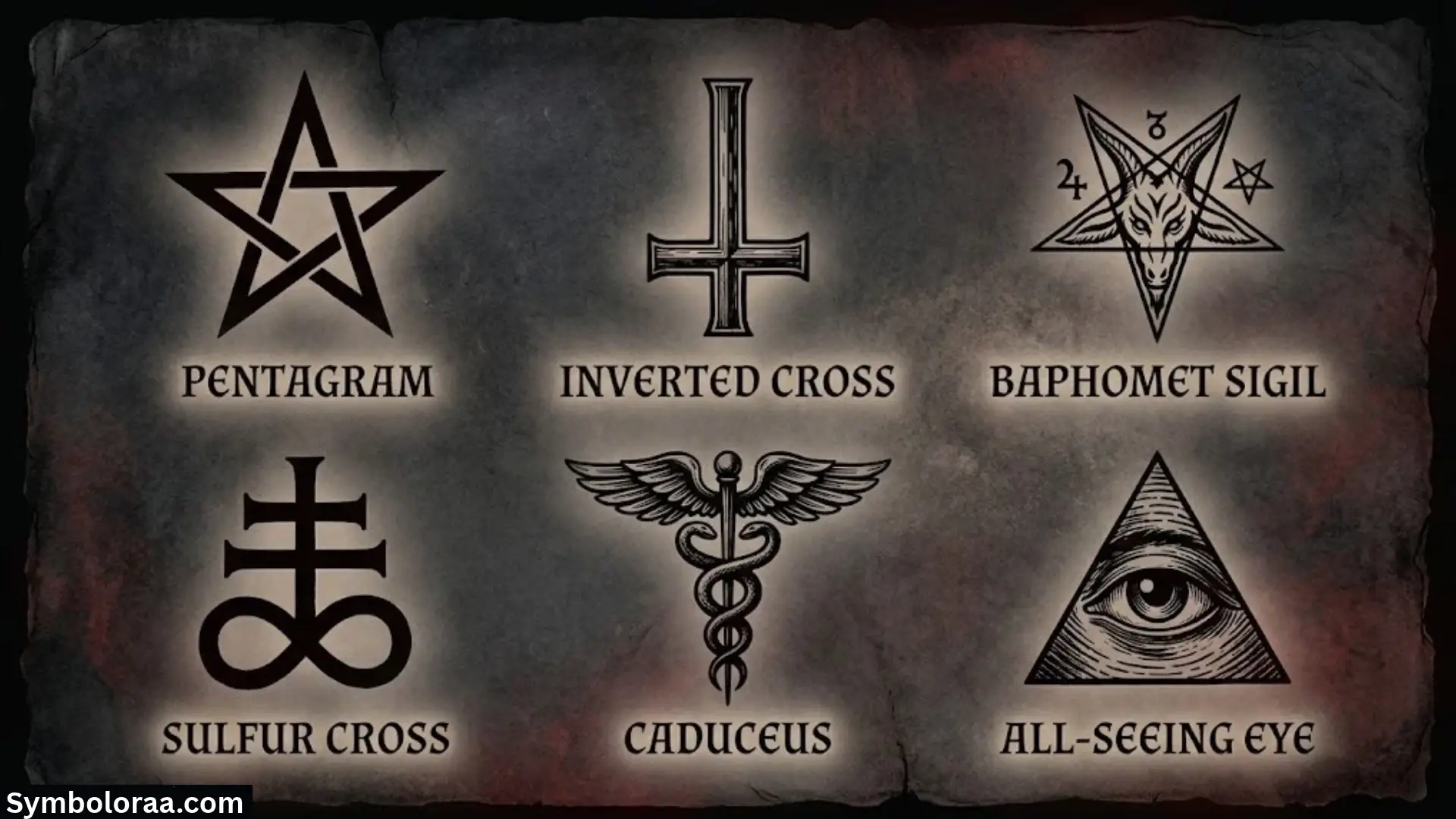
Satanic symbols have fascinated people for centuries. From the inverted pentagram to the Sigil of Baphomet, these striking images appear in religious movements, occult literature, music, films, and modern art. Yet their meanings often differ from what popular culture suggests.
Some symbols have a direct connection to modern Satanism. Others originated in Christianity, alchemy, or Western occult traditions before acquiring new meanings. A few are frequently labeled Satanic despite having little or no inherent connection to Satanism.
Understanding Satanic symbols and their meanings requires looking beyond their appearance. Their historical origins, religious associations, and modern uses reveal a much richer story than the familiar images of goats, inverted crosses, and mysterious geometric designs.
This guide explores the most recognizable Satanic symbols, explains their documented histories, and examines how different Satanic traditions interpret them. It also separates established facts from common misconceptions about Satanic symbolism, occult imagery, and modern religious expression.
What Are Satanic Symbols?
Satanic symbols are images, signs, and emblems associated with Satan, Satanism, or particular traditions that use Satanic imagery. They can communicate religious identity, philosophical beliefs, opposition to established religious authority, or participation in certain occult practices.
Their meanings depend on the people and traditions that use them. The same image might represent religious commitment to one person, artistic rebellion to another, and a historical reference to someone studying religious iconography.
For example, the inverted cross has a traditional Christian association with Saint Peter. However, horror films and anti-Christian artwork have also used it to convey rebellion or infernal themes. Its orientation alone doesn’t establish which meaning applies.
The distinction between different forms of Satanism also matters.
- Non-theistic Satanism: Some Satanists treat Satan as a literary or symbolic figure rather than a literal supernatural being.
- Theistic Satanism: Some practitioners regard Satan as a real spiritual entity and may incorporate that belief into their religious practices.
- Luciferian traditions: These vary considerably, with some emphasizing knowledge, illumination, independence, or spiritual development. They aren’t automatically identical to Satanism.
- Occult traditions: These encompass a wide range of esoteric philosophies and practices, many of which have no direct connection to Satanism.
Consequently, no single interpretation explains every Satanic emblem. Historical evidence and the context in which someone uses a symbol provide the clearest starting points.
The Most Recognizable Satanic Symbols and Their Meanings
Sigil of Baphomet: The Best-Known Modern Satanic Emblem
The Sigil of Baphomet is among the most recognizable symbols associated with modern Satanism. Its design features a goat’s head inside an inverted pentagram, surrounded by two circles containing Hebrew lettering spelling the name Leviathan.
The symbol is closely associated with the Church of Satan, founded by Anton LaVey in 1966. Although its imagery draws on older occult illustrations and symbolic traditions, its familiar modern form became widely recognized through the Church of Satan’s publications and activities.
According to the Church of Satan’s historical account, the imagery developed through earlier European occult literature before the organization adopted and adapted it. The complete emblem shouldn’t be mistaken for an unchanged symbol inherited from ancient Satanic worship.
What does the Sigil of Baphomet represent?
Its meaning depends partly on the tradition interpreting it. Within the Church of Satan, the emblem expresses the organization’s Satanic identity and worldview. Its goat imagery and inverted star also connect it to earlier occult depictions of the so-called Sabbatic goat.
The surrounding lettering adds another layer of symbolism through its reference to Leviathan, a figure associated with biblical and later religious traditions.
The emblem appears in several settings:
- Religious insignia and organizational materials
- Occult-inspired artwork and publications
- Jewelry, clothing, and other merchandise
- Horror films, music, and popular culture
Although the Sigil of Baphomet is strongly associated with modern Satanism, it doesn’t represent every Satanist or every occult tradition. Its specific design and organizational history distinguish it from generic images of goats or five-pointed stars.
Inverted Pentagram: Meaning and Symbolism
An inverted pentagram is a five-pointed star positioned with one point facing downward and two points facing upward. It has become a prominent feature of modern Satanic iconography, especially when combined with a goat’s head.
However, the pentagram has a much broader history. Five-pointed stars appeared in different cultural, mathematical, religious, and magical contexts long before their modern association with Satanism became widespread.
During the 19th century, French occultist Éliphas Lévi discussed the pentagram’s orientation in relation to competing symbolic interpretations. His work helped shape later Western occult imagery, including depictions of the inverted star as a goat’s head.
The important distinction is that the inverted pentagram isn’t synonymous with every use of the pentagram throughout history.
In modern Satanic imagery, the inverted form may communicate identification with Satanism or rejection of conventional religious symbolism. Outside that context, a similar geometric design may have a different purpose.
When interpreting an inverted pentagram, consider:
- Whether it contains a goat’s head or other distinctive imagery
- Whether an organization or practitioner has identified it as a Satanic emblem
- Where the image appears and how it is being used
- Whether the source provides a documented explanation of its meaning
A star’s orientation provides useful information, but the surrounding context remains essential.
Inverted Cross: Christian Origins and Satanic Associations
The inverted cross, also called an upside-down Latin cross, is one of the most frequently misunderstood religious symbols.
In Christian tradition, it is associated with Saint Peter, one of Jesus Christ’s apostles. According to a longstanding Christian account, Peter was crucified upside down because he considered himself unworthy of dying in the same manner as Jesus.
This tradition gives the inverted cross a meaning rooted in Christian martyrdom rather than Satanism. Its historical interpretation differs sharply from the sinister associations often assigned to it in entertainment.
The inverted cross acquired another layer of meaning through its use in anti-Christian imagery, horror films, heavy metal artwork, and some modern Satanic contexts. In these settings, it may express defiance, religious criticism, or deliberate inversion of Christian imagery.
The distinction matters because the same shape can serve very different purposes.
| Context | Possible meaning |
| Christian religious art | Saint Peter and his traditional martyrdom |
| Anti-Christian artwork | Rejection or deliberate inversion of Christian symbolism |
| Horror films | Supernatural danger, demonic themes, or suspense |
| Modern Satanic imagery | Religious identity or opposition to conventional Christianity |
| Decorative design | Artistic expression without a specific religious meaning |
The most reliable interpretation comes from the image’s setting and intended use. Seeing an inverted cross doesn’t automatically mean that a person practices Satanism.
For further historical context, consult The Acts of Peter, an early Christian text associated with the development of the inverted-crucifixion tradition.
Sigil of Lucifer: Origins and Meaning
The Sigil of Lucifer is an emblem associated with Lucifer in certain Western occult and Luciferian traditions. It has a distinctive geometric appearance and appears in modern esoteric literature and symbolic artwork.
Its interpretation varies among practitioners. Some associate Lucifer with illumination, knowledge, intellectual independence, or the pursuit of personal understanding. Others use Luciferian symbolism within spiritual systems that differ substantially from non-theistic Satanism.
These associations require an important qualification: Lucifer doesn’t have one universal meaning across religious history.
In Christian interpretations, Lucifer became associated with the fall of a proud heavenly being and with Satan in later theological traditions. In other literary and philosophical contexts, Lucifer has been portrayed as a figure connected with rebellion, knowledge, or resistance to authority.
Modern Luciferian interpretations draw on some of these themes but don’t all share the same beliefs.
The Sigil of Lucifer should therefore be understood within its particular tradition rather than treated as a universal Satanic emblem. Its presence in occult artwork doesn’t establish that every person displaying it follows the same philosophy or practices.
Leviathan Cross: Sulfur and Modern Satanic Symbolism

The Leviathan Cross, also known as the sulfur symbol in some modern contexts, is recognizable by its double-barred cross above an infinity-like lower loop.
Its contemporary associations include alchemical symbolism and modern Satanic iconography. The Church of Satan also uses the Leviathan name within the Sigil of Baphomet, connecting the name to its distinctive organizational emblem.
Sulfur has a long history in alchemy. Alchemists used symbolic signs to represent substances, processes, and ideas within their systems of thought. Later occult and Satanic interpretations gave certain sulfur-related designs additional meanings.
The Leviathan Cross is sometimes interpreted in modern contexts through ideas such as independence, personal identity, or resistance to religious authority. These meanings should not be treated as universal historical definitions, however.
Its significance depends on the specific design and the tradition using it.
The symbol also illustrates a broader principle of Satanic symbolism: an image can acquire new associations over time without losing every connection to its earlier history.
Baphomet: History, Origins, and Symbolic Meaning
Baphomet is one of the most important figures in modern occult imagery. Often depicted as a horned, goat-headed being, Baphomet has a complicated history that cannot be reduced to a simple alternative name for Satan.
The name appears in historical records connected with the persecution and trials of the Knights Templar in the early 14th century. The exact origin and meaning of the name remain subjects of historical discussion. Those medieval references do not establish that the Templars worshipped the familiar goat-headed figure seen in modern artwork.
The best-known depiction emerged much later.
In 1856, French occultist Éliphas Lévi published Dogme et Rituel de la Haute Magie, commonly known in English as Transcendental Magic. His illustration portrayed Baphomet as a winged, goat-headed figure with both human and animal characteristics.
Lévi’s image became influential in Western occultism because it combined multiple symbolic elements into one composition.
These include:
- Goat’s head and horns: Central features of Lévi’s distinctive illustration.
- Torch between the horns: A visual element often interpreted as representing illumination or intellectual light.
- Human and animal characteristics: Features that encourage interpretations involving contrasting aspects of existence.
- Contrasting bodily features: Elements frequently read through ideas of duality and the reconciliation of opposites.
- Hand gestures: Gestures often interpreted through the Hermetic principle of correspondence, although explanations vary by source.
Baphomet later became an important figure in modern Satanic symbolism, including the imagery used by the Church of Satan and The Satanic Temple.
However, these organizations do not necessarily interpret every element in the same way. Lévi’s original occult framework, the Church of Satan’s emblem, and The Satanic Temple’s monumental sculpture belong to different historical and institutional contexts.
For that reason, Baphomet is best understood as a figure whose meaning developed through several stages of religious and cultural reinterpretation.
Baphomet Statue: Meaning and Modern Significance
The Baphomet statue commissioned by The Satanic Temple provides a prominent modern example of religious symbolism entering public debate.
The monument depicts Baphomet seated on a throne with two children standing nearby. Its design draws on the historical figure while presenting the imagery within the organization’s own religious and political framework.
The Satanic Temple is a non-theistic religious organization. It uses Satanic imagery in connection with its stated philosophical principles, which include bodily autonomy, individual liberty, and religious pluralism.
The monument became especially prominent in debates over religious displays on government property. In Oklahoma, The Satanic Temple proposed a Baphomet monument after a Ten Commandments monument appeared on the grounds of the state capitol.
The dispute raised questions about religious equality and whether public property should accommodate different religious viewpoints under comparable conditions.
The statue’s meaning therefore extends beyond its visual design. It serves as a statement about religious representation, the relationship between religion and government, and the treatment of minority religious groups.
The two children are part of the sculpture’s composition. Their presence shouldn’t be treated as evidence of a sinister meaning simply because the central figure is Baphomet.
The monument demonstrates how Satanic iconography can function as religious expression, public art, and political commentary at the same time.
Sources: The Satanic Temple — Baphomet Monument and The Satanic Temple — Monument Case.
Goat’s Head Symbolism
Goat imagery appears throughout modern Satanic art, especially in depictions of Baphomet and the Sigil of Baphomet. The association has become so familiar that some people assume every goat-headed figure must be Satanic.
That conclusion goes too far.
Goats have appeared in many religious, mythological, and artistic traditions. Their meaning changes according to the surrounding imagery and cultural setting.
In Christian art, goats sometimes appear in discussions of judgment, sin, or the separation of the righteous from the wicked. In other traditions, goat imagery may have unrelated religious or cultural significance.
Modern Satanic artwork often uses goat imagery because of its established connection with the occult interpretations of Baphomet and the inverted pentagram.
The distinction is straightforward: a goat’s head can contribute to a Satanic emblem, but the animal itself isn’t an exclusively Satanic symbol.
Sulfur and Brimstone Symbolism
Sulfur, historically called brimstone in many English religious texts, occupies two important symbolic contexts.
First, sulfur has a practical history as a chemical substance and an ingredient studied in alchemy. Second, brimstone appears in biblical imagery associated with divine judgment and destruction.
These connections helped shape sulfur’s later presence in occult and infernal symbolism.
The Leviathan Cross is frequently associated with sulfur in modern Satanic contexts. However, that association doesn’t mean every historical sulfur sign was intended to communicate Satanism.
Understanding the difference between alchemical symbols and meanings and modern Satanic iconography prevents a common historical mistake: assuming that every sign associated with an old esoteric practice belongs to the same religious tradition.
Upright Pentagram: A Symbol With Many Meanings
The upright pentagram is a five-pointed star with one point facing upward. Unlike the inverted pentagram in familiar modern Satanic imagery, the upright version has a long history of varied use.
It has appeared in mathematical traditions, religious symbolism, ceremonial magic, and protective practices. In some Western esoteric systems, practitioners have associated it with protection or the relationship between different elements.
The pentagram’s meanings have never been completely uniform. Its interpretation changes across periods and traditions.
An upright pentagram may therefore appear in a religious or magical setting without having any connection to Satanism.
The comparison between upright and inverted pentagrams is useful, but orientation alone cannot explain the full history of either symbol. Accompanying images, written explanations, and the identity of the group using the emblem provide more reliable clues.
Caduceus: An Occult Symbol That Isn’t Inherently Satanic
The caduceus consists of a staff with two serpents entwined around it, often accompanied by wings. In Greek mythology, it is associated with Hermes, the messenger of the gods.
Its historical associations include communication, commerce, negotiation, and the role of Hermes as a divine messenger. The symbol has also appeared in Western esoteric traditions.
Because the caduceus contains serpents and appears in some occult imagery, it is occasionally misclassified as Satanic. Its established connection to Hermes, however, is distinct from its possible use in an occult or modern artistic context.
The caduceus also differs from the rod of Asclepius, which traditionally features one serpent around a staff and is associated with medicine.
This distinction matters when identifying unfamiliar occult symbols and their meanings. Similar designs can have separate origins and cultural roles.
“As Above, So Below”: Hermetic Philosophy and Symbolism
The phrase “As Above, So Below” is associated with Hermetic thought, a Western esoteric tradition linked to writings attributed to Hermes Trismegistus.
The phrase is commonly understood as expressing a relationship between different levels of reality. In Hermetic interpretations, patterns or principles operating on one level may correspond to those found on another.
Its history is connected with Hermetic philosophy and the broader development of Western esotericism, not exclusively with Satanism.
Modern occult artwork may incorporate the phrase alongside other symbols. Its appearance in such a setting doesn’t make it a specifically Satanic expression.
The saying illustrates why researchers should distinguish broad occult philosophy from the particular beliefs of Satanic organizations.
Infinity Symbol and Other Commonly Misidentified Designs
The infinity symbol, usually represented by a horizontal figure eight, generally communicates endlessness, continuity, or an unbounded process.
It appears in mathematics, decorative art, jewelry, and many cultural contexts. Although an artist might incorporate it into a Satanic design, the symbol itself has no exclusive connection to Satanism.
The same principle applies to generic five-pointed stars, double-barred crosses, and other geometric designs.
A design’s meaning depends on how people use it. Without supporting evidence, assigning a Satanic interpretation to an otherwise common symbol can create misleading conclusions.
The History and Origins of Satanic Symbols

Understanding modern Satanic symbolism requires examining the historical traditions that shaped it. Many familiar images emerged through several centuries of reinterpretation rather than from one continuous ancient system.
Ancient Symbolism Before Modern Satanism
Ancient societies used geometric patterns, animal imagery, stars, and religious emblems for many purposes. These symbols could represent gods, political communities, protective practices, or ideas about the natural world.
However, their existence doesn’t establish an ancient Satanic origin.
The modern concept of Satanism developed within a much more specific religious and cultural history. Some contemporary Satanic symbols borrow from older imagery, but borrowing a symbol doesn’t make its original users members of a later religious movement.
When discussing the origins of Satanic symbols, it’s important to distinguish between an image’s earliest known appearance and the period when it acquired an identifiable Satanic association.
Medieval Christianity and the Development of Baphomet
Baphomet entered European historical records in connection with accusations made against the Knights Templar. During the early 14th century, members of the order faced trials involving allegations of heresy and improper religious practices.
The evidence surrounding these accusations is complicated. The historical record doesn’t establish that the familiar goat-headed Baphomet of modern imagery existed in the form later popularized by occultists.
The distinction between the medieval name and the 19th-century illustration is essential.
Later writers and artists transformed Baphomet into a recognizable figure through new interpretations of older religious and occult material.
Nineteenth-Century Occultism and Éliphas Lévi
The 19th century played a major role in the development of recognizable modern occult imagery.
Éliphas Lévi’s depiction of Baphomet, published in 1856, combined human, animal, and symbolic features in a single figure. The illustration became influential in Western esoteric literature and helped establish the visual language later associated with Baphomet.
Other occultists subsequently developed related imagery. An influential goat-headed pentagram appeared in the work of French occultist Stanislas de Guaita in the late 19th century.
These developments helped connect the inverted pentagram, goat imagery, and infernal associations in the Western occult imagination.
Yet these illustrations were not all originally created by Satanists. Some came from occult writers who described or interpreted what they regarded as dangerous or forbidden magical ideas.
Later Satanic movements adopted selected images and gave them new meanings.
Modern Satanism and the Adoption of Recognizable Emblems
Modern organized Satanism brought particular symbols into wider public awareness.
Anton LaVey founded the Church of Satan in 1966. The organization subsequently popularized its distinctive version of the Sigil of Baphomet, particularly through The Satanic Bible, published in 1969.
This history explains why the emblem is so closely connected with the Church of Satan today.
The Satanic Temple later adopted Baphomet imagery for a different institutional purpose, using it in religious expression and public debates about religious liberty.
Although these organizations both use Satanic imagery, they are distinct organizations with their own philosophies and approaches.
The history of modern Satanic symbolism is therefore not simply a story of ancient symbols surviving unchanged. It is a story of older imagery being selected, redesigned, and reinterpreted in modern religious contexts.
How Different Satanic Traditions Interpret Symbols

Although certain emblems have become widely recognized, Satanism isn’t a single unified religious tradition. Different groups and individuals may assign different meanings to the same image.
LaVeyan Satanism and the Church of Satan
The Church of Satan follows a non-theistic form of Satanism associated with Anton LaVey. Its philosophy treats Satan primarily as a symbolic figure rather than a supernatural being requiring worship.
Within this framework, Satan can represent individualism, personal responsibility, self-interest, and resistance to conformity. The Sigil of Baphomet serves as the organization’s distinctive emblem.
The Church of Satan’s approach differs from the popular stereotype of Satanism as a religion centered on worshipping a literal devil. Its official history and publications provide the clearest explanation of its beliefs.
Learn more through the Church of Satan’s official history.
The Satanic Temple
The Satanic Temple also follows a non-theistic approach, but its public philosophy and activities differ from those of the Church of Satan.
The organization emphasizes principles such as compassion, bodily autonomy, individual liberty, and religious pluralism. Its use of Baphomet imagery often appears in public discussions about religious equality and the relationship between religion and government.
The Baphomet monument is a particularly visible example. Rather than functioning solely as an occult emblem, the sculpture also serves as a statement about equal treatment for religious groups.
Although both organizations use Satanic imagery, their institutional identities and philosophies shouldn’t be confused.
Theistic Satanism and Luciferian Traditions
Some practitioners believe Satan exists as a real spiritual entity. Others approach Lucifer through spiritual systems that emphasize knowledge, transformation, or independence.
These traditions vary widely in their beliefs and practices. Some may use sigils, ritual objects, or other mystical symbols as part of their spiritual lives. Others may place greater emphasis on personal philosophy or individual interpretation.
Luciferianism and Satanism can overlap, but the terms aren’t interchangeable. Not every Luciferian identifies as a Satanist, and not every Satanist understands Lucifer in the same way.
The most accurate approach is to identify the particular tradition before assigning a meaning to its symbols.
Common Misconceptions About Satanic Symbols
Misunderstandings often arise when people interpret symbols without considering their history or intended use.
Is Every Inverted Cross Satanic?
No. The inverted cross has a longstanding association with Saint Peter in Christian tradition. It can also appear in anti-Christian imagery and modern Satanic contexts.
The design alone doesn’t establish which interpretation applies.
Is Every Pentagram an Occult or Satanic Symbol?
No. Pentagrams have appeared in mathematics, religious traditions, protective practices, and ceremonial magic.
The inverted pentagram has a prominent role in modern Satanic imagery, especially when paired with a goat’s head. However, neither the five-pointed star nor every variation of it belongs exclusively to Satanism.
Is Baphomet the Same as Satan?
Not historically in every context. Baphomet has a distinct history involving medieval accusations, 19th-century occultism, and modern Satanic reinterpretation.
Some modern Satanic imagery associates Baphomet with Satan, but the two names don’t have identical meanings throughout religious history.
Are All Occult Symbols Satanic?
No. Occult symbolism includes imagery from many traditions, including alchemy, astrology, Hermetic philosophy, ceremonial magic, and other esoteric practices.
Some Satanic movements draw on these traditions. Others use symbols developed specifically for their own religious identity.
The caduceus, for example, is associated with Hermes and has important historical meanings unrelated to Satanism.
Do Satanic Symbols Always Indicate Religious Belief?
No. People use Satanic imagery in religion, music, fashion, satire, literature, and visual art.
A person wearing a pentagram necklace might be expressing a religious belief, appreciating its design, or simply following a fashion trend. The image alone doesn’t establish the person’s intentions.
Are Satanic Symbols Dangerous?
A symbol by itself doesn’t demonstrate that someone intends harm or poses a threat. Religious emblems, occult designs, and controversial artwork should be assessed in their actual context.
If a particular situation raises safety concerns, observable behavior and credible evidence matter far more than a person’s jewelry, clothing, or artwork.
How to Identify Satanic Symbols Accurately
Identifying a symbol correctly requires more than matching an image to a list online. A little historical research can prevent major errors.
Follow these steps when examining an unfamiliar design:
- Examine the details. Look for distinctive features such as a goat’s head inside an inverted pentagram, Hebrew lettering, or a recognizable organizational emblem.
- Identify the source. Determine whether the image appears in a religious publication, museum collection, historical manuscript, artwork, or commercial product.
- Check the date. An image created in the 19th century may have a very different history from an emblem adopted by a modern religious organization.
- Separate origin from later use. A symbol can acquire new meanings without losing its earlier associations.
- Consult reliable references. Historical scholarship, primary documents, and official organizational publications can help establish how a symbol developed.
- Avoid assumptions about individuals. Don’t infer someone’s religious beliefs or intentions from a symbol alone.
For example, identifying the Sigil of Baphomet is relatively straightforward because its design and association with the Church of Satan are well documented. Identifying a generic five-pointed star is more difficult because that shape appears in many unrelated settings.
Satanic Symbols Compared: Meanings at a Glance
The following table summarizes the principal symbols and their historical or modern associations.
| Symbol | Main association | Important distinction |
| Sigil of Baphomet | Modern Satanic identity | Distinctive emblem associated with the Church of Satan |
| Inverted pentagram | Modern Satanic iconography | Has broader historical and occult contexts |
| Inverted cross | Saint Peter or anti-Christian imagery | Also has a Christian history |
| Sigil of Lucifer | Luciferian and occult traditions | Interpretations differ among practitioners |
| Leviathan Cross | Sulfur-related and modern Satanic symbolism | Its associations depend on context |
| Baphomet | Western occultism and modern Satanism | The familiar goat-headed depiction dates to the 19th century |
| Upright pentagram | Religious, magical, and protective traditions | Not inherently Satanic |
| Caduceus | Hermes, commerce, and communication | Has established non-Satanic origins |
| Sulfur symbol | Alchemy and chemical symbolism | Not every sulfur-related sign is Satanic |
| Infinity symbol | Continuity and endlessness | Widely used outside occult traditions |
This comparison highlights a central point: Satanic symbols and related occult imagery don’t all share the same origin or meaning. Their associations depend on historical development, the traditions that use them, and the circumstances in which they appear.
Frequently Asked Questions About Satanic Symbols
What Is the Most Recognizable Satanic Symbol?
The Sigil of Baphomet is one of the most recognizable symbols associated with modern Satanism. Its inverted pentagram, goat’s head, and surrounding lettering distinguish it from more general occult designs.
What Do Satanic Symbols Represent?
Depending on the tradition, they may represent Satanic religious identity, individualism, opposition to established religious authority, spiritual beliefs, or artistic expression. No single meaning applies to every symbol.
What Does the Sigil of Baphomet Mean?
The Sigil of Baphomet is a modern Satanic emblem associated with the Church of Satan. Its design draws on earlier Western occult imagery, but its familiar organizational form became widely recognized during the 20th century.
What Does the Inverted Pentagram Represent?
In modern Satanic imagery, the inverted pentagram is often associated with Satanic identity or the inversion of conventional religious symbolism. Its meaning elsewhere depends on the historical tradition and surrounding design.
Is the Upside-Down Cross a Satanic Symbol?
It can be used as one, particularly in anti-Christian artwork or modern Satanic imagery. However, the inverted cross also has an established Christian association with Saint Peter and his traditional martyrdom.
What Does the Sigil of Lucifer Represent?
The Sigil of Lucifer appears in certain Luciferian and occult traditions. Interpretations may involve illumination, knowledge, independence, or spiritual development, but there is no universal meaning accepted by all practitioners.
What Is the Meaning of the Leviathan Cross?
The Leviathan Cross is associated with sulfur symbolism and modern Satanic iconography. Its familiar double-barred cross and lower loop distinguish it from many other cross designs.
Why Is Baphomet Associated With Duality?
Éliphas Lévi’s 19th-century depiction combines human and animal characteristics, contrasting features, and other symbolic elements. Later interpretations often understand this composition through the idea of opposing forces brought together in one figure.
That interpretation is influential, although it shouldn’t be treated as the only possible reading of Baphomet.
Are Satanic Symbols the Same as Occult Symbols?
No. Occult symbols come from a wide range of esoteric traditions, including alchemy, astrology, ceremonial magic, and Hermetic philosophy. Some Satanic groups use occult imagery, but most occult symbols aren’t inherently Satanic.
Do All Satanists Use the Same Symbols?
No. The Church of Satan, The Satanic Temple, theistic Satanists, and individual practitioners may use different emblems or interpret familiar ones differently. Their beliefs and organizational affiliations matter when interpreting their symbolism.
How Can You Tell Whether a Symbol Is Actually Satanic?
Start by examining the symbol’s design, documented origin, historical use, and association with a particular group. Compare reliable sources rather than relying on appearance or sensational claims.
Conclusion: Understanding Satanic Symbols in Their Historical Context
Satanic symbols carry a complex history shaped by religion, occult philosophy, cultural reinterpretation, and modern artistic expression. The Sigil of Baphomet, inverted pentagram, inverted cross, Sigil of Lucifer, and Leviathan Cross each have distinct associations that deserve careful examination.
Some emblems developed within modern Satanic organizations. Others emerged from Christian traditions, medieval history, alchemy, or 19th-century occultism before acquiring additional meanings.
Recognizing these differences makes it easier to separate documented history from popular misconceptions. It also helps explain why the same image can carry different meanings across religious, cultural, and artistic settings.
Ultimately, the most reliable way to understand Satanic symbols and their meanings is to examine their origins, identify the traditions that use them, and consider the context in which they appear. A symbol’s appearance may catch your attention, but its history tells the more revealing story.

I’m Ethan Brooks, an American writer passionate about stories that explore modern life, relationships, ambition, and personal growth. I love creating characters who feel real and face challenges readers can recognize. Through my writing, I hope to entertain, inspire, and encourage readers to see everyday experiences from a different perspective.
Three Books:
The City Between Us
After the Last Goodbye
A Different Tomorrow
 Madison Reed