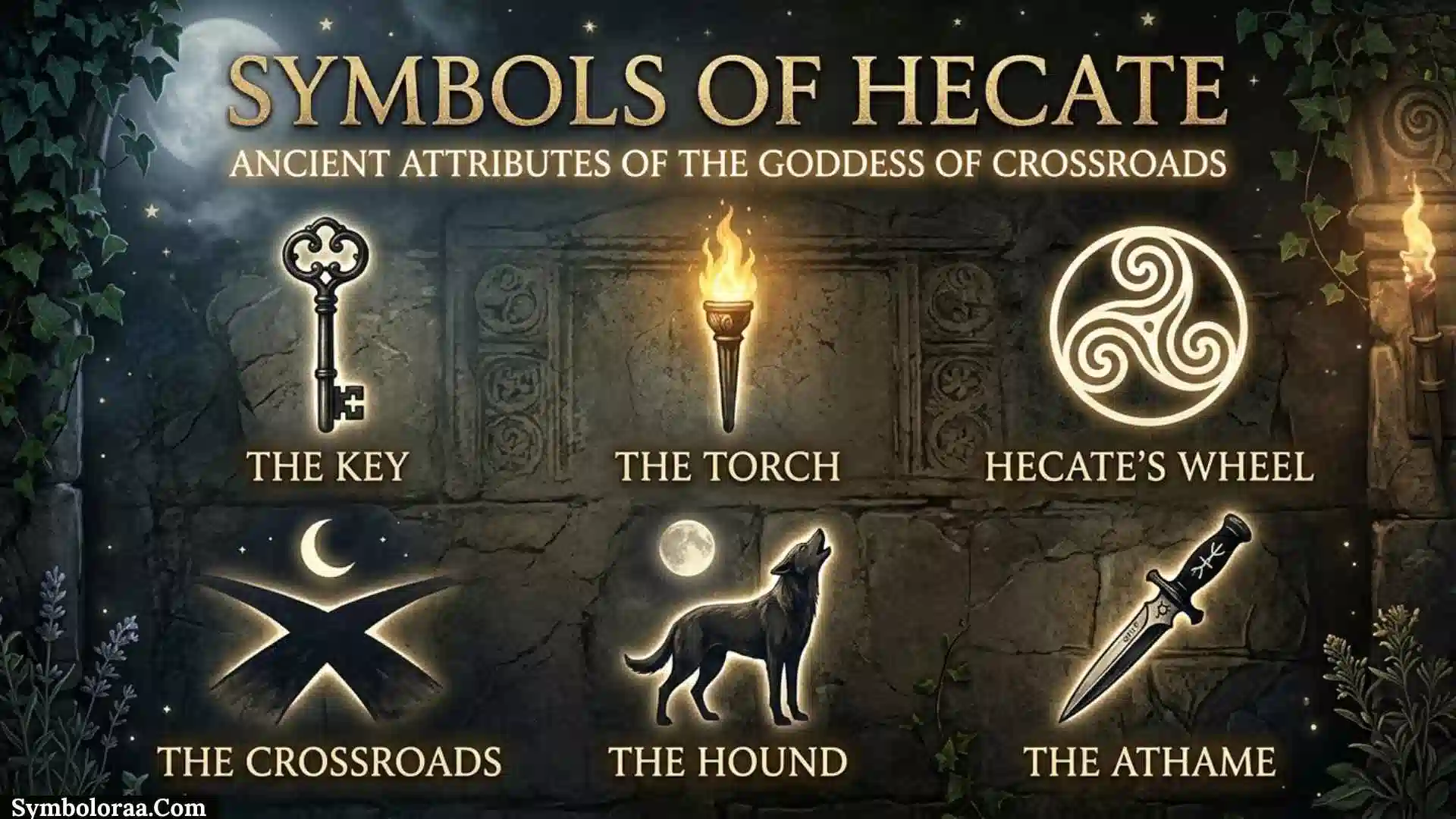
If you are searching for the symbols of Hecate, the most important ones to know are the torch, dog, crossroads, key, and triple form. Other symbols, including the serpent, dagger, wheel, moon, and pomegranate, appear in particular ancient, later, or modern traditions, but they do not all have the same historical status.
Hecate, also spelled Hekate, was a Greek goddess whose roles changed and expanded across time. Ancient evidence connects her with crossroads, boundaries, torches, dogs, household protection, magic, and the night. She was also represented in triple form, especially in later classical and Hellenistic art. The Metropolitan Museum, for example, preserves a Roman-period hekataion, a triple-bodied image of Hekate associated with pathways and crossroads.
Understanding these differences matters because many modern websites mix ancient Greek evidence, later mythology, modern Pagan traditions, and popular occult symbolism into one list. This guide separates those layers so you can see which symbols have strong historical evidence and which are later interpretations.
Quick Answer: What Are Hecate’s Main Symbols?
The strongest and most recognizable symbols associated with Hecate include torches, dogs, crossroads, keys, and triple-bodied imagery.
| Symbol | Main meaning or association | Historical strength |
| Torch | Light, guidance, night, searching | Very strong |
| Dog | Protection, crossroads, night, chthonic associations | Very strong |
| Crossroads | Choices, boundaries, transition | Very strong |
| Key | Gates, thresholds, access | Strong, especially in later traditions |
| Triple form | Three directions, crossroads, multiple aspects | Very strong in later ancient iconography |
| Serpent | Chthonic symbolism and mystery | Strong in some representations |
| Dagger | Power, protection, ritual authority | Present in ancient imagery |
| Moon | Night and later lunar associations | Important, but historically complex |
| Wheel | Later esoteric and modern Hecate traditions | More limited as an ancient symbol |
| Pomegranate | Underworld and Persephone-related symbolism | Contextual rather than primary |
The key point is that Hecate does not have one single official symbol. Her imagery developed across different periods and locations.
Who Was Hecate in Ancient Greek Religion?
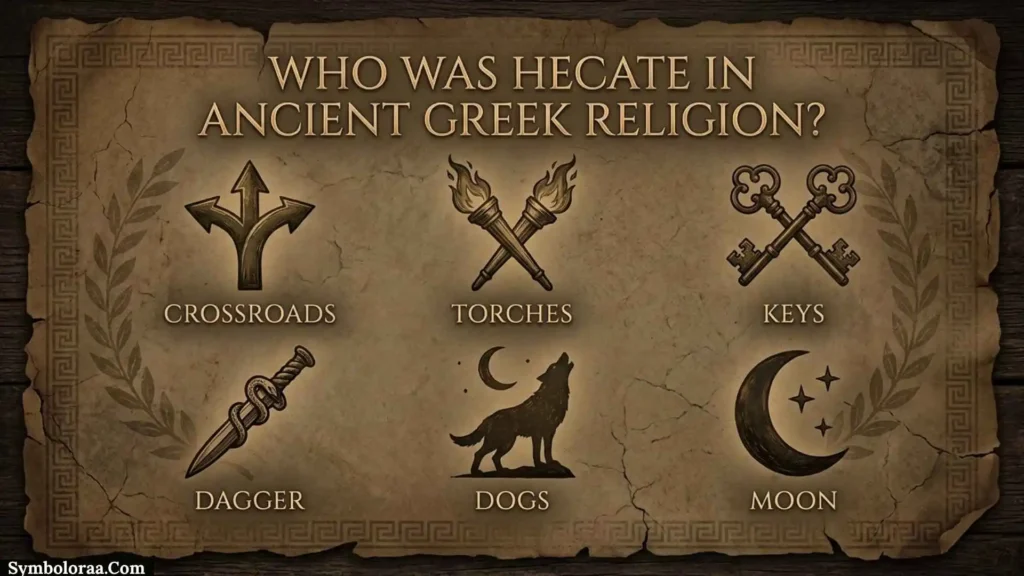
Hecate was an ancient Greek goddess whose identity cannot be reduced to the modern idea of a goddess of witchcraft.
In early literary evidence, particularly Hesiod’s Theogony, Hecate is presented as a powerful deity with influence extending across different realms. Later traditions increasingly connected her with crossroads, night, magic, ghosts, the underworld, and protective boundaries.
Her name also appears in different forms, with Hecate being the common English spelling and Hekate reflecting the Greek form more closely.
Hecate’s Changing Roles
One reason Hecate has so many symbols is that her religious identity developed over a long period.
Her associations include:
- Crossroads
- Roads and pathways
- Doorways and thresholds
- Night
- Torches
- Dogs
- Magic
- Ghosts
- Protection
- The underworld
- The moon in later traditions
- Transition and liminal spaces
The Metropolitan Museum describes Hekate as a goddess associated with pathways and crossroads and notes her connections with nighttime and nocturnal sorcery.
This historical development is important. A symbol strongly associated with Hecate in Roman or later occult traditions does not necessarily have the same status in the earliest Greek evidence.
Also Check This Post: Taoist Symbols: Hidden Meanings Behind Ancient Images
The Torch: Hecate’s Most Recognizable Attribute
The torch is probably the clearest single object associated with Hecate.
Ancient literary and artistic evidence repeatedly connects her with torches. In the Homeric Hymn to Demeter, Hecate meets Demeter while carrying a torch and tells her that she heard Persephone’s voice.
The connection is also visible in ancient art. A British Museum vessel depicting the abduction of Persephone shows Hecate approaching with a torch.
What Does Hecate’s Torch Symbolize?
The torch can reasonably be connected with:
- Light in darkness
- Guidance
- Searching
- Night travel
- Revelation
- Protection
- Hecate’s connection with Persephone
It is tempting to assign a separate mystical meaning to every part of the torch, but the historical evidence does not require that.
The strongest interpretation is simpler: Hecate is a torch-bearing goddess associated with navigating darkness and difficult boundaries.
Hecate as a Light-Bearer
An especially interesting linguistic connection appears in the Greek term phosphoros, meaning “light-bringing” or “light-bearing.” The Perseus Scaife ATLAS dictionary notes that the term was used as an epithet for torch-bearing deities, including Hecate.
This reinforces the importance of light-bearing imagery in understanding her ancient identity.
The Dog: Hecate’s Sacred Animal
The dog is one of Hecate’s strongest animal associations.
Ancient literary sources connect dogs with Hecate, while surviving art also places dogs or hounds alongside her.
A Roman bronze figure in the British Museum depicts the triple Hecate holding a torch, a hound, and a snake.
This is particularly useful evidence because it shows that the dog was not simply a modern invention.
What Does the Dog Represent?
The dog can be understood in connection with:
- Guardianship
- Protection
- Night
- Roads and crossroads
- The boundary between ordinary and supernatural spaces
- Hecate’s chthonic associations
Dogs were also associated with other ancient goddesses, so a dog alone does not always prove that an image represents Hecate.
For example, a Classical Greek relief in the British Museum shows a woman holding a torch with a large dog behind her. The museum identifies the figure as probably Artemis but notes that she may also be Hekate or the Thessalian goddess Ennodia because of overlapping imagery.
That is an excellent example of why context matters when identifying ancient religious art.
Is a Black Dog Specifically Hecate’s Symbol?
Modern Hecate imagery often emphasizes the black dog, but the safest historical statement is that dogs or hounds are associated with Hecate.
The color black has acquired additional symbolic meaning through later folklore, magic, and modern occult traditions. It should not automatically be presented as an ancient rule that every Hecate dog had to be black.
The Crossroads: The Place Most Closely Associated With Hecate
The crossroads may be more important to understanding Hecate than any individual object.
A crossroads is a place where paths meet and choices must be made. It is also a boundary between different routes and territories.
Ancient evidence connects Hecate with crossroads and roads. The Metropolitan Museum describes her as presiding over pathways and crossroads, while the Perseus Dictionary of Greek and Roman Biography and Mythology records small Hecate images placed at houses and places where roads crossed.
Why Were Hecate Images Placed at Crossroads?
Crossroads were practical places for travelers, but they also carried religious significance.
A person arriving at a junction had to decide:
Which road should I take?
That physical decision fits Hecate’s broader association with:
- Transition
- Boundaries
- Choice
- Direction
- Uncertainty
- Protection
Her crossroads symbolism therefore has both a literal religious context and a broader symbolic meaning.
Hecate and the Three-Way Crossroads
Hecate became particularly associated with three-way roads.
This helps explain her later triple-bodied imagery.
Instead of thinking of the three forms only as a mystical “three-in-one” goddess, it is useful to remember the very physical ancient setting: a goddess connected with a place where multiple roads meet could naturally be represented facing multiple directions.
The Key: Guardian of Gates and Thresholds
The key is another important Hecate symbol.
The key is naturally associated with:
- Doors
- Gates
- Entrances
- Access
- Hidden places
- Boundaries
- Passage between spaces
A particularly valuable piece of archaeological evidence is a Roman-period marble relief in the British Museum. It depicts Hecate in triple form, with one figure holding a key, another holding two torches, and another holding a dagger and serpent.
This single artifact demonstrates why the key, torch, serpent, dagger, and triple form are often discussed together.
What Does Hecate’s Key Mean?
At the simplest level, it represents access and thresholds.
In later religious and esoteric interpretations, the key can symbolize access to hidden knowledge or the passage between worlds.
Those interpretations can be meaningful, but they should be distinguished from what the ancient object itself proves.
The safest historical interpretation is:
Hecate’s key is connected with gates, boundaries, and controlled passage.
The Triple Form of Hecate
One of the most famous features of Hecate’s iconography is her triple form.
Rather than showing one woman, artists sometimes represented three connected female figures facing different directions.
The Metropolitan Museum has a Roman-period marble hekataion specifically described as a triple-bodied Hekate.
The British Museum likewise records a triple Hecate with different attributes distributed among her three bodies.
Why Is Hecate Shown Three Times?
The triple form fits her connection with:
- Crossroads
- Multiple directions
- Boundaries
- Pathways
- Different aspects of divine power
It also makes the goddess visually suited to a crossroads where a traveler may face several possible directions.
Does the Triple Hecate Mean Maiden, Mother, and Crone?
This is one of the most common modern misconceptions.
The Maiden-Mother-Crone interpretation is important in some modern Pagan traditions, but it should not automatically be applied to every ancient triple Hecate.
Ancient triple-bodied representations existed within a different historical and religious context.
Therefore:
Ancient triple form ≠ automatically Maiden, Mother, Crone.
That distinction makes an article about Hecate’s symbols much more historically reliable.
The Serpent: A Chthonic and Mysterious Attribute
The serpent appears in some representations of Hecate.
The British Museum’s Roman bronze triple Hecate, for example, includes a snake as one of the attributes associated with the goddess.
Another British Museum relief gives one of Hecate’s three forms a dagger and serpent.
What Can the Serpent Represent?
The serpent can be interpreted in relation to:
- Earth and chthonic powers
- Mystery
- Transformation
- Hidden forces
- Life and death
- The underworld
But there is no need to force one universal meaning onto every snake image.
Greek religious symbols were often context-dependent, and the meaning of an animal could change according to the deity, artwork, ritual, and historical period.
The Dagger or Sword: Power and Protection
Weapons such as a dagger can also appear among Hecate’s attributes.
The British Museum’s Roman relief gives one of the triple forms a dagger and serpent.
This provides direct evidence for the weapon as an ancient artistic attribute.
What Does Hecate’s Dagger Symbolize?
Modern interpretations often connect the blade with:
- Protection
- Power
- Authority
- Defense
- Separation
- Cutting through obstacles
Some of these meanings are interpretive rather than directly stated by ancient sources.
For historical writing, it is better to say that the dagger demonstrates Hecate’s association with armed or powerful protective imagery, rather than claiming that ancient Greeks universally believed the dagger had one fixed symbolic meaning.
The Moon and Hecate
The moon is strongly associated with Hecate in many later representations and modern traditions.
The connection is understandable because Hecate became increasingly linked with:
- Night
- Darkness
- Magic
- Lunar cycles
- The unseen world
The Metropolitan Museum describes Hekate in its Roman-period collection as a goddess of the moon and nocturnal sorcery.
However, it is historically inaccurate to treat Hecate as though she was simply “the Greek moon goddess” from the beginning.
Hecate, Artemis, and Selene
Hecate’s lunar identity became intertwined with other divine figures, especially Artemis and Selene.
This overlap is one reason ancient images can sometimes be difficult to identify.
The British Museum even has an ancient object described as Artemis-Hecate, showing how closely their iconography could overlap.
Therefore, a crescent moon alone is not enough to identify an ancient image as Hecate.
The Hecate’s Wheel
The Hecate’s Wheel, sometimes called the Strophalos, is widely recognized in modern Hecate-related spirituality and occult communities.
It is usually represented as a circular symbol with a three-part or labyrinth-like design.
Modern interpretations may connect it with:
- Cycles
- Movement
- Transformation
- The threefold nature of Hecate
- Spiritual paths
- Mystical knowledge
Is the Hecate’s Wheel an Ancient Symbol?
This requires caution.
Unlike the torch, dog, crossroads, and triple form, the modern “Hecate’s Wheel” should not automatically be treated as a universally established symbol of ancient Greek Hecate worship.
It is more accurate to describe it as a later or modern esoteric symbol associated with Hecate.
That distinction is important because many online articles present modern symbols as if they were archaeological facts.
The Pomegranate and Persephone Connection
The pomegranate sometimes appears in modern lists of Hecate symbols because of Hecate’s connection with Persephone and the underworld.
The pomegranate is strongly established in the wider Persephone myth, but it is not as distinctive a Hecate attribute as the torch, dog, or crossroads.
Should the Pomegranate Be Called a Primary Hecate Symbol?
No—not if the goal is historical precision.
It is better described as a contextual association.
Hecate’s connection to Persephone makes the fruit relevant to the broader mythological story, but that does not make the pomegranate a primary identifying attribute of Hecate.
Hecate’s Symbols in the Persephone Story
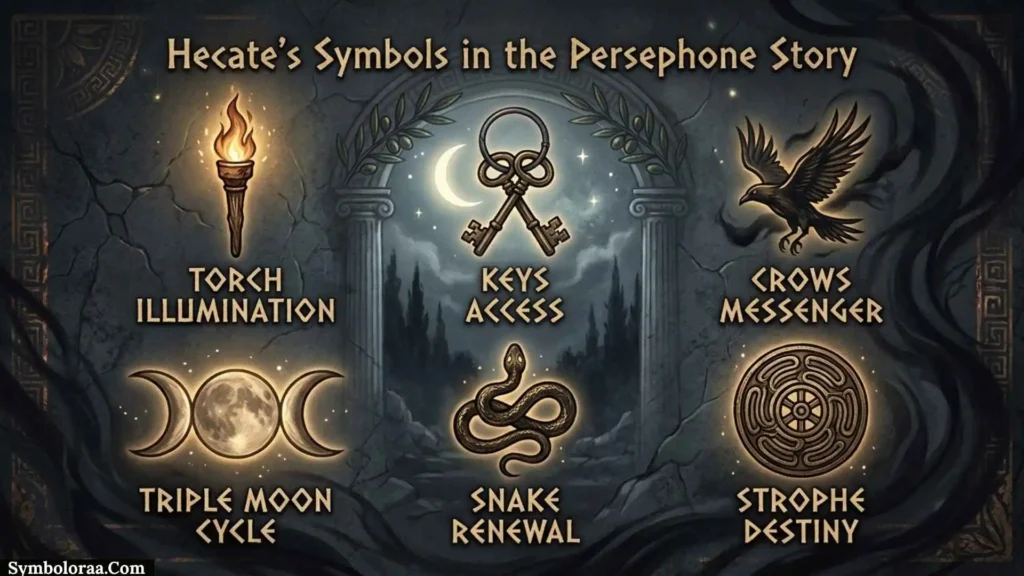
The story of Persephone’s abduction is essential for understanding Hecate’s torch.
In the Homeric Hymn to Demeter, Hecate hears Persephone’s cry. When Demeter is searching for her daughter, Hecate approaches carrying a torch and tells Demeter what she heard.
This gives the torch a strong literary foundation.
The connection also appears in visual art. A British Museum vessel showing the Persephone narrative depicts Hecate holding a torch as she approaches the scene.
Why This Story Matters for Hecate’s Symbolism
The myth brings several of her major themes together:
Night → uncertainty
Torch → guidance
Persephone → underworld
Journey → transition
Hecate → witness and guide
This is much more useful than memorizing a simple list of “Hecate symbols and meanings.”
Hecate as a Guardian of the Home
Hecate was not only associated with remote crossroads.
Ancient evidence also connects her with houses and entrances.
The Perseus reference work records small Hecate images, known as Hecataea, placed before or inside houses and at locations where roads crossed.
This helps explain why her symbolism includes both crossroads and thresholds.
A doorway is itself a boundary:
outside → inside
public → private
safe → uncertain
Hecate’s presence at these locations fits her broader role as a guardian of transitions.
Hecate and Protection
Hecate’s reputation as a dark or frightening goddess sometimes overshadows her protective role.
Her association with entrances, crossroads, and boundary places gave her a protective dimension.
Ancient sources record offerings to Hecate and other protective powers at crossroads. The Perseus reference also records offerings including dogs, honey, and black female lambs in ancient traditions.
These practices varied by period and place, so they should not be treated as one universal Hecate ritual.
The larger point is that Hecate’s symbolism includes protection as well as darkness and magic.
Also Check This Post: 67+ Symbols of Jesus: Powerful Christian Symbols Explained
Ancient Hecate Symbols vs. Modern Hecate Symbols
This distinction is essential for anyone researching Hecate.
Strong Ancient Evidence
The following have particularly strong support in ancient art or literature:
- Torches
- Dogs
- Crossroads
- Triple-bodied imagery
- Keys
- Serpents
- Daggers or other attributes in specific depictions
Ancient museum objects directly demonstrate several of these combinations.
Later or More Contextual Associations
These require more explanation:
- Moon symbolism
- Pomegranate
- Certain plants
- Specific flowers
- Magical tools
- The Hecate’s Wheel
They may be meaningful in later religious or modern spiritual contexts, but their historical status is not identical to the torch or crossroads.
Why This Distinction Improves Accuracy
A common online mistake is to combine:
ancient Greek religion + Roman religion + medieval folklore + modern witchcraft + contemporary Paganism
and label the entire mixture “ancient Hecate symbolism.”
Those traditions influenced one another, but they are not the same thing.
A reliable article should tell readers which period and tradition a symbol belongs to.
How to Identify Hecate in Ancient Art
If you find an ancient statue, vase, relief, or coin and want to know whether it depicts Hecate, do not rely on one symbol alone.
Start With the Figure’s Attributes
Look for:
- One or more torches
- Dogs or hounds
- A key
- A serpent
- A dagger
- Multiple bodies
- Multiple directions
- A crossroads or doorway setting
Check Whether the Figure Is Triple
A three-bodied female deity is a particularly useful clue.
The Met’s hekataion and the British Museum’s triple Hecate relief provide clear examples.
Look at the Surrounding Scene
Context can be more important than one object.
For example, a torch-bearing goddess with a dog might be Hecate, Artemis, or another deity with overlapping attributes. The British Museum specifically notes this problem in one Classical Greek relief.
Check the Date and Region
Ask:
- Is the object Greek, Hellenistic, or Roman?
- Where was it found?
- What other figures appear?
- What attributes does the goddess carry?
- Is there an inscription?
- Does the museum or archaeological record identify the figure?
This approach is much safer than using modern symbolic lists to identify ancient artwork.
A Simple Hecate Symbol Decision Tree
Use this quick guide when identifying an image or symbol.
Does it show Hecate with torches?
↓ Yes
Strong Hecate association.
↓ No
Does it show a triple-bodied female deity?
↓ Yes
Hecate is a strong possibility.
↓ No
Is there a dog or hound together with other Hecate attributes?
↓ Yes
Investigate Hecate, Artemis, or related deities.
↓ No
Is there a key, serpent, dagger, or crossroads setting?
↓ Yes
Hecate remains a possibility, but context is needed.
↓ No
Is it only a moon, crescent, black dog, or modern wheel?
↓ Yes
Do not identify it as Hecate from that symbol alone.
This decision tree helps prevent one of the most common mistakes in mythology research: treating one modern symbol as definitive proof of an ancient identity.
Common Misconceptions About Hecate’s Symbols
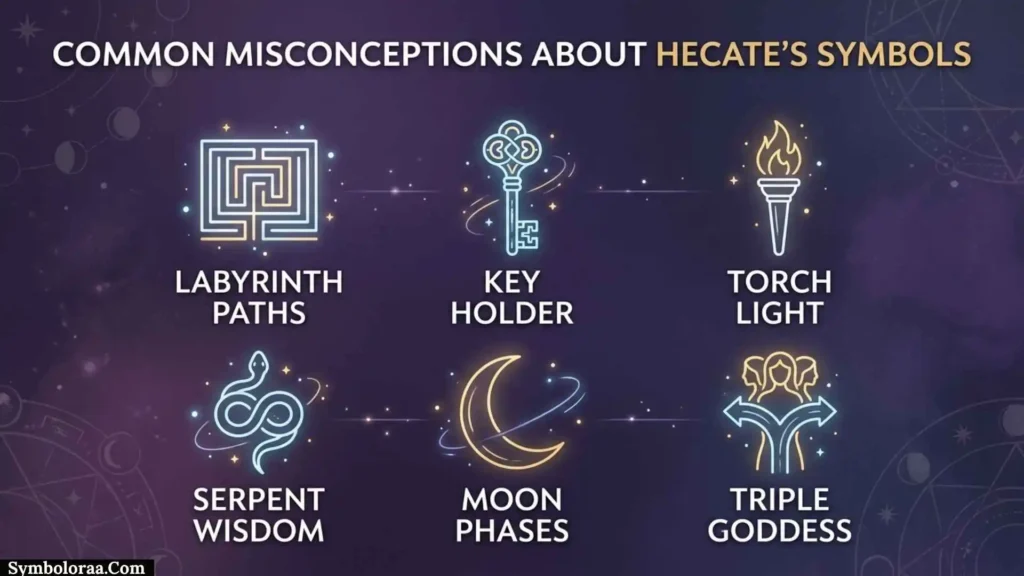
“Hecate Has One Official Symbol”
Hecate has no single official emblem comparable to a modern logo.
Her symbolism is a collection of attributes developed through different religious and artistic traditions.
“Hecate Was Always the Goddess of Witchcraft”
Her association with magic became important, but her early identity was broader.
Her crossroads, household, protective, and boundary associations are essential parts of her history.
“Three Hecate Figures Always Mean Maiden, Mother, and Crone”
This is a modern interpretive framework and should not automatically be projected onto ancient artwork.
“Every Black Dog Represents Hecate”
Dogs have a genuine ancient connection with Hecate, but not every black dog is Hecate’s animal.
“The Moon Is Hecate’s Original Main Symbol”
Hecate’s lunar associations are important, especially in later traditions, but her earliest religious identity was more complex.
“Hecate’s Wheel Was Her Main Ancient Symbol”
The wheel has an important place in modern Hecate traditions, but the archaeological evidence for the major ancient symbols is much stronger for torches, dogs, crossroads, keys, and triple imagery.
Hecate Symbols Compared: Which Ones Are Most Reliable?
| Symbol | Ancient evidence | Modern popularity | Best use |
| Torch | Very strong | Very high | Historical and modern symbolism |
| Dog | Very strong | Very high | Animal symbolism and protection |
| Crossroads | Very strong | Very high | Transition and choice |
| Triple form | Very strong | Very high | Ancient art and modern spirituality |
| Key | Strong | High | Thresholds and access |
| Serpent | Strong in some art | Moderate | Chthonic symbolism |
| Dagger | Present in ancient art | Moderate | Power and protection |
| Moon | Later/complex | Very high | Night and lunar spirituality |
| Wheel | More limited/late | Very high | Modern esoteric traditions |
| Pomegranate | Contextual | Moderate | Persephone/underworld themes |
The table shows why popularity and historical evidence are not the same thing.
A symbol can be extremely popular today while having limited evidence as a primary ancient attribute.
Real Historical Examples of Hecate Symbols
The British Museum Triple Hecate Relief
One Roman-period marble relief shows Hecate in triple form. One figure holds a nail and key, the central figure carries two torches, and the third carries a dagger and serpent.
This is an unusually useful artifact because several commonly discussed symbols appear together in one ancient representation.
The British Museum Bronze Hecate
Another Roman bronze figure depicts the triple Hecate holding a torch, hound, and snake.
This directly supports the connection between Hecate and these animals and objects.
The Metropolitan Museum Hekataion
The Met holds a marble hekataion showing Hekate in triple form. The museum identifies her with pathways and crossroads and dates the object to the Roman period.
This provides a concrete example of how the triple form was used in actual religious art.
Hecate in the Persephone Myth
The Homeric Hymn to Demeter describes Hecate meeting Demeter with a torch after hearing Persephone’s cry.
This is one of the strongest literary examples for understanding the torch as more than decorative imagery.
What Hecate’s Symbols Mean Together
The symbols become easier to understand when viewed as one connected system.
Torch → illumination
Key → access
Dog → guardianship
Crossroads → choice
Triple form → multiple directions
Serpent → chthonic mystery
Dagger → power
Night → uncertainty
Together, these images create a consistent theme:
Hecate stands at places where one condition meets another.
That might mean one road meeting another, the inside meeting the outside, darkness meeting light, or the human world meeting the underworld.
This does not mean every ancient Greek worshipper used exactly this modern symbolic framework. It is a useful synthesis of the recurring themes found in her mythology, iconography, and cult associations.
Why Hecate’s Symbols Still Matter Today
Hecate remains an important figure in modern literature, art, Pagan traditions, occult practices, and popular culture.
Modern artists often emphasize:
- Triple-faced figures
- Torches
- Black dogs
- Keys
- Crescent moons
- Crossroads
- Dark colors
- Serpents
- Magical imagery
The modern image is sometimes much darker than the ancient evidence.
A good example is Henry Fuseli’s 1796 painting The Night-Hag Visiting Lapland Witches. The Metropolitan Museum explains that the work presents Hecate through the later literary image of the “Night-Hag” and connects her with witchcraft, magical rites, the moon, and spectral hounds.
This demonstrates how Hecate’s image continued to evolve long after ancient Greek religion.
How to Use Hecate Symbols in Research, Art, or Design
If you are creating artwork, an educational graphic, tattoo concept, mythology illustration, or symbolic design, choose the symbol according to the message you want to communicate.
For Guidance
Choose the torch.
It has the strongest connection with light, searching, and Hecate’s role in the Persephone story.
For Protection
Choose the dog or doorway/crossroads imagery.
These connect naturally with guardianship and boundary spaces.
For Transformation
Choose the crossroads.
It visually communicates a decision, transition, or change in direction.
For Hidden Knowledge or Thresholds
Choose the key.
It is especially suitable for themes involving doors, secrets, access, or passage.
For Ancient Greek Visual Authenticity
Use:
- Triple form
- Torches
- Key
- Dog
- Serpent
- Dagger
These have stronger ancient artistic evidence than many modern additions.
For Modern Hecate Spirituality
A modern design may also include:
- Moon imagery
- Wheel symbolism
- Modern ritual objects
- Contemporary interpretations of the triple goddess
Just avoid presenting those modern choices as though they were all documented ancient Greek symbols.
Key Takeaways About Hecate Symbols
- The torch is one of Hecate’s strongest and best-documented attributes.
- Dogs and hounds have a genuine ancient association with her.
- Crossroads are central to understanding her religious identity.
- Keys represent gates, thresholds, and access, especially in later traditions.
- Triple-bodied Hecate is a major feature of ancient and Roman-period iconography.
- Serpents and daggers appear in ancient representations but are not as universally recognizable as the torch.
- Moon symbolism became important but should be understood in historical context.
- Hecate’s Wheel is much more prominent in later and modern esoteric traditions.
- Pomegranates and flowers are better treated as contextual or later associations rather than universal ancient symbols.
- Modern interpretations should not automatically be presented as ancient Greek beliefs.
- The most useful theme connecting Hecate’s symbolism is boundaries, transition, guidance, and protection.
Frequently Asked Questions About Hecate Symbols
What is Hecate’s main symbol?
The torch is one of Hecate’s most recognizable attributes. Ancient literature and artwork repeatedly associate her with torch-bearing, especially in connection with the Persephone story.
What animal is sacred to Hecate?
The dog or hound is the animal most strongly associated with Hecate. Ancient artwork provides examples of Hecate accompanied by or holding a hound.
What does Hecate’s key mean?
The key is associated with gates, thresholds, access, and boundaries. A Roman-period relief in the British Museum actually depicts one of Hecate’s triple forms holding a key.
Why does Hecate have three bodies?
Her triple form fits her association with crossroads and multiple directions. Ancient and Roman-period artwork provides clear examples of triple-bodied Hecate.
What does Hecate’s torch represent?
The torch is connected with light, searching, guidance, and nighttime movement. Her torch-bearing role is especially clear in the Homeric Hymn to Demeter.
Why is Hecate associated with crossroads?
Crossroads were important locations in Hecate’s worship. They also fit her broader association with boundaries, choices, roads, and transitions.
Is the moon a symbol of Hecate?
Yes, the moon became an important Hecate association, particularly in later traditions. However, Hecate’s identity is broader than that of a simple moon goddess.
Is Hecate’s Wheel an ancient Greek symbol?
The wheel is strongly associated with modern Hecate spirituality and later esoteric traditions, but it does not have the same level of ancient evidence as the torch, dog, crossroads, and triple form.
Is a snake a symbol of Hecate?
Yes. Snakes appear among Hecate’s attributes in ancient representations. A British Museum Roman bronze, for example, shows a triple Hecate with a snake.
Is a dagger one of Hecate’s symbols?
A dagger appears in some ancient depictions. A Roman-period British Museum relief shows one of Hecate’s three bodies carrying a dagger and serpent.
What is Hecate the goddess of?
Hecate’s roles include crossroads, pathways, boundaries, protection, night, magic, ghosts, and later underworld associations. Her exact profile changed across different historical periods.
Was Hecate always associated with witchcraft?
No. Her association with magic and witchcraft became prominent over time. Her earlier religious identity was broader and included crossroads, boundaries, protection, and other functions.
Are Hecate’s symbols the same in ancient and modern traditions?
No. Modern Hecate traditions use many symbols that either developed later or have been given new meanings. Historical research should distinguish ancient evidence from modern spiritual interpretation.
What symbol represents Hecate’s protection?
There is no single official protection emblem. Dogs, crossroads, household images, torches, and threshold symbolism are all useful ways to represent her protective associations.
Conclusion
The symbols of Hecate tell the story of a goddess associated with places and moments of transition.
Her torch brings light into darkness. Her dog represents a powerful connection with guardianship and the night. Her crossroads symbolize roads meeting and choices being made. Her key connects her with gates and thresholds, while her triple form reflects one of the most recognizable developments in her ancient iconography. Ancient objects preserved by institutions such as the British Museum and Metropolitan Museum provide direct evidence for several of these attributes.
Other symbols deserve more careful treatment. The serpent and dagger appear in ancient representations, while the moon became an important later association. The Hecate’s Wheel, pomegranate, flowers, and various modern occult tools may be meaningful within later traditions, but they should not all be presented as equally ancient.
The most reliable way to understand Hecate is therefore not to memorize a fixed list of symbols. Instead, look at the common idea connecting them: Hecate stands at boundaries.
She is found where roads meet, where doors divide spaces, where darkness needs illumination, and where one state gives way to another. That central idea explains why the torch, key, dog, crossroads, and triple form continue to be the most useful symbols for understanding her.
Also Check This Post: 73+ Louis Vuitton Symbols: The History Behind the Famous Icons

I’m Jackson Miller, an American author inspired by mystery, adventure, and the unpredictable nature of life. I enjoy writing fast-moving stories filled with memorable characters, unexpected choices, and meaningful moments. Through my books, I want readers to experience new worlds while discovering something about courage, determination, and themselves.
Three Books:
The Edge of Tomorrow
Under a Broken Sky
The Road We Chose
 Madison Reed